
Court of Appeals hears dispute over recordings of insurance-claim call under Washington Privacy Act
Get AI-powered insights, summaries, and transcripts
Subscribe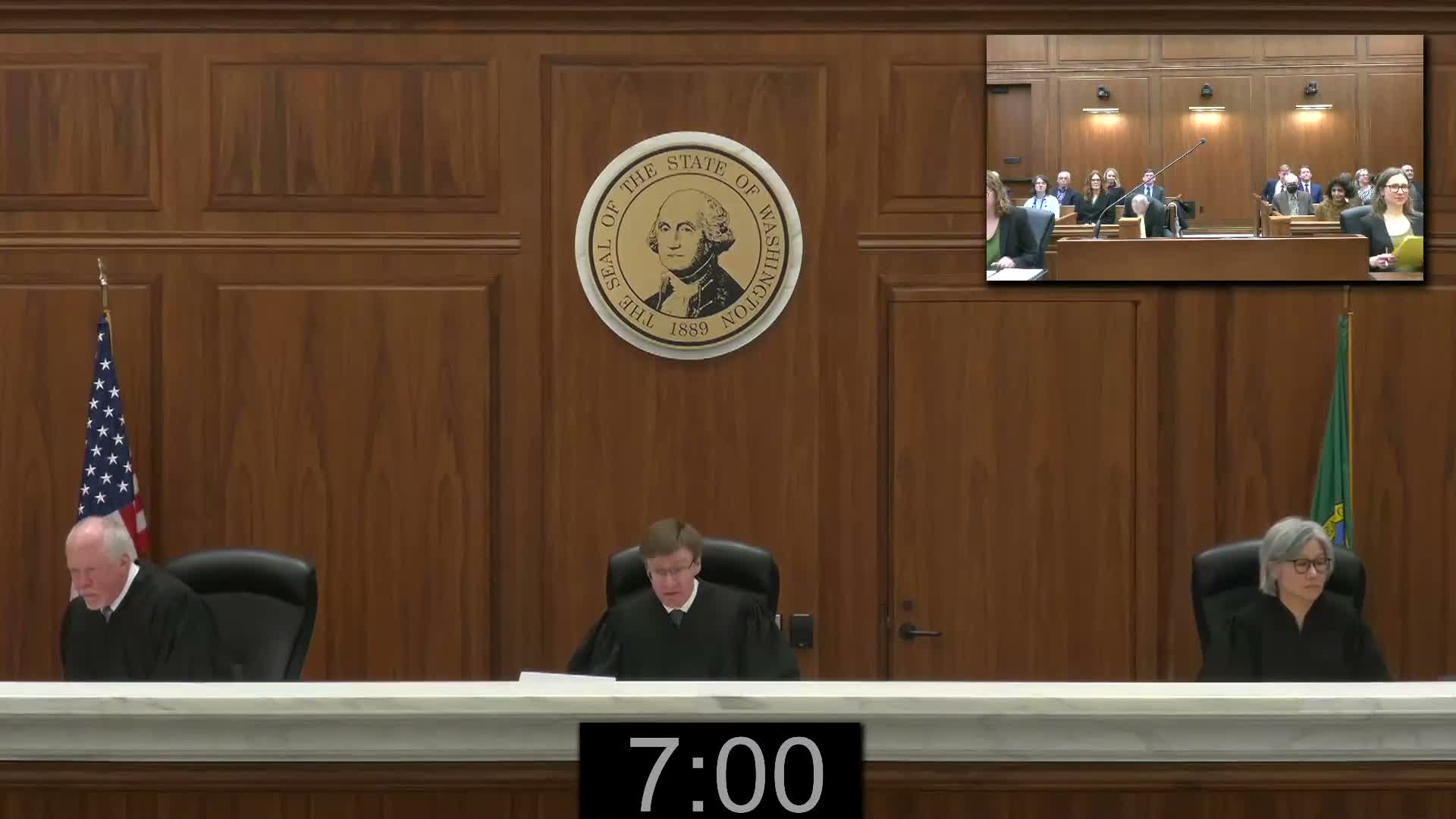
Summary
The Washington State Court of Appeals, Division 1 heard argument in State v. Robinson over whether a Progressive customer-service call reporting an auto collision was a “private” communication under Washington’s Privacy Act (Ch. 9.73 RCW) and whether its recording tainted later evidence admitted at trial.
The Washington State Court of Appeals, Division 1 on Monday heard oral argument in State v. Robinson about whether a Progressive customer-service call reporting an auto collision was a “private” communication under the Washington Privacy Act and whether recording that call tainted subsequent evidence at trial.
Jennifer Winkler, counsel for Salim Robinson, told the court that the case “involves Washington’s Privacy Act, Chapter 9.73 RCW,” and argued much of the prosecution’s case flowed from a Progressive recording made without informing Robinson. Winkler said the central legal issue is whether later evidence should be excluded as the “fruit of the poisonous tree” that followed from that initial recording and urged the court to resolve the issue as a matter of law.
The state, represented by Samantha Kenner of the King County Prosecutor’s Office, countered that the relevant inquiry is objective. Kenner argued that, given the subject matter — an auto collision that occurred on a public street — and the expectation that claim information will be passed to third parties or inspected by regulators, “no one would reasonably believe this call to be private.” She added the later calls, she said, contained more detailed admissions and were not tainted by the initial recording, asserting any potential taint was severed under attenuation doctrines when Robinson was told subsequent calls were being recorded and continued to speak.
The judges tested both sides on how the Privacy Act’s multi-factor test should apply. Presiding Judge Ian Hester noted insurers’ statutory duties to investigate and report potential fraud and asked whether those regulatory duties undercut a claim of privacy. “They have a legal duty to investigate,” Hester said, pressing counsel on how a reasonable person would foresee the information being shared.
Winkler responded that those regulatory duties are only one factor and that the court must carefully apply the factors adopted in prior cases (cited by counsel as Mayfield, McGee, Parker and others) — including duration, subject matter and relationship between parties — to determine whether the communication was private and whether later evidence must be excluded. Winkler argued the appellate court should be attentive to the causal chain from the recording to the evidence used at trial.
Kenner urged the court to affirm the trial court’s finding that the initial call was not private and to hold that later investigative conversations were admissible. As an alternative, she asked the court to find any error harmless because the evidence of fraud came from multiple calls and other sources.
Argument concluded after questioning from the bench. The court did not announce a decision at the hearing.