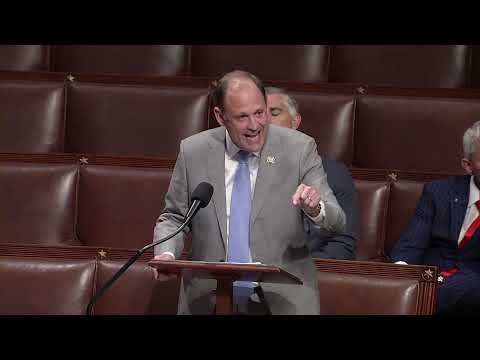
Lawmaker opposes War Powers Resolution, defends Operation Epic Fury and presidential authority
Loading...
Summary
A lawmaker speaking in the transcript opposed a proposed War Powers Resolution as "dangerous and misguided," argued recent strikes against Iran (referred to as Operation Epic Fury) are lawful and effective, and urged Congress to use appropriations rather than new constraints to check the president.
A lawmaker opened floor remarks by saying he "rise[s] in strong opposition to this dangerous and misguided war powers resolution," arguing the measure would "weaken our country and serve as a gift to our enemies." The speaker framed the resolution as a constraint on the president's ability to respond to threats.
The lawmaker described Iran as "the world's leading state sponsor of terrorism," asserting the regime has "targeted and killed thousands of Americans since 1979," and cited historical attacks including the taking of U.S. embassy hostages in 1979, the 1983 Beirut barracks bombing that the speaker said killed 241 U.S. Marines, and the USS Cole attack that the speaker said killed 37 sailors. He used those incidents to argue a continuing threat from Tehran.
The speaker called recent military activity "Operation Epic Fury," stating, "Operation Epic Fury is neutralizing that threat, and it's been a tremendous success." He also asserted that "President Trump promised that Iran can never obtain a nuclear weapon. He is acting on that promise to make the world a safer place, and he is complying with the law in doing so." The lawmaker said the administration met War Powers Resolution notification and consultation requirements and has "routinely" updated Congress.
On constitutional grounds, the speaker argued the commander-in-chief clause gives the president substantial independent authority to direct military operations, "so long as the president does not infringe on the exclusive powers of Congress." He identified those exclusive powers as the authority to declare war and the power of the purse, saying, "If my friends want to constrain the president, they have the authority to do it through the appropriations process." The speaker described the National Defense Authorization Act as "the policy of this Congress," saying it identifies Iran as a threat.
The lawmaker invoked historical context, including Alexander Hamilton's Federalist 70, to argue that the founders expected an energetic executive capable of rapid action for national security. He concluded by reiterating that Congress should use its appropriations authority rather than attempt to limit the president's ability to defend the country.
No formal motion or recorded vote appears in the transcript of this statement.