
Trinity County board approves two‑year extension for CAO after extended public debate over transparency
Get AI-powered insights, summaries, and transcripts
Subscribe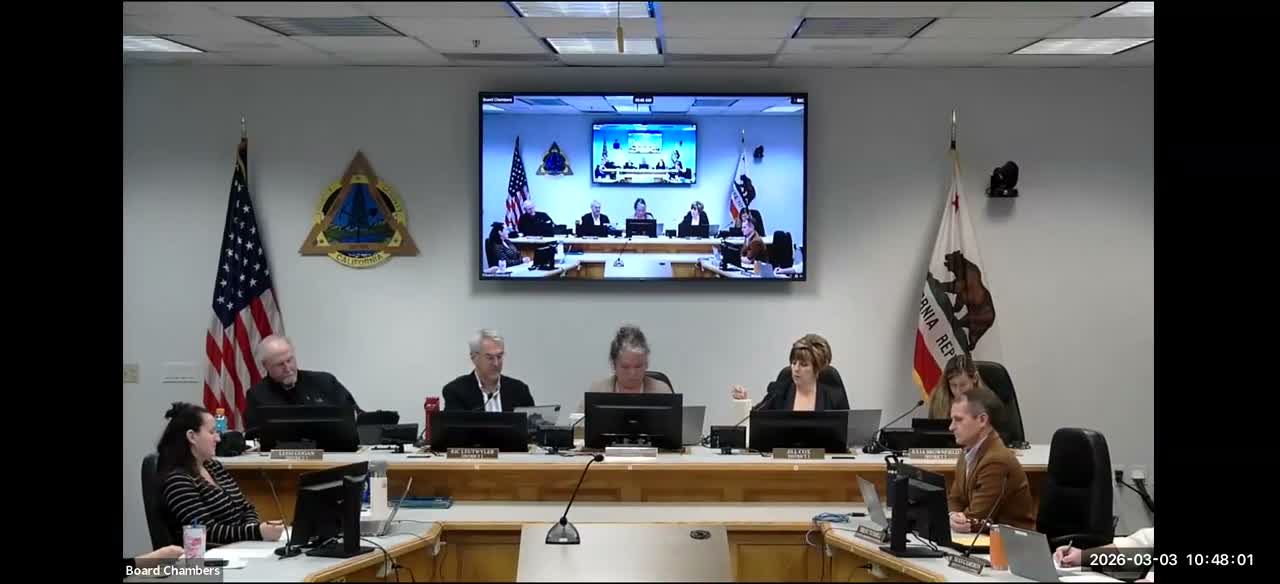
Summary
After more than an hour of public comment and supervisor debate over transparency and succession planning, the Trinity County Board of Supervisors voted to approve Amendment No. 3 extending CAO Trent Tuthill’s agreement through April 18, 2028, and funding $20,000 annually for leadership/succession training.
The Trinity County Board of Supervisors on Tuesday approved Amendment No. 3 to the county administrative officer employment agreement, extending Trent Tuthill’s term through April 18, 2028, and adding funds for countywide leadership and succession training.
The motion to approve the amendment was made by Supervisor Goguen and seconded by Supervisor Cox. The roll-call vote recorded ‘aye’ from Supervisors Brownfield, Goguen, Lou Weiler, Cox and Chairman Carpenter Harris.
The decision followed extensive public comment and debate. Dan Trujillo of Weaverville urged the board to “articulate in open session the reasoning, the benchmarks, and the governance goals that justify your decision,” saying that when “significant decisions are shaped outside of public view, the public is effectively reduced to spectators.” Vedette VanderWey of Lewiston warned that “resignation signals conclusion. Extension signals renewed intention,” and asked the board to explain why the contract was framed as it was and how the professional development funds would be used.
Several speakers defended the CAO and the board’s process. An HR professional who identified herself in public comment said she had “never had the privilege of working under such a strong, powerful, amazing person” as the CAO. Supervisor Goguen and other board members described a multi‑stage hiring process that included review of roughly 50–58 applications, written responses and interviews, and said external candidates did not meet the board’s qualifications. Supervisor Lutweiler said the succession‑planning funds would be used to develop internal leaders across departments.
The amendment increases paid personal leave time for the CAO and authorizes an annual $20,000 allocation aimed at leadership development and succession planning for county staff. Board members said the training funds are intended for department heads and other staff to prepare internal candidates, not solely for the CAO.
Critics at the meeting and online asked that the board make public the evaluation criteria and metrics used during the closed‑session portions of the selection process. Scott White, a Lewiston resident, said the agenda language misstated fiscal impacts and asked the board to remove or revise contract clauses he argued limited future boards’ authority.
Board members said personnel matters and candidate evaluations are handled in closed session to protect applicant privacy and legal interests, but that the board performs annual reviews of at‑will senior positions and can remove an at‑will appointee. Following the vote the board moved into closed session as scheduled.
The approval marks a procedural and political flashpoint for the county: supporters cited improved departmental morale and continuity, while opponents called for greater public deliberation about executive appointments. The board said it will return with any required budget adjustments and with contract ratification documents.