Audit finds late post-election reviews, SEEC says it will clear backlog by May
Get AI-powered insights, summaries, and transcripts
SubscribeSummary
Auditors of Public Accounts found 92% of selected 2022 post-election audits were incomplete when reviewed, noting delays of 132to454 days and eight recommendations; SEEC Executive Director Ryan Burns said 34 audits remain and the agency plans to resolve them by May and publish updated treasurer guidance.
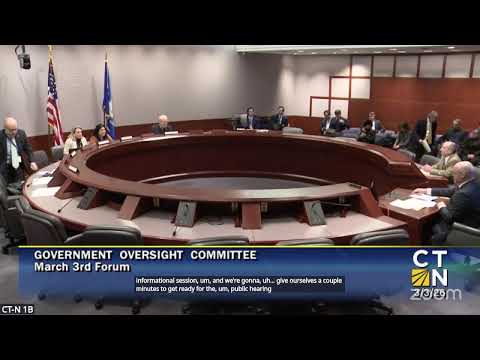
The Government Oversight Committee on Monday heard auditors of public accounts describe compliance findings from their audit of the State Elections Enforcement Commission covering fiscal years 2022 and 2023, including a major timeliness problem in post-election reviews.
"Our goal is to make government better," Lisa Daley, deputy state auditor, told the committee as she summarized the audit, which included eight recommendations and covered payroll, purchasing, information technology, post-election audits, complaint investigations and Citizens' Election Program grants. "This audit report included 8 recommendations of which 4 were repeated from the previous audit." (Lisa Daley, deputy state auditor)
The audit flagged a particular concern with post-election reviews: Jennifer Corbin, the associate auditor who led the review, told members that at the time of field work 92% of the selected 2022 post-election audits had not been completed, which prevented auditors from reviewing those audit reports. Maura Pardo, an administrative auditor, said the reports they were able to review were late by between 132 and 454 days and warned that late audits "increase the risk that state elections enforcement and the candidate committee may not resolve audit issues, and the public may not be informed before the next election." (Jennifer Corbin; Maura Pardo)
Committee members pressed for explanations and remedies. One lawmaker noted repeated recommendations from prior audits and asked what internal controls or policy changes could help. Auditors pointed to the state comptrollerproperty and accounting manuals as criteria agencies should follow, and said appointing a point person to organize data and follow-up on prior findings could improve timeliness and record keeping.
The audit also identified 17 "controllable assets" missing from SEEC records, with a reported total value of $5,718. Auditors clarified these items are not capital assets under the $5,000 capitalization threshold but are trackable electronics such as monitors, projectors and printers that agencies are expected to inventory and report if lost. Auditors said agencies are required to perform annual physical inventories and to file loss reports with the comptroller when items cannot be found. (Auditors of Public Accounts)
Ryan Burns, who identified himself to the committee as "executive director and general counsel for the State Elections Enforcement Commission," said he joined the agency in late December 2025 and described steps the commission is taking in response. Burns said 34 audits remain open across SEEC(8 covering the 2022 cycle and 26 covering the 2024 cycle) and that the agency plans to resolve all outstanding audits by May, the statutory cutoff for the next election cycle. "We should have all audits within the agency resolved by May," Burns said, adding that SEEC had expanded its fiscal unit from one to three staff and was conducting a full inventory of technology and licensing. (Ryan Burns, SEEC executive director)
Burns also described an updated Citizens' Election Program (CEP) guidebook that his staff has drafted and said he expects the commission to review the draft at its next meeting and publish the guidance shortly thereafter. He said SEEC will also publish an exhaustive list of the documentation treasurers must retain to make audit expectations transparent and to help treasurers prepare for reviews.
On enforcement, Burns outlined how incoming complaints are triaged: staff first verify jurisdiction, then significant matters are referred to the commission to authorize investigations; attorneys prioritize cases based on factors including use of public funds or alleged tampering with ballots. Burns said most enforcement matters resolve through public settlements posted on SEEC's website, while criminal referrals are handled in coordination with law enforcement and may be kept confidential during active investigations.
The committee did not take formal action during this informational forum. Members thanked the auditors and SEEC staff for their presentations; the committee paused briefly and moved to a public hearing scheduled to begin at 11:05 a.m.
The record: auditors presented a compliance audit with eight recommendations and highlighted significant delays in post-election reviews; SEEC leadership pledged to clear a remaining backlog of 34 audits by May, publish updated treasurer guidance and continue inventory and staffing improvements.