Get Full Government Meeting Transcripts, Videos, & Alerts Forever!
Get email alerts on the Cte Resolution topic
No spam. Unsubscribe anytime.
Cook County committee defers CTE awareness resolution after public testimony
Summary
After testimony from families and concussion experts, the Health & Hospitals Committee deferred a Cook County resolution calling for local CTE awareness programs, referrals to concussion clinics and requests for state and federal research, scheduling a public hearing for further input.
The Cook County Health & Hospitals Committee voted to defer consideration of a resolution calling for local chronic traumatic encephalopathy (CTE) awareness and referral programs after public testimony from families and concussion specialists and extended commissioner questioning.
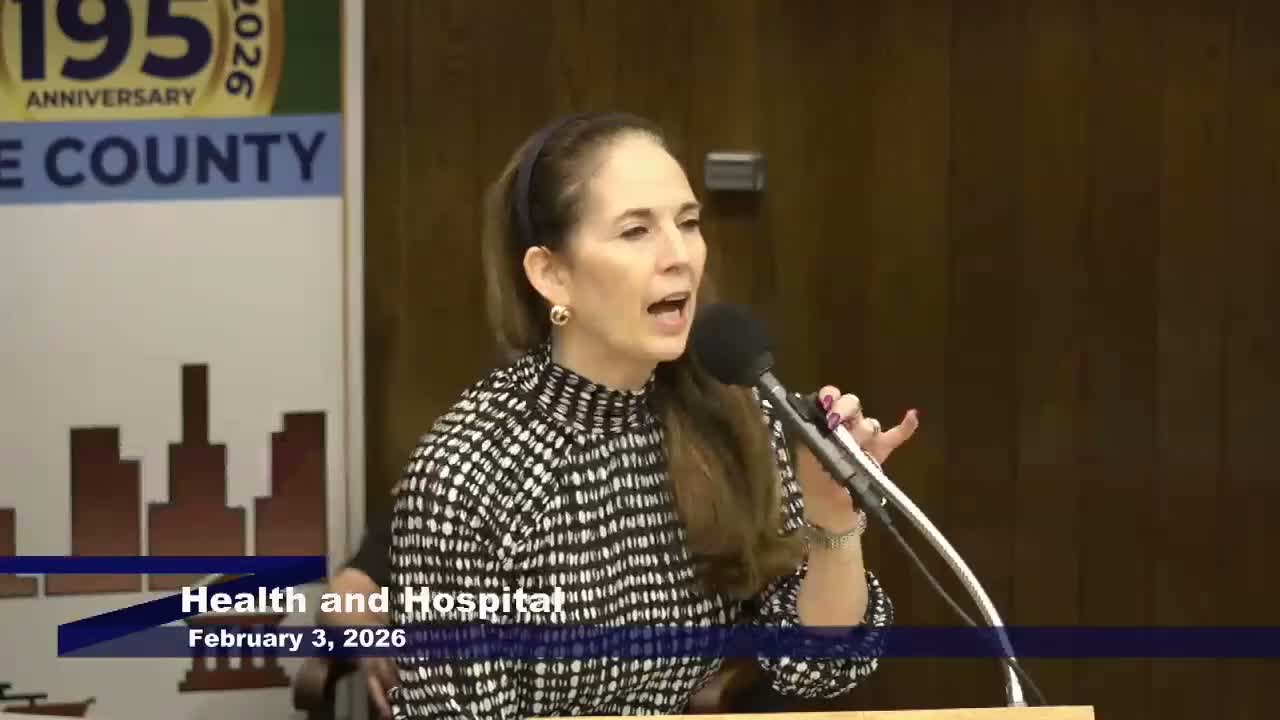
Commissioner Tara Stamps introduced the resolution and framed CTE as a personal and urgent public‑health problem, urging Cook County to lead on education and early intervention. ‘‘This is where Cook County must lead,’’ Stamps said, describing several families affected by suspected CTE and calling for local programs and federal research funding.
The resolution (Item 206649) asks the Cook County Department of Public Health and Cook County Health to develop CTE awareness programs, facilitate referrals to concussion clinics, request state regulation of name‑image‑likeness (NIL) deals and ask the federal government to fund research into how the transfer portal and NIL agreements may affect CTE injuries and young athletes’ mental health. Liz Nicholson, who identified herself as the wife of a former NFL player and a Concussion and CTE Foundation volunteer, told the committee she has seen ‘‘horrific changes’’ in a loved one she believes stem from repeated head trauma.
Dr. Chris Nowinski, co‑founder and CEO of the Concussion and CTE Foundation, testified remotely in support and described recent research from Boston University that links CTE to dementia. ‘‘CTE is the most underreported global public‑health problem that we are not yet addressing,’’ he said, and urged more clinician education and services in Illinois.
Cook County Department of Public Health presenter Dr. Joshi explained the distinction between concussion (a mild traumatic brain injury often reversible) and CTE (a degenerative condition currently diagnosable only at autopsy). Dr. Joshi clarified a statistic shown in slides: the 14% figure refers to public high‑school students in suburban Cook County who report having had a concussion from playing a sport or being physically active, not a general prevalence across all student populations.
Commissioners pressed for practical next steps: whether the Illinois Sports Concussion Act (2015) covers elementary schools or only high schools; how provider education and school‑level outreach (including park districts) could be expanded; and whether mental‑health screening could be integrated into pre‑participation physicals. Committee members raised concerns about disparities in diagnosis and care for Black youth and the need to reach suburban and park‑district programs that may lack professional medical oversight.
Rather than vote to approve the resolution, Vice Chair Anaya amended the motion to defer to a public hearing so the committee can gather more testimony and data. The committee agreed by voice vote. No policy was adopted at the meeting.
Next steps: the committee will schedule a public hearing on the resolution and invited additional expert and community testimony, including providers and organizations active in concussion prevention and care.