Get Full Government Meeting Transcripts, Videos, & Alerts Forever!
Get email alerts on the Education topic
No spam. Unsubscribe anytime.
Cheshire School District showcases expanded elementary coaching program
Summary
District coaches described year-two classroom units in science and robotics, hands-on agriscience and ecosystems investigations, teacher workshops and in-class modeling; coaches said a local farm will donate plants for experiments and emphasized coaching as a districtwide strategy to build teacher capacity.
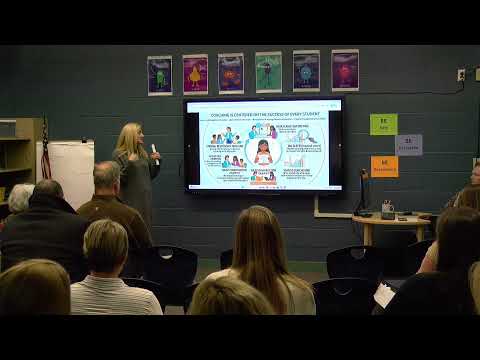
Marlene, introduced by the board chair, opened the Cheshire School District’s elementary showcase and said the district is expanding instructional coaching to deepen hands-on science learning across elementary grades.
Two science coaches described year-two curriculum units in robotics, agriscience and ecosystems designed to strengthen students’ use of models, data collection and engineering design practices while supporting teachers through modeling and co-planning. "My name is Stephanie and I am a science coach for the district," one presenter said, describing how coaches model lessons in classrooms and lead professional workshops so teachers can run the units independently.
The presenters outlined specific classroom investigations: students compare sandpaper grain to soil particle size, conduct soil shake tests with loam, clay and sand to observe settling layers, measure water flow and absorption through different soils with and without plants, and run experiments that connect soil properties to sustainable agricultural choices. Coaches said students gather evidence, analyze data and revise models as part of unit storylines that culminate in a unit-driving question.
Robotics lessons were presented as another strand of the work: students apply measurement and coding skills, define problems, test solutions and revise programs. Coaches said robotics learning supports math skills and problem solving while fostering student engagement and collaborative discourse.
Coaches described a multi-step teacher-support model: targeted professional development, in-class modeling and co-teaching, post-observation debriefs, and follow-up planning. They said the district uses teacher surveys and learning walks to iterate on curriculum and target coaches where data show the greatest need. A principal and multiple classroom teachers gave testimonials describing the value of in-the-moment feedback from coaches and the subsequent spread of practices among grade-level teams.
Presenters also noted resource implications and community support. In addition to strategic classroom purchasing to keep units within budget, a presenter said Kurt's Farm will donate plants needed for the agriscience experiments, and coaches welcomed other donations for supplies.
Marlene and another coach described the district-level coordination that aligns coaches, administrators and central office staff to target support across schools and to build vertical continuity from elementary to middle grades. They named recent professional development partners and state-sponsored trainings used to keep instruction current, and they said coaches serve as thought partners who help teachers apply new practices with students.
The meeting concluded with thanks to the coaching team and teacher participants and a motion to adjourn, which was made and acted on by the board.