
North Little Rock board workshop weighs $4 million to raise teacher pay, examines savings options
Get AI-powered insights, summaries, and transcripts
Subscribe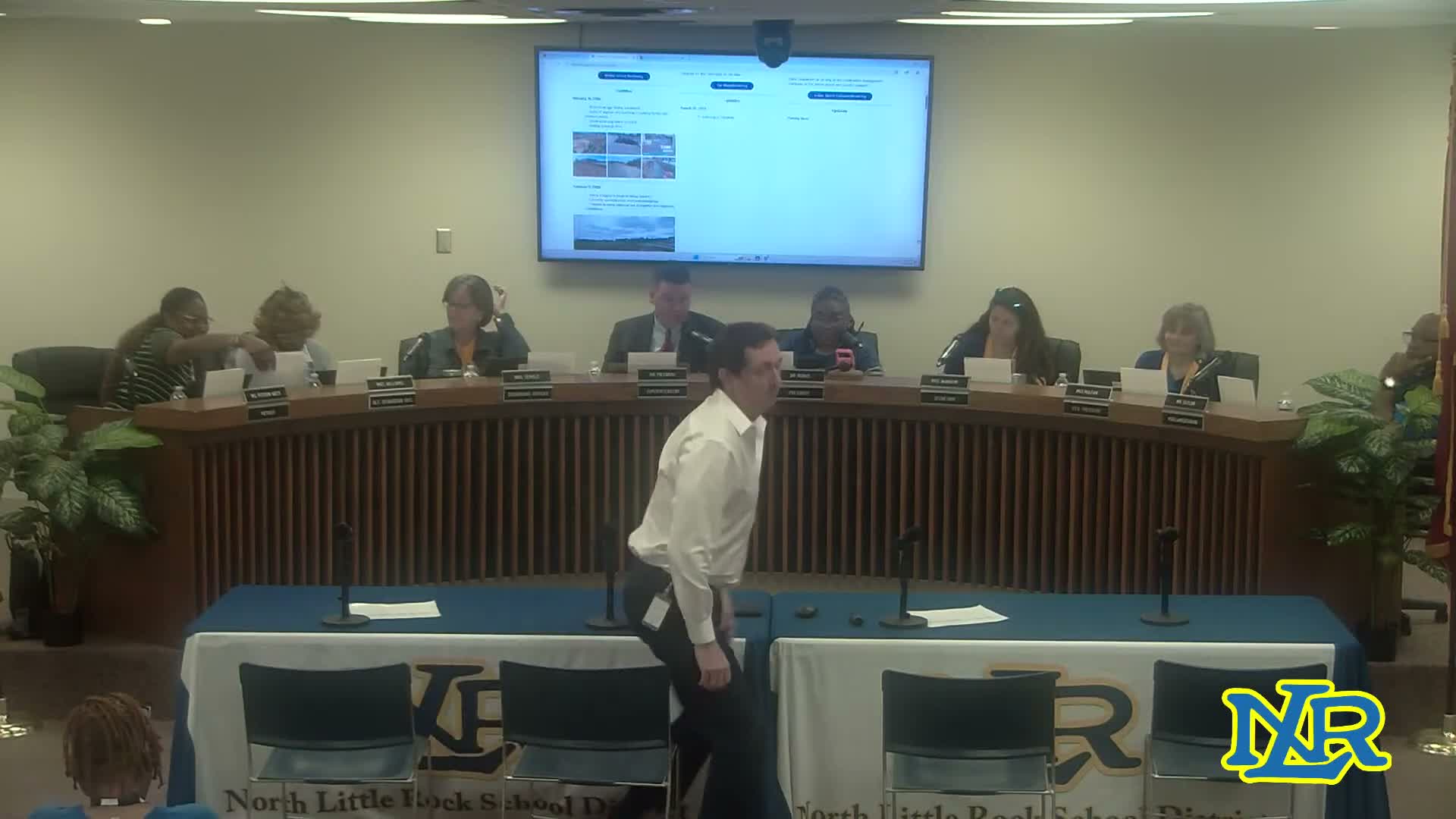
Summary
CFO Brian Brown told the board about options to free up roughly $4 million to invest in licensed teacher pay; the board discussed staged approaches, possible use of net-legal balances and broader staff involvement as it balances construction costs and depleted federal funds.
Brian Brown, chief financial officer for the North Little Rock School District, told the board at a workshop that the district needs about $3.99 million — roughly $4.0 million — to raise the licensed teacher base by $5,000. "So it's 3,990,000.00 for a $5,000 raise to the licensed salary base," Brown said while reviewing projected costs and the district's expenditure categories.
Brown framed the proposal as a trade-off driven by two revenue pressures: declining student enrollment, which reduces state revenue tied to average daily membership, and the end of federal ESSER funds that had temporarily supported district expenses. He said salary and benefits account for about 75% of the district's expenditures and that certain expenditures (debt service, utilities, maintenance-of-effort) are largely fixed.
The workshop discussion focused on how to create room in the budget without destabilizing cash flow. Brown said the district maintains a long-standing net legal balance (about $12.8 million in past years) that ADE previously recommended to carry the district through lean months; he reported that ADE staff told him reducing that balance to about $11.5 million could be acceptable if the district's metrics remain strong, but would prompt closer state review. "If we reduced our net legal balance from 13 to say 11,500,000, and your metrics remained good ... we wouldn't have a problem with that," Brown summarized of his conversation with ADE's fiscal unit.
Board members and participants raised several options: staging any reinvestment over years rather than making a single large, permanent increase; involving certified and classified staff in planning and negotiations; and ensuring one-time bond-related savings remain reserved for capital needs amid new asbestos abatement costs. A board member urged the administration to present a salary schedule model showing how much money is required to reach different target base salaries and how classified and licensed increases would differ.
Public speakers who appeared earlier in the meeting had urged care in cutting classified employees and highlighted the human impacts of reductions. Brown emphasized the choice would be a board decision and recommended pairing any operating-fund investments with some expenditure reductions to avoid long-term cash-flow stress.
Next steps: Brown said staff can model phased approaches and bring a clearer proposed schedule and numbers to an upcoming regular meeting or a follow-up workshop with community input.
Ending: The board did not vote on changes at the workshop; the presentation was informational and any formal action would be brought to a future public meeting.