Denton staff outlines local work on NCTCOG’s Regional Transit 2 initiative and seeks targeted pilots
Loading...
Summary
NCTCOG’s Transit 2 regional planning framework was presented to Denton’s Mobility Committee; staff proposed a Denton‑specific Transit 2 synthesis study, potential $2–2.5 million federal grant applications, and short‑term implementation 'low‑hanging' projects in coordination with DCTA.
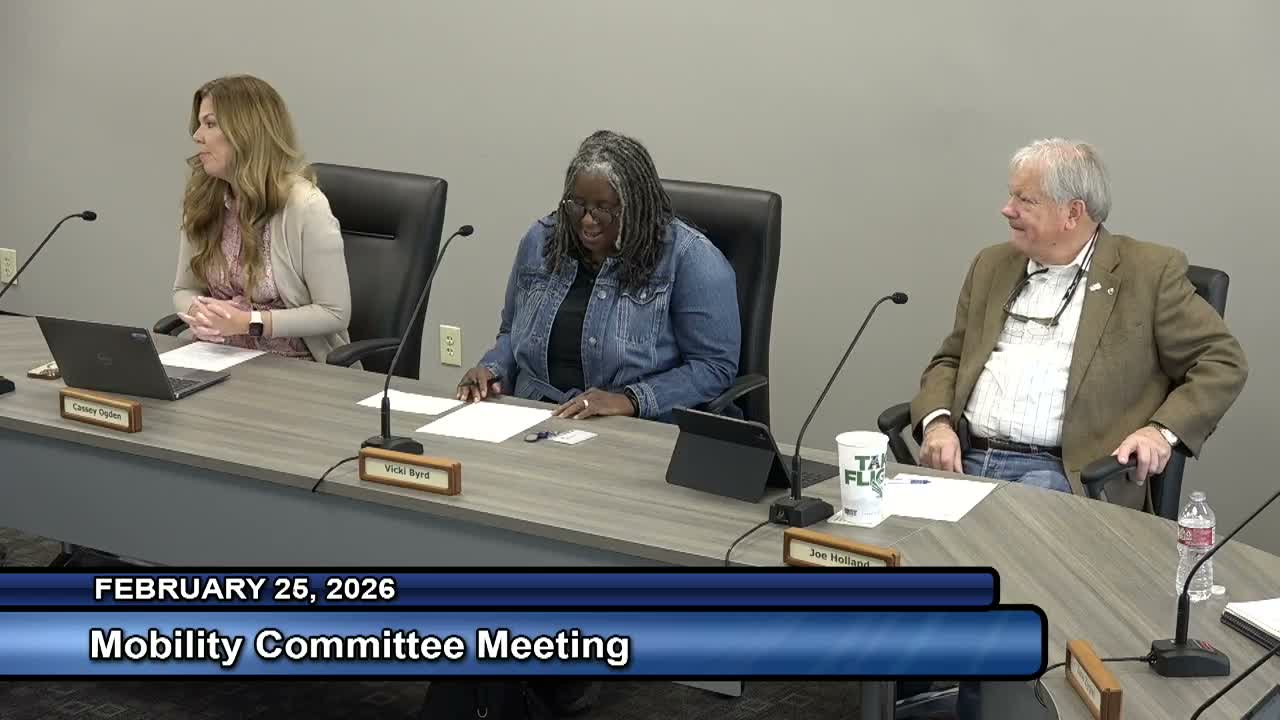
Farhan (Deputy Director, Transportation Services Division) briefed the Mobility Committee on the NCTCOG Regional Transit 2 initiative and how the city plans to develop a Denton‑specific Transit 2 synthesis and integrate it into forthcoming comprehensive and mobility plan updates.
Staff described Transit 2 as a regional, DFW‑wide initiative launched in April 2024 to assess long‑term public‑transportation needs in light of projected DFW population growth to about 8.6 million by 2050. Farhan said the initiative combines planning for sustainable funding, governance enhancements, transit‑oriented development and land‑use changes to address a projected gap between vehicle miles traveled and roadway capacity.
Local next steps: Farhan said staff plans several linked efforts if grant funding is secured, including a Denton Transit 2 synthesis, a comprehensive plan update, a mobility plan update with bike/ped components, and an ADA transition plan update. He noted the city is applying for an economic development assistance grant (federal) in the $2.0–$2.5 million range to support a Denton‑focused study.
Committee members pressed staff for near‑term, implementable pilots rather than only long studies. "We have low‑hanging fruits," Farhan said, pointing to recent trip‑fund allocations and coordination with DCTA on short‑term multimodal enhancements; he referenced approximately $5 million in trip funding received in prior fiscal years and said staff is targeting smaller projects alongside longer‑range planning.
Questions addressed included public perception and branding of transit, safety concerns and pilot experiments (such as temporary amenity upgrades or added stops), and how land‑use changes could be phased so that any removal of parking minimums is tied to demonstrated multimodal options. Staff emphasized coordination with DCTA and the goal of avoiding a reactive approach.
The committee encouraged pilots and asked staff to return with specific projects for regional trip funding and short‑term implementation.