
Denton Mobility Committee hears multi‑year update on I‑35 North, utility funding and strategies to accelerate projects
Get AI-powered insights, summaries, and transcripts
Subscribe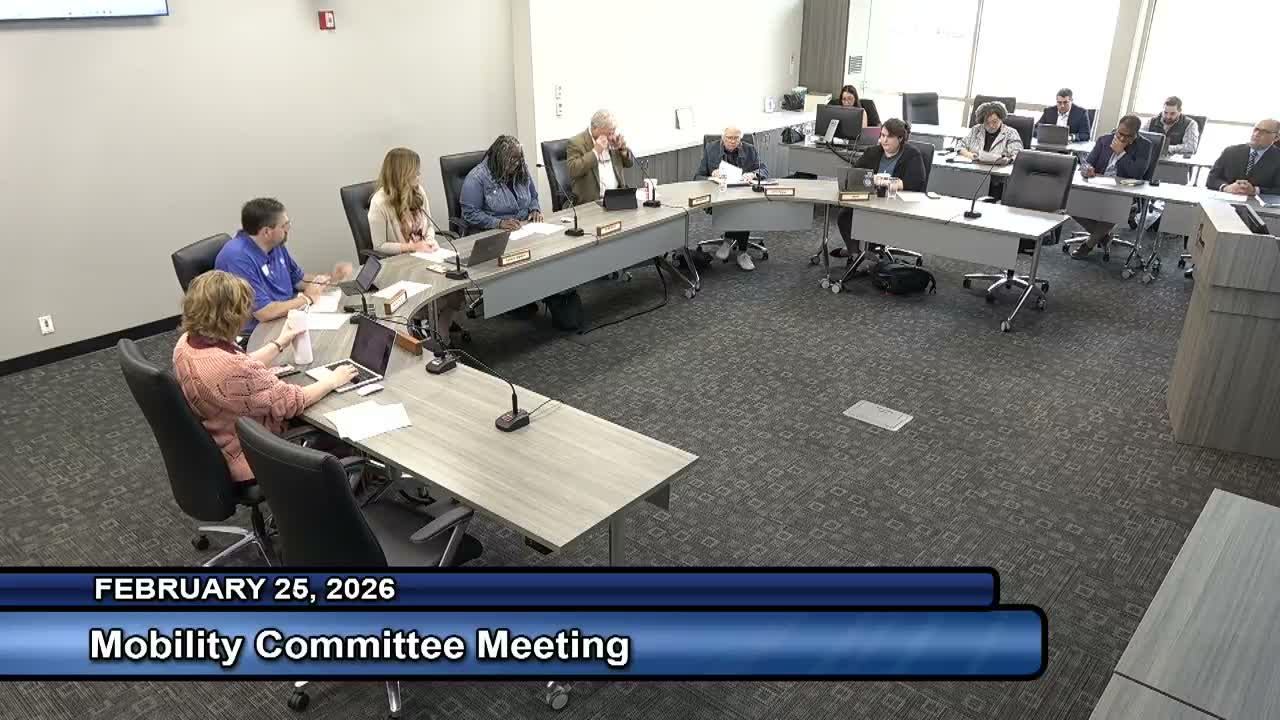
Summary
County and state project managers told the Mobility Committee Feb. 25 that large interstate projects such as I‑35 North were rebid into smaller packages after inflated bids, and outlined utility‑relocation, frontage‑road and funding strategies intended to move sections into the state Unified Transportation Plan (UTP) by 2027–2029.
County and state project staff updated the City of Denton Mobility Committee on Feb. 25 about the status of major roadway investments — including the I‑35 North merge and Loop 288 frontage‑road work — and outlined steps they say are necessary to accelerate letting and construction schedules.
The most detailed update came from John (agency official), who said very large projects drew too few bidders and produced bids well above estimates, so staff divided the “yellow” I‑35 project into three smaller construction packages to attract more contractors. “We thought it was $450,000,000. We got two bidders. Both of them bid 54 months and $100,000,000 over the estimate,” John said, explaining the decision to break the work into smaller bid packets to expand the pool of bidders and reduce costs.
Why it matters: staff told the committee that segmented bidding, plus targeted utility‑relocation work financed by county and discretionary funds, could move sections into the 2027 UTP window. John said December 2027 is a key milestone for utility relocation to allow projects to be let during the September 2027–August 2028 UTP cycle.
Committee members sought specifics about constructability, local impacts and where people can find up‑to‑date project information. John said project phasing and daily construction changes are posted on an NCTCOG/TxDOT project site (keepitmovingdallas.com and project‑specific pages) and offered to have staff share the direct link with the committee.
Other items highlighted in the update included:
• Frontage‑road strategy and freeway definition: Staff described a plan to add frontage roads and convert long stretches to controlled‑access freeway sections in phases; John noted a “freeway” classification requires main lanes, braiding and frontage roads and explained that conversion would be staged to avoid taking access from adjacent development until alternate access is in place.
• Utility relocation and funding: County and state staff described a plan to reallocate some county funds to pay for utility relocation (DME, Atmos, CoServ, Lumen and others) and to hire a utility coordinator and consultant to accelerate relocation work so more of the corridor can be included in nearer‑term UTP cycles.
• Local impacts and right‑of‑way: Staff said the projects would largely remain within existing footprints at intersections and that, while right‑of‑way would be acquired in places, they expect to avoid wholesale residential displacement. “We’re staying in the existing footprint,” John said.
• Timelines: For the merge/interchange projects staff presented multi‑year schedules; for some large work John said construction completion could be as late as 2029–2030 depending on phasing and letting strategies.
The committee did not take a formal vote beyond approving meeting minutes earlier; staff committed to provide committee members with project webpages and to continue coordinating with state partners on phasing, funding and outreach. The presentation closed when the committee moved on to a regional transit briefing and the citywide parking study.