
Rep. Kenneth Volkow warns invasive plants are raising wildfire risk, points to drone mapping and targeted treatment
Get AI-powered insights, summaries, and transcripts
Subscribe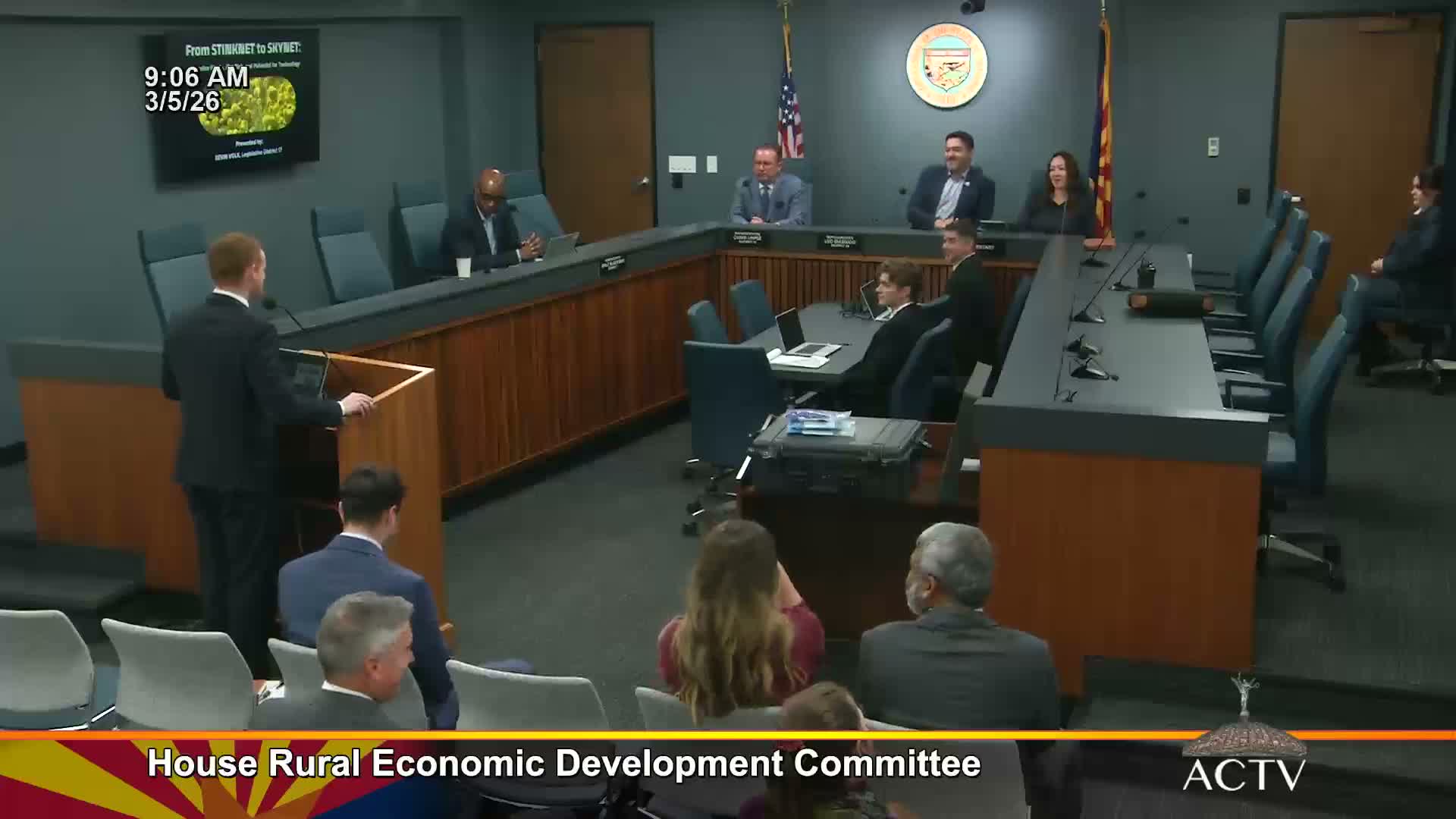
Summary
State Rep. Kenneth Volkow (D17) told the rural economic development committee that invasive species—particularly buffalo grass and "stinknet"—are transforming the Sonoran Desert into continuous fuel beds, increasing fire risk and insurance impacts; he urged expanded mapping, volunteer removal and pilot drone-based targeted herbicide treatment.
State Rep. Kenneth Volkow (District 17) told the Committee on Rural Economic Development that invasive plants such as buffalo grass and the recently observed "stinknet" have converted parts of the Sonoran Desert into continuous, flammable fuel that can drive more intense wildfires.
"It burns hot. It burns fast, and it burns for a long time," Volkow said as he reviewed maps showing widespread infestations from Sabino Canyon into the Tucson metro area. He said stinknet is "dense" and "contains oils that act as accelerants" and can also cause respiratory irritation.
Volkow used photos and fire examples to make the case that the desert’s historical mosaic—with bare ground between native plants that served as natural firebreaks—has been altered where invasive grasses take hold. He cited the 2020 Bighorn Fire in the Catalina Mountains as an example of an event where invasive grass contributed to the fire’s behavior and warned that higher fire risk has led insurers to raise rates or withdraw coverage in some rural areas.
As short-term mitigation, Volkow described hand extraction coordinated by local organizations such as the Arizona-Sonora Desert Museum and volunteer groups. "You gotta pull from the root," he said, noting that manual removal is intensive and often volunteer-driven.
Volkow also highlighted technology options to improve detection and treatment. He described drone mapping to identify infestations and said jurisdictions are discussing targeted aerial pesticide treatments. "They're experimenting with the effectiveness," he said, noting 2014 helicopter spray examples and an ongoing pilot in Apache Junction using spray drones. He added that Pima County contacts are training local workers in drone technology to support mapping and treatment.
Committee members pressed for detail on specificity and cost. Volkow said some programs study herbicide use (he referenced glyphosate in earlier programs) and noted grant support across jurisdictional lines, including funding from the Department of Fire Forestry Management (DFFM). He also cited an earlier federal effort in which Rep. Raul Grijalva secured roughly $50,000 for southern Arizona treatment efforts as precedent for targeted funding.
The committee did not take formal action on the subject during the session; the presentation concluded with members thanking Volkow and asking follow-up questions.