Get Full Government Meeting Transcripts, Videos, & Alerts Forever!
Get email alerts on the Election Administration topic
No spam. Unsubscribe anytime.
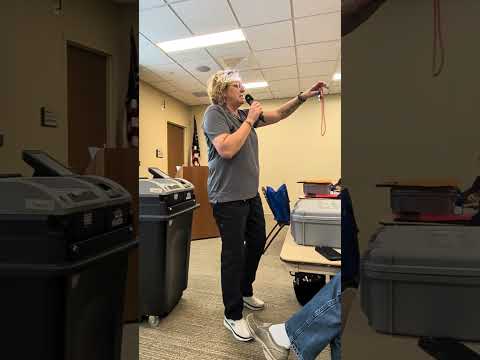
Tazewell County holds training for election judges on polling procedures and equipment
Summary
Tazewell County held a training session for election judges covering setup, tabulator and touchscreen operation, handling overvotes/undervotes and auxiliary-bin procedures, curbside voting, poll-watcher credentials, and end-of-day reporting and returns.
Presenter opened a Tazewell County training session for election judges, reviewed morning setup and supplies, and invited participants to follow-up classes at 6 p.m. or on Saturday.
The session focused on practical procedures election judges must follow on election day, including arrival at 5 a.m., signing the judge's oath (in the precinct envelope with an orange sticker), and the roles of coordinating judges and station assignments for check-in, poll books, ballot distribution and the tabulator. "You are serving as officers of the circuit court and are the sole authority in the polling place," the Presenter told attendees, emphasizing judges' responsibility for maintaining a campaign-free zone.
Trainer instructions covered equipment checks for the tabulator and touchscreen: inspect the ballot box belly for stray ballots, run and sign zero reports for each ballot style, verify the device's date/time and precinct programming, and print open reports to place in the orange envelope. The presenter warned that if a tabulator fails during the day, judges should use the auxiliary bin and keep a running tally of ballots placed there to reconcile counts later.
On voter flow and special procedures, the Presenter described Station 1 (greeter/registration), Station 2/3 (electronic poll books and affidavits), Station 4 (ballot distribution), and Station 5 (ballot-box judge). For curbside voting the Presenter reiterated the bipartisan requirement: "two judges, one from each party" must go to the voter’s car with the poll book and a privacy cover.
The session also explained how the tabulator handles overvotes and undervotes: voters may choose to accept a ballot that omits or spoils a contest, or they may spoil it and be issued a replacement. Judges were instructed not to override a voter's choice and to call the election office for guidance on unusual situations. The Presenter stressed that ballots must bear judges' initials for recount eligibility: "Any ballot that does not have an initial does not get recounted."
Closing-day procedures covered announcing the polls' impending closure (the Presenter advised an announcement 30 minutes before closing), reconciling auxiliary-bin tallies with tabulator totals at the end of the night, printing required write-in and summary reports when closing voting on the tabulator, sealing voted ballots into white boxes with orange labels, and returning materials to the health department complex. The Presenter closed by reminding judges to complete judge expense sheets to ensure timely payment.
The training concluded with an offer to take questions and a reminder to call the election office if unexpected situations arise on election day.