
Lake County advances Housing Lake plan, approves 3-year MOU with CMAP to pursue zoning, funding and modular-construction pilots
Get AI-powered insights, summaries, and transcripts
Sign Up Free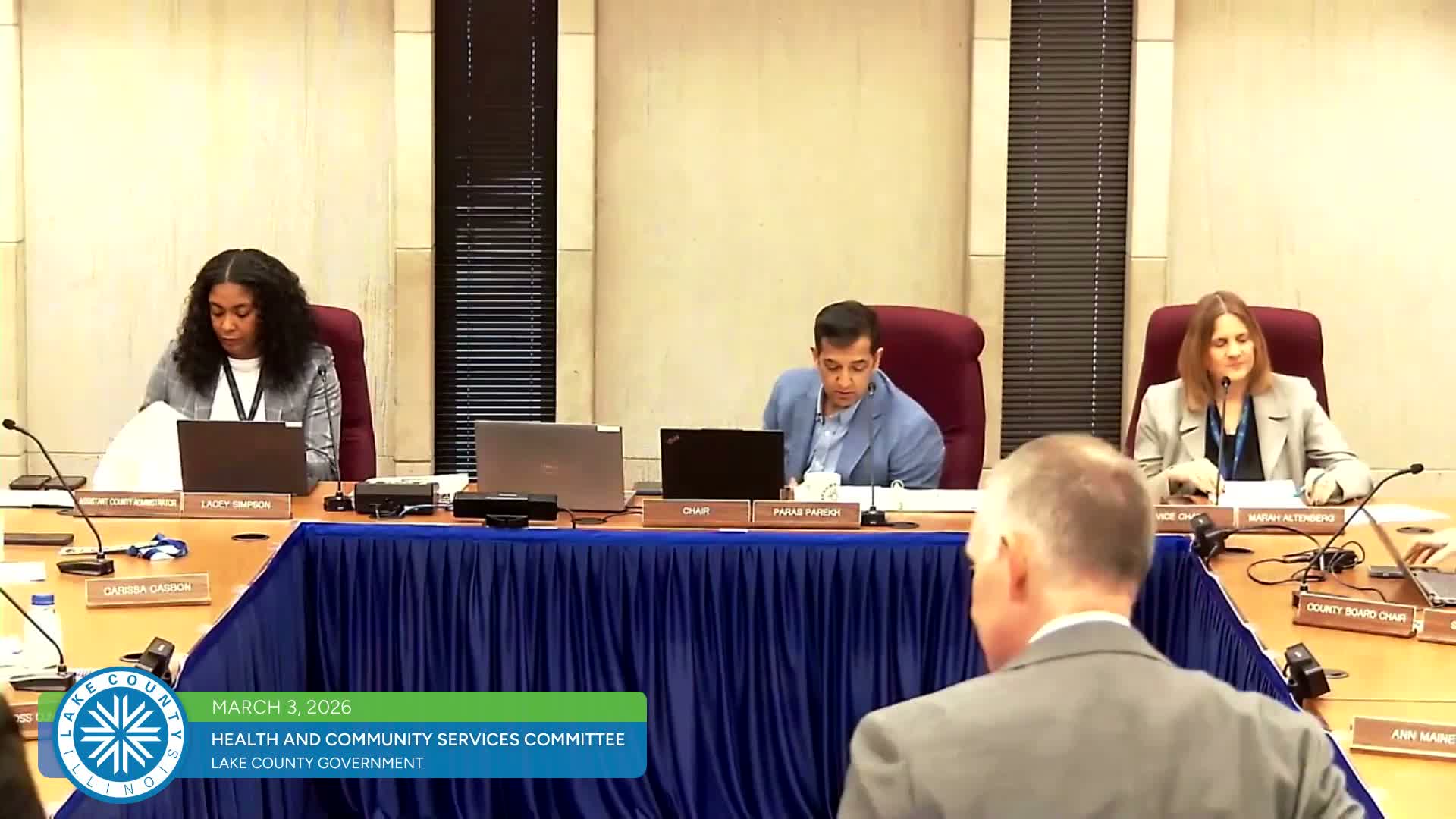
Summary
After a multi-stakeholder summit, county staff briefed the Health and Community Services Committee on Housing Lake's four pillars and a proposed 3-year memorandum of understanding with the Chicago Metropolitan Agency for Planning; the committee voted to approve the MOU to fund a work plan and quarterly deliverables.
County staff and coalition partners on March 3 presented results from the Housing Lake Phase 1 series and a Feb. summit, then asked the Health and Community Services Committee to approve a memorandum of understanding (MOU) with the Chicago Metropolitan Agency for Planning (CMAP) to begin a three-year implementation phase.
Presenters said Housing Lake convened seven meetings and a summit with roughly 175 participants from more than 50 municipalities and stakeholders across development, finance, nonprofits, health and education. They cited Lake County Partners' 2023 housing report estimating a multi-year shortfall of units and framed the initiative around four pillars: policy and regulatory reform; funding and financing tools; partnerships and development capacity; and communications and education.
"The summit represented the culmination of work the coalition's been engaging in since July," one presenter said. The coalition's "call to action" document and engagement toolkit (presentation decks, social content and talking points) are publicly available by QR code, staff said.
Members pressed for clarity on deliverables and timelines under the proposed MOU, asked how the county will work with municipalities that have limited regulatory authority or infrastructure constraints, and discussed the role of modular and prefabricated construction, accessory dwelling units (ADUs) and inclusionary zoning as tools to expand supply. Staff said a work plan will be developed in the early months of the MOU to break the 36-month program into year-by-year and quarterly deliverables and identify specific workshop objectives.
Staff also identified state-level activity to watch, including potential changes to low-income housing tax credit (LIHTC) programs and a governor's "missing middle" task-force report that could influence state policy; presenters emphasized the county would pursue local pilot reforms in parallel with legislative engagement.
Item 8.4 was a resolution approving the MOU with CMAP to coordinate implementation across the four pillars, create a project plan, identify funding strategies and assist procurement to build the implementation team. Member Casman moved approval and Member Cunningham seconded; the committee voted to approve the resolution and recommended adoption by the county board.
What happens next: Staff said they will finalize the work plan with CMAP, report quarterly deliverables to the committee, and advance county-led UDO amendments this year to test process streamlining and density incentives in unincorporated areas.