Planning commission forwards split recommendation on eGroup solar project amid dust, CEQA and benefits debates
Loading...
Summary
The Twentynine Palms Planning Commission voted to forward a split recommendation on the proposed eGroup commercial solar farm to the City Council after extensive public comment about aesthetics, dust/valley fever risks, missing grading plans and the adequacy of the EIR; two commissioners favored approval, two favored denial and one was neutral.
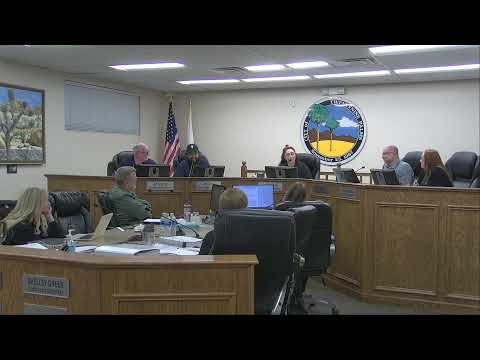
The Twentynine Palms Planning Commission voted to forward a split recommendation to the City Council on the proposed eGroup commercial solar project after a nearly three-hour continued hearing that focused on environmental impacts, community benefits and procedural questions.
The motion to send a split recommendation passed with two commissioners in favor of approving the project, two in favor of denying it and one neutral. The commission’s action means the City Council will receive the record and the Planning Commission’s divided findings for further consideration.
Why it matters: speakers at the hearing sharply disagreed over whether the project’s promised revenue and community benefit package justify disturbing roughly 140 acres of largely undisturbed desert. The applicant’s representative, Robert Smith, said the developer has proposed an annual community-benefit payment that starts at $105,000 and escalates to $150,000 after five years, producing roughly $5,445,000 over the life of the project. He told commissioners construction grading would require about 40 days and about 1.3 acre-feet of water, brought in by truck, and said the developer would offer HEPA filters to residents within 1.5 miles during construction to reduce dust exposure.
Process and CEQA: Multiple speakers — including environmental groups and local residents — urged the commission to withhold any recommendation until the city recirculates the environmental impact report (EIR), arguing that critical materials such as a grading plan and cut-and-fill diagrams were not available during the draft comment period. Mary Kay Sherry asked the commission to enter a formal request to recirculate the EIR under CEQA guideline 15088.5; Ed Marshall for Citizens for Responsible Industry said the final EIR did not adequately respond to expert comments submitted during the draft phase.
Health and environmental concerns: Several residents and conservation experts said dust and valley fever risk are prominent unresolved issues. Pat Flanagan, a biologist and board member of the Morongo Basin Conservation Association, told the commission that "water does not work — this is the desert; it has not worked in any of the projects," and warned that disturbed soils on sand-transport paths continue to blow for many years. The applicant cited California Department of Public Health data and said San Bernardino County had far fewer valley fever cases in 2024 than neighboring Kern County, and that the EIR concluded risk would be low with appropriate dust-mitigation measures.
Benefits and economics: Proponents, including local landowner George Malopoulos and representatives of a local nonprofit, said the project would generate predictable revenue for a small city with infrastructure needs. "This project does bring significant recurring annual income directly into our city," Malopoulos said, adding that strengthening the grid via projects that sell power to Southern California Edison can benefit local reliability.
Technical gaps: Opponents repeatedly flagged the absence of a publicly available grading plan and a detailed topography/cut-and-fill map in the EIR, and raised questions about how soil would be redistributed, long-term revegetation prospects and the responsibility for responding to dust complaints. Kurt Kepler said the EIR repeatedly referred to a grading plan that "is not anywhere that the public has access to," and asked the commission to withhold certification until the public can meaningfully review that plan.
What’s next: The split recommendation will go to the City Council. The commission’s divided vote and the record of public comments and technical challenges make it likely the council will either take up the matter directly or consider referring unresolved questions — including CEQA adequacy and grading-plan transparency — before deciding whether to certify the EIR and approve the related entitlements.
Quotes (selection): "Upon build out, eGroup have immediately become the largest taxpayer in the city if you look at sales tax revenue," said Robert Smith, the applicant’s attorney, describing the developer’s economic case. "Water does not work — this is the desert; it has not worked in any of the projects," said Pat Flanagan, a biologist and MBCA board member, describing long-term dust concerns. "The draft EIR relied on a grading plan that was not included in the circulated draft EIR appendices and was not publicly available during the comment period," said Mary Kay Sherry, urging recirculation under CEQA guideline 15088.5.
Meeting outcome: The commission’s motion to forward a split recommendation passed; two commissioners indicated support for approval, two opposed approval, and one was neutral. The record and the split recommendation will be transmitted to the City Council for its review.
No final permit, rezoning or certification occurred at the Planning Commission level; the matter will proceed to the City Council.