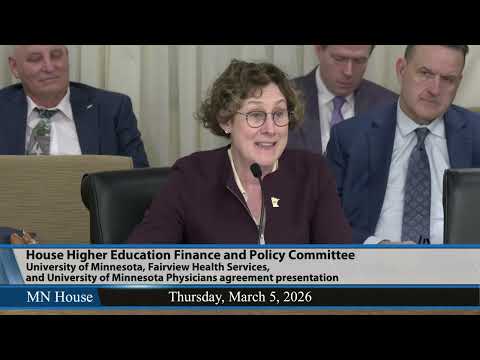
House panel hears details of mediated 10-year University of Minnesota–Fairview–UMP agreement
Loading...
Summary
Witnesses told the House Higher Education Finance and Policy Committee that a mediated settlement among the University of Minnesota, Fairview Health Services and University of Minnesota Physicians will provide $1 billion in capital investment over 10 years, $50 million in fixed annual academic support and measures to preserve clinical care and research oversight while some staff move to Fairview employment.
A House committee on Jan. 26 heard testimony about a mediated 10-year settlement among the University of Minnesota, Fairview Health Services and University of Minnesota Physicians (UMP) that officials said is intended to stabilize academic medicine and patient care across the state.
Lois Quam, the strategic facilitator designated by the attorney general's office, told the House Higher Education Finance and Policy Committee that the parties signed a mediation agreement on Jan. 23 and are drafting definitive contracts to be completed by March 31, or at a later mutually agreed date. Quam summarized core commitments: Fairview will fund about $1,000,000,000 in capital improvements on the university medical campus over roughly 2027–2036, provide $50,000,000 in annual academic support (with the possibility of additional performance-based funding), and contribute an initial $10,000,000 to a program aimed at strengthening care in Greater Minnesota. "The agreement will ensure that the 1,200,000 Minnesotans a year will continue to receive world-class patient care in our state," Quam said.
University President Rebecca Cunningham said the mediated settlement clarifies roles for the next decade. "This agreement brings clarity and stability to the university's relationship with our physician group and to Fairview for the next 10 years," Cunningham said, noting the University of Minnesota Board of Regents approved the agreement on Jan. 30. She described the pact as affirming the medical school's academic mission, securing clinical teaching capacity and enabling modernized facilities.
Greg Bealman, chief executive of UMP, described the practice plan's role as the faculty practice entity that supports clinical care, teaching and research. Bealman said UMP will continue to be the designated faculty practice and that the mediated arrangements aim to stabilize faculty funding: "This makes sense because the revenue that is generated by our doctors supports the faculty, supports their salaries, and supports the academic mission," he said, adding that some administrative and operational staff who currently work in Fairview-supported roles will transition to Fairview employment over an 8–9 month period.
Fairview President and CEO James Hereford framed the settlement as a partnership to protect clinical platforms that support research and training statewide. He reiterated Fairview's statewide footprint and said the system expects to remain a primary private investor in the medical school's facilities and operations.
Committee members pressed witnesses on several details. Lawmakers noted the $50 million fixed annual academic support represents a shift from prior arrangements and asked how the university will make up the difference; Cunningham said the university is budgeting on the fixed component and characterized the change as a shift in how financial risk and support are allocated among the parties. Members also asked about ownership and potential repurchase of East Bank and West Bank facilities; Cunningham said Fairview has owned those buildings for about 30 years and that the mediated agreement leaves ownership with Fairview while securing substantial Fairview investment in deferred maintenance.
On staffing and labor questions, Bealman said UMP employs roughly 4,500 people (about 1,500 physicians and roughly 2,500 staff) and that employees supporting Fairview's mission will be moved to Fairview employment homes in a phased transition; he said the parties have identified about 112 employees with collective bargaining agreements and will work to ensure contractual obligations are honored during the transition.
Witnesses also addressed research oversight. Cunningham stressed that university faculty, students and clinical trials remain under university oversight and institutional review board (IRB) processes; Fairview may pursue independent research activities that do not involve university faculty or trainees, but research involving U of M personnel and students will flow through university oversight.
Committee members asked for follow-up detail on consultant fees and other financial specifics; witnesses said they would provide those numbers. The witnesses repeatedly described the agreement as a way to preserve clinical care, stabilize the medical school's academic mission and enable future planning for facilities and workforce development without promising immediate expansion beyond the terms being finalized.
The committee did not take formal votes on the settlement itself during the hearing. Members and witnesses agreed to exchange additional documents and clarifications as the definitive agreements are finalized.
The committee adjourned after expressing relief that an agreement had been reached to sustain Minnesota's academic medical capacity.