
Norwalk council approves development agreement to enable Project West data‑center campus after lengthy public hearing
Get AI-powered insights, summaries, and transcripts
Subscribe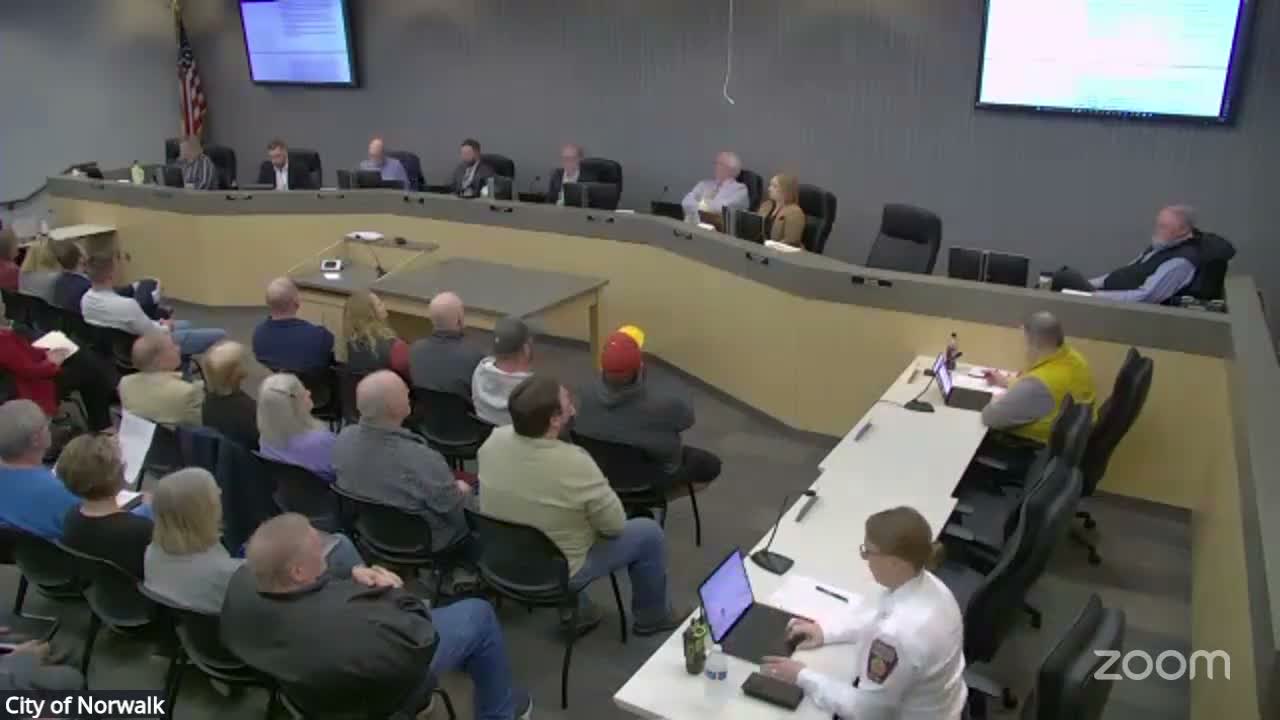
Summary
After two hours of staff presentations and nearly three hours of public comment, the Norwalk City Council voted to approve a development agreement with IALCO, Warren County 2 LLC to enable infrastructure for a proposed 282‑acre data‑center campus (Project West); the agreement authorizes certain TIF‑backed appropriations and requires future site approvals.
The Norwalk City Council on March 5 approved a development agreement with IALCO, Warren County 2 LLC that authorizes annual appropriation tax‑increment payments and pledges certain tax‑increment revenues to reimburse developer‑funded infrastructure for a proposed 282‑acre data‑center campus known in staff materials as "Project West." The resolution passed on a council roll call after a public hearing that drew dozens of residents, business owners and outside experts.
The decision follows presentations from Mayor Phillips, Economic Development Director Holly Zajaczak and Community Development Director Lud Paris, who described the site (south of Delaware, west of Madison and Highway 28), staff planning dating to the late 1990s, and an estimated full build‑out private investment figure staff discussed as roughly $12 billion. Zajaczak told the council that the developer would pay initial infrastructure costs estimated at about $8.2 million and that no tax‑increment financing (TIF) rebates or grants are being requested by the developer; the council packet and staff presentation included projected taxable valuation and estimated annual tax revenues to various local taxing entities.
Why it matters: Council members and staff framed the vote as authorization to proceed with a site‑development agreement with a private developer, not approval of any specific data‑center operator or final site plan. Supporters said the agreement secures infrastructure paid by the developer, strengthens the city’s commercial tax base and brings temporary construction work and a modest number of permanent jobs. Opponents warned of water‑use, noise (including low‑frequency concerns), light pollution, potential health risks and cumulative regional impacts of many nearby data centers. Many speakers called for stronger local ordinances, more transparency about nondisclosure agreements and clearer assurances about water and wastewater handling.
What council approved: The resolution authorizes the development agreement with IALCO, Warren County 2 LLC and allows use of incremental property tax receipts to repay developer‑funded infrastructure under the terms shown in staff materials. Council member Cool made the motion to approve; council member Meineke seconded. The roll call recorded affirmative votes and the motion carried.
Key points from staff and witnesses: - Water and infrastructure: Staff said Norwalk belongs to Central Iowa Water Works and had set aside 650,000 gallons per day of industrial allocation; the developer has requested a 400,000 gpd reservation, which staff said fits within the city’s planning assumptions. Staff emphasized that any capacity increases would be paid by the developer, and they described a proposed $6,000,000 pipe the developer would fund to serve the site and adjacent areas. - Environmental and health concerns: Multiple residents and commenters raised worries about diesel‑generator emissions, nitrates and the potential for closed‑loop cooling blowdown to affect downstream waters. Staff and presenters said modern data centers increasingly use closed‑loop cooling and advanced emissions controls and noted that state and federal agencies (for example, the Iowa Utilities Commission and environmental regulators) have roles in oversight. - Noise, light and security: Residents cited low‑frequency noise and light spillage concerns near housing and schools; staff said newer facilities and established operators in the metro area use shielded lighting and mitigation measures, and the council asked staff to pursue ordinance language as needed. - Jobs and economics: Staff estimated multi‑phase construction activity (hundreds of temporary construction jobs) and dozens to perhaps 80–100 permanent high‑skill positions once an operator is in place; Zajaczak and partners projected annual local tax revenues for the region derived from the property valuations presented.
What remains: Approving the development agreement authorizes the site‑infrastructure contract with the developer but does not approve any eventual data‑center operator, site plan, or building permits. Council and staff said future site plans, environmental reviews and permits will proceed through normal public processes; council members and many public speakers urged additional ordinance work (noise, light, construction controls, and protections for nearby wetlands and schools) before site plan finalization.
Procedure and next steps: Council members indicated the next steps would include drafting or strengthening local ordinances on noise and lighting, coordinating fire and plan‑review requirements during construction, and ensuring agreements specify developer responsibility for infrastructure costs and debt‑repayment sequencing. Staff said when a specific data‑center operator is identified that company would follow public approvals for site plans, building permits and required environmental compliance.
The council’s vote on the development agreement was followed later in the meeting by adoption of the FY2027 Capital Improvement Plan and several zoning and accessory‑structure ordinance readings; those votes were unanimous as recorded in the meeting minutes.