
Trinity County planning commission continues zoning-code overhaul after hours of debate over cannabis opt-outs and odor rules
Get AI-powered insights, summaries, and transcripts
Subscribe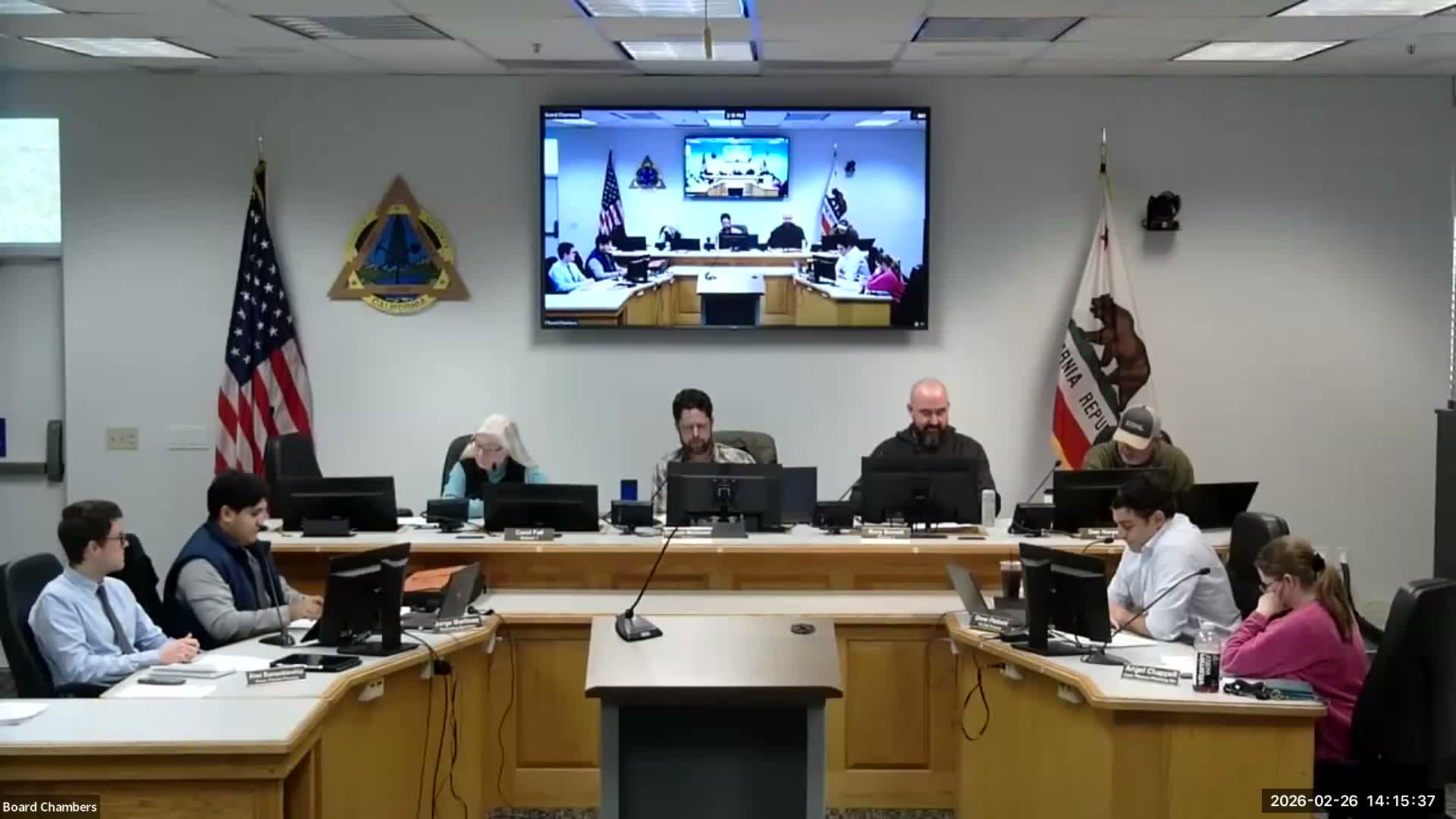
Summary
After more than five hours of review and public testimony, the Trinity County Planning Commission elected Commissioner McIntosh as chair and continued its in-depth zoning-code and cannabis-ordinance study to a March 12 follow-up session. Key disputes centered on cannabis opt-out maps, odor-control requirements, and whether county rules duplicate state regulations.
The Trinity County Planning Commission on Feb. 26 held an extended study session on a sweeping rewrite of the county zoning code, including a consolidated cannabis ordinance, and agreed to continue its review March 12 after hours of public comment and back-and-forth among commissioners.
The commission voted to appoint Commissioner McIntosh chair in a procedural motion, with Commissioners Harper and Barrett voting aye, Commissioner Fauch abstaining and Commissioner Flights absent. The vote came before a long line of agenda items that consumed the afternoon and evening, including line-by-line review of land‑use tables, the consolidated cannabis chapter, and the proposed cannabis opt‑out overlay.
Why it matters: The draft will replace older, separate cannabis chapters with a single land‑use framework (Chapter 17.85), and moves county oversight from an annual county-license model toward land‑use entitlements (use permits) plus a program‑enrollment compliance license. That shift would change how long‑term entitlements are granted and how environmental mitigation is tied to approvals; it also prompted extensive public comment because many local livelihoods and long‑standing parcel arrangements could be affected.
Drew Plobani, Trinity County’s community development director, told the commission that staff consolidated definitions, performance standards and the permit structure "to create more formal and long‑standing land‑use entitlements for cannabis operations" while using program enrollment to focus on compliance with the mitigation monitoring and reporting program. Plobani said the county is targeting a public‑review draft in May and plans to present consolidated commission direction to the Board of Supervisors on March 17.
Public commenters pressed several issues. Some growers and residents urged removal or reevaluation of geographically defined cannabis opt‑out overlays — particularly the Coffee Creek and Trinity Center areas — saying the opt‑outs lack objective findings and prevent lawful local agricultural opportunities. "We're being denied any kind of opportunity to participate in this legal industry," one speaker said of the opt‑out that affects large tracts of the two communities. Other commenters asked that the county avoid duplicating state water or wildlife requirements at the local level.
Odor and monitoring drew sharp debate. The draft adds an olfactometer‑based trigger (a 7:1 dilution ratio) that staff proposed be used to determine when an odor‑control plan's mitigation tiers must be implemented. Supporters said an objective measurement reduces subjectivity; opponents argued the county should not hold cannabis to stricter odor or well‑monitoring standards than other agricultural uses. Plobani responded that many of the performance standards were carried from the county’s cannabis program EIR and that the provisions will be reexamined as part of the forthcoming general‑plan EIR.
Commissioners and the public also discussed permit thresholds across zones — whether agritourism, apiaries, firewood processing, small farm stands and similar cottage industries should be permitted by right or require director/conditional review — and how rezoning unclassified parcels to RR (rural residential) bands will affect existing uses. Several speakers and commissioners urged the county to preserve pathways for small, home‑based operations to reduce barriers to entry in a county with limited economic opportunity.
On medical care and personal cultivation, the commission heard repeated requests to align county rules with state law and to include a clear caregiver or medical subsection. Several speakers asked the commission to adopt the state’s six‑plant baseline for noncommercial personal cultivation and to create a separate, state‑aligned pathway that protects qualified patients and caregiver arrangements.
What the commission directed staff to do: add a narrowly worded definition of “project” that preserves the prior program intent allowing contiguous parcels under common ownership or control to be counted together for an entitlement; align county definitions and setback terms (for example, youth/school setbacks) with Department of Cannabis Control language where appropriate; and prepare a draft medical/caregiver subsection. Staff was also asked to clarify whether and how certain mitigation measures from the earlier cannabis EIR will be updated in the general‑plan EIR.
What happens next: The commission scheduled a continuation of the study session for March 12, 2026, at 2 p.m. and asked staff to publish notice in the local paper in advance; staff also plans to brief the Board of Supervisors on March 17. No final code or map changes were adopted at Tuesday’s session.
Meeting note: A formal motion to install Commissioner McIntosh as chair was made by the acting chair and seconded; the record shows three ayes, one abstention and one absence. The commission’s discussion and the many public comments will be incorporated into the redrafted public‑review materials staff expects to publish in May.
(Reporting based on the Feb. 26, 2026 Trinity County Planning Commission zoning‑code study session transcript.)