Get Full Government Meeting Transcripts, Videos, & Alerts Forever!
Get email alerts on the Flood Preparedness topic
No spam. Unsubscribe anytime.
Arlington outlines upgraded flood‑monitoring, buyout and alert plans after historic events
Summary
City public‑works and emergency‑management staff told council they are expanding flood monitoring and pre‑identified buyouts, tightening freeboard and floodplain standards, and pursuing IPAWS mobile alerts while continuing siren maintenance and EOC training.
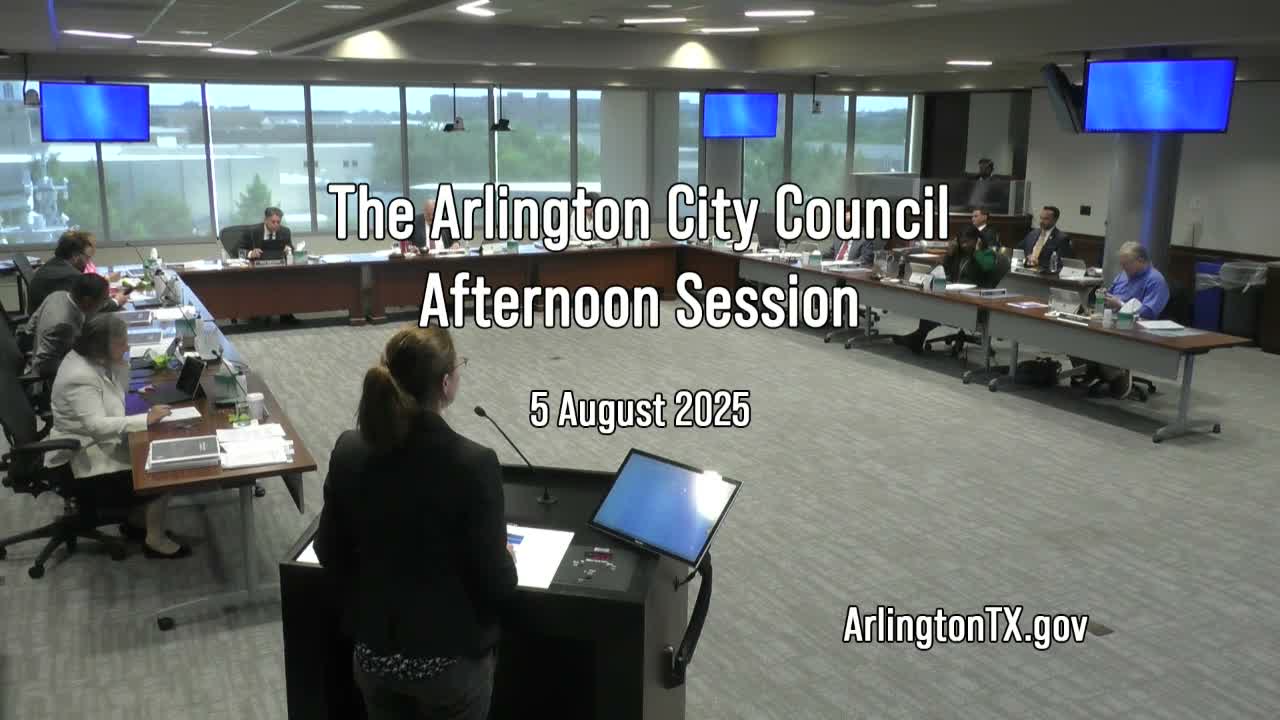
Assistant Director of Public Works Amy Cannon told the Arlington City Council that the city is shifting flood work from reaction to prevention, detailing a series of watershed studies, buyouts and code changes intended to reduce risk to homes and infrastructure.
Cannon reviewed major local flood events, including the May 1989 run of storms that forced roughly 400 evacuations and Tropical Storm Hermine in 2010, and said those events shaped the city's ‘‘worst‑first’’ approach to stormwater planning. She said staff have pre‑identified roughly 463 structures as candidates for voluntary buyouts, have completed prior buyouts along Johnson and Rush creeks, and have invested in mitigation projects the city counts at about $200 million to date. Cannon said additional projects identified through 2040 total roughly $400 million (estimate), and noted ongoing work to clarify code language on a two‑foot freeboard and to add floodproofing standards for nonresidential buildings.
Irish Hancock, the city's Emergency Management Administrator, described efforts to expand real‑time monitoring and public alerting. Hancock said Arlington operates a network of 55 outdoor warning sirens (53 mechanical), tests them monthly and maintains them on a three‑year maintenance cadence; the city has added three gauge locations this year and plans a full monitoring expansion in fiscal 2026 with app‑based internal alerts and additional roadway flashers. Hancock also described the STEAR registry that feeds vulnerable‑person data into 911 dispatch and said staff are pursuing authority to send Wireless Emergency Alerts (WEA) through FEMA’s IPAWS system so the city can issue direct smartphone warnings when appropriate.
Council members pressed for planning against extreme localized events. Council Member Andrew Peel asked whether staff have run a ‘‘20‑inch’’ localized rainfall scenario and whether police and fire have maps identifying houses where officers may need to do door‑to‑door checks for mobility‑impaired residents. Cannon said the city's maps and watershed models are based on federal standard analyses (100‑ and 500‑year events) and that staff have not run a centered 20‑inch analysis but will include more extreme, localized scenarios in forthcoming watershed studies; she said modeling capacity is improving and that staff will incorporate more severe event scenarios as technology allows. Fire leadership said EOC director training and tabletop exercises are planned for the fall and that the city will incorporate council suggestions into future drills.
The council asked for a concrete exercise and follow‑up. Several members urged staff to schedule a cross‑agency tabletop that includes police, fire, sector chiefs, Arlington ISD and UTA emergency staff to run a worst‑case scenario, review maps and produce an action memo to council.
What happens next: staff will include more extreme, centered storm scenarios in upcoming watershed work, proceed with siren and gauge upgrades planned for FY26, and report back to council with simulation outcomes and proposed operational changes.