
Banks and credit unions back FDIC alignment, push back on mandates for cards and candidate accounts
Get AI-powered insights, summaries, and transcripts
Subscribe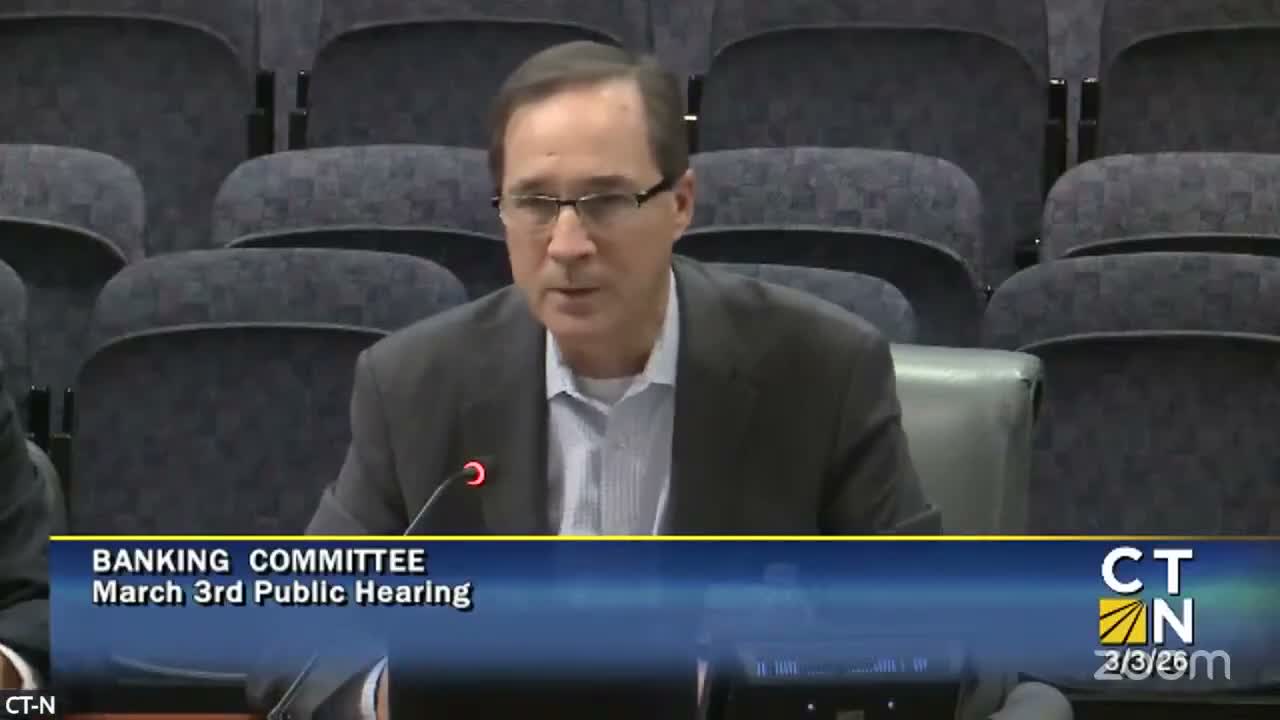
Summary
Industry witnesses told the Banking Committee they support aligning state branch approval rules with recent FDIC changes (SB 302) and backing a fraud‑prevention campaign, but they oppose mandates that would force small institutions to offer card‑issuing programs or be ready to host candidate committee accounts (SB 303, HB 5318).
Representatives of Connecticut banking and credit‑union interests told the committee they broadly back modernization to align state branch rules with recent FDIC changes but urged caution before imposing product mandates on small institutions.
Tom Mangelo of the Connecticut Bankers Association told the panel that SB 302 would synchronize state law with recent FDIC adjustments to branch applications and reduce duplicative filings while preserving the commissioner’s oversight. "It really syncs up what the FDIC has done," he said, describing the change as a modest modernization to reduce regulatory friction for opening branches.
Credit‑union witnesses said mandates for card‑issuing or candidate‑committee accounts would impose disproportionate costs on small institutions. Bruce Adams, who identified himself as a president of Connecticut credit unions, warned that onboarding a card‑issuing program can cost tens of thousands of dollars and suggested an asset‑size carve‑out; he offered $50 million as a potential threshold for relief.
Industry representatives also questioned efforts to require state‑chartered banks to offer secured credit cards and said many smaller institutions rely on third‑party issuers for card services. They argued that where similar products exist in the marketplace (fintechs, national banks) a state mandate on state‑chartered banks could be duplicative and burdensome.
Why it matters: Committee members pressed witnesses on how Community Reinvestment Act (CRA) plans relate to branch applications and whether relief for satisfactory‑rated banks would reduce a planning burden without weakening community protections. Industry witnesses said satisfactory and outstanding banks commonly do not file separate branch CRA plans and that the commissioner retains discretion and oversight.
What’s next: Legislators asked industry to supply more specific data on onboarding costs, counts of institutions without card services and options for targeted asset‑size exemptions; industry witnesses offered to follow up and work with the committee on draft language.
Ending: The hearing closed with staff and stakeholders agreeing to exchange follow‑up information on cost estimates, membership counts and proposed asset thresholds; no bill was voted on at the session.