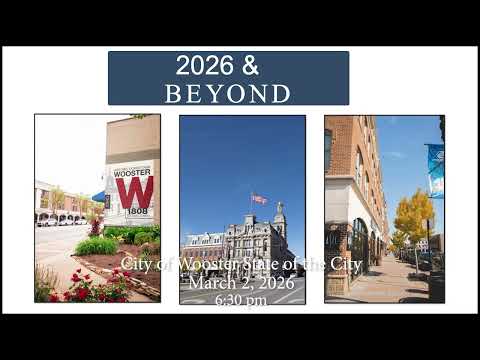
Wooster mayor highlights strong finances, housing plans and industrial site search in State of the City
Loading...
Summary
In a State of the City address the mayor said Wooster has 207 days in cash, reviewed $14.4 million in recent capital projects, outlined the Graham Farm annexation for future housing and said the city must identify new industrial sites as existing parks nears buildout.
The mayor delivered the State of the City address, reviewing the past year's accomplishments and outlining priorities for maintaining quality of life, expanding housing options and pursuing strategic economic growth.
The administration pointed to fiscal strength as a foundation for those goals, saying the city currently holds 207 days of cash on hand, up from a low of 111 days in 2010. The mayor credited voter approval of a half‑percentage point income tax increase (from 1% to 1.5%) with improving the city's ability to move from reactive repairs to proactive infrastructure investment. He also said revenues have grown at a roughly 4.3% annual compound rate over the past decade.
Infrastructure and capital work featured prominently. The mayor noted the city took delivery of a new ladder truck that cost $2,000,000 after about a 2½‑year wait, said the Geyer Chapel roundabout was 100% funded by the Ohio Department of Transportation, and described Silver Road improvements and a multi‑use path paid in part through a partial TIF tied to a Mechanicsburg residential development. He said 18 major projects collectively cost $14,400,000 and came in under budget.
On economic development, the address highlighted recent business retention successes. Officials used site availability, utility capacity and tax incentives to retain employers such as Jarrett Logistics, Wago and Worcester Brush when those companies considered locations outside Wayne County. The mayor said the city's industrial park invested north of Old Airport Road has paid off but is largely built out, and he urged joint work with the Wayne Economic Development Council to identify new sites that meet utility and access needs.
Housing and land use were central topics. The Graham Farm annexation—248 acres on the city's west side—was presented as a long‑term opportunity for residential expansion that could yield roughly 500–800 units depending on development patterns. The mayor said the city added 232 housing units over the past three years and accounted for almost 45% of new housing starts in Wayne County during the last two years. He also noted zoning amendments developed by a steering committee led by Vince Marion were unanimously approved earlier this year to provide greater flexibility for new construction.
The mayor emphasized the role of municipal utilities in farmland preservation, arguing that higher‑density development served by city water and sewer can protect outlying farmland by concentrating growth within served areas rather than on private well and septic lots.
Health care and downtown vitality were also cited as economic strengths. The mayor noted the Wayne County Hospital ER expansion opened Feb. 25 and described the downtown core as the area generating the most tax revenue per parcel, crediting CRAs and TIFs for enabling recent private investment.
He framed a key long‑term challenge as demographic change: projections presented in the address showed the workforce population falling from about 76,000 in 2023 to roughly 70,000 over 30 years and a projected nearly 25% reduction in school‑age population (ages 5–19) over 20 years. The mayor warned those shifts could increase demand on health care services and strain revenue sources that rely on income taxes.
The address closed with a preview of yearlong 250th celebrations coordinated with the Wayne County Convention & Visitors Bureau, including a Memorial Day parade on May 25 and expanded events July 3–5, and with the Great Ohio Bicycle Adventure scheduled to visit in late June.
The mayor thanked the council and attendees for their service and time. The address contained no recorded motions or formal votes.