Lifetime Citizen Portal Access — AI Briefings, Alerts & Unlimited Follows
Economic Revitalization Commission seeks council support for budget, loan fund and vacant‑lands pilots
Loading...
Summary
The commission presented its 2025 annual report and 2026 priorities, urging council support for OER’s budget, a loan fund for entrepreneurs and statutory tweaks (Bill 35 / Bill 10) to facilitate below‑market leases and pilot economic uses of vacant city lands, including Chinatown pilot concepts.
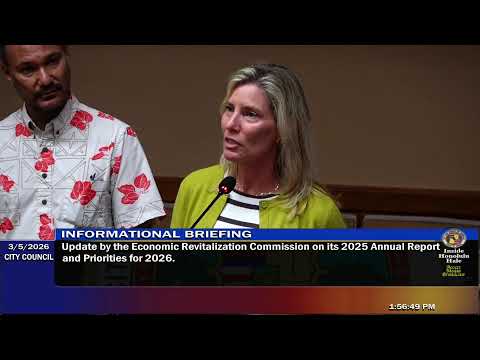
The Committee on Public Safety and Economy heard an informational briefing from the Economic Revitalization Commission (ERC) on its 2025 work and priorities for 2026. Amy Oselbay, executive director of the Office of Economic Revitalization (OER), and ERC chair Eliza Talbot and vice chair Olin Lagan described site visits, work on agriculture and food systems, entrepreneur cohorts and advocacy for local procurement and use of vacant city land.
Olin Lagan summarized 2025 activities: "In 2025, our focus was on agriculture and food systems," and described site visits (including urban farming and loʻi that help retain water during flooding) and outcomes from entrepreneur cohorts that helped several founders secure loans. Eliza Talbot said the commission is drafting a five‑year strategic plan aligned to Oʻahu’s Comprehensive Economic Development Strategy (SEDS) and emphasized priorities including inclusive communities, affordability, workforce development and resiliency.
Council members used the presentation to press for specifics on two bills referenced in the report. Councilmember Ke Aina asked for a succinct summary of Bill 35 and Bill 10 and their current status. ERC representatives explained that Bill 35 (a chapter‑38 tweak discussed at the council) is intended to give the city authority to negotiate leases at below‑market rates for nonprofits and community economic development and that Bill 10 focuses on pilot projects such as using vacant retail spaces in Chinatown. Amy Oselbay and Olin Lagan said OER is coordinating with the Department of Housing and Land Management (DHLM) and other departments but council members urged closer, district‑level coordination and requested a public list of vacant parcels. Councilmembers suggested starting with one or two pilot parcels and working closely with council offices while the bills move through the legislative process.
OER asked for council support on three items: OER’s budget, paving the way for development opportunities on vacant city land (statutory changes or pilots), and city funds for a loan fund to support local entrepreneurs. The commission framed AI and workforce development as crosscutting priorities for 2026.
Next steps: OER and ERC will continue coordination with DHLM and other departments and pursue pilots where allowable under current authority while advocating for statutory changes; council members signaled interest but asked for more detailed, district‑level engagement and a transparent list of vacant city properties.