
Seattle officials warn city is approaching state property-tax levy limit, urge 10% buffer
Get AI-powered insights, summaries, and transcripts
Subscribe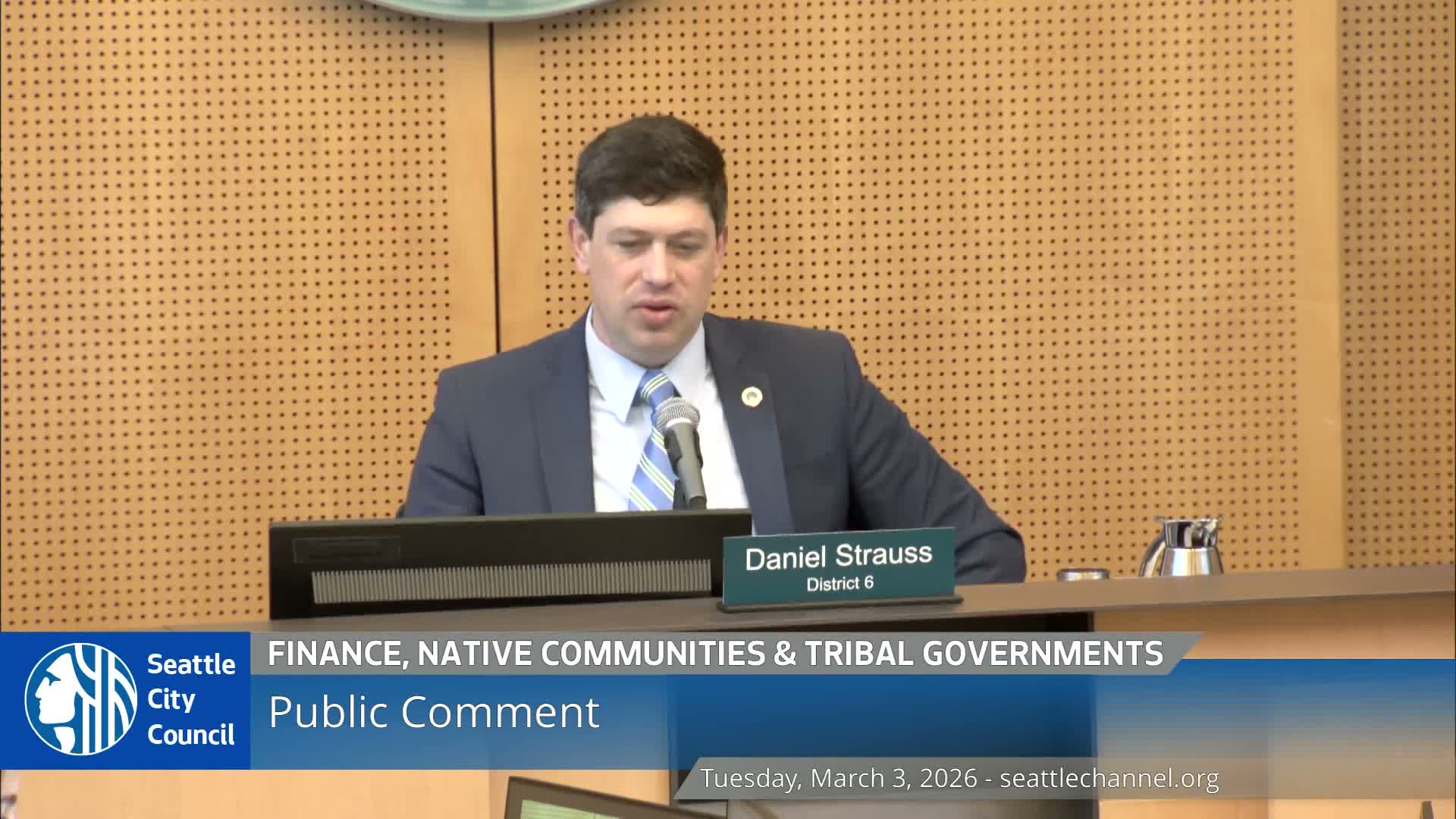
Summary
City budget staff told the council the city's regular property-tax levy is nearing Washington's $3.60-per-$1,000 legal cap and presented a model showing roughly $780 million in remaining levy capacity over seven years; staff recommended a 10% capacity reserve and offered follow-up analyses of lower growth scenarios and county levies.
Seattle budget officials told the Council's Finance, Native Communities and Tribal Governments Committee on March 3 that the city is approaching the legal ceiling on its regular property-tax levy and urged caution before advancing new levy proposals.
"State law limits us to $3.60 per $1,000 of assessed value for our city's regular levy," said Joe Russell of the City Budget Office, explaining the statutory ceiling and how voter-approved "lid lifts" interact with the cap. Russell and other staff said volatility in assessed value (AV) is the principal risk to levy capacity because AV determines the tax rate in the formula the Department of Revenue uses.
Alex Zang of the City Budget Office told the committee the office modeled several scenarios and found "a remaining levy capacity of approximately $780,000,000 over the next seven years," an average of about $111 million per year under a conservative 3% AV-growth assumption. Zang and colleagues warned that the number depends on assumptions about levy renewals and AV, and that a renewal of the library levy could use a large share of that capacity.
Why it matters: the regular levy funds general city services and is subject to a state-imposed rate cap; when the city approaches that ceiling, a sudden AV decline can push the tax rate higher and force proration or cuts to levies. Staff recommended keeping a capacity reserve to reduce the risk that a downturn would require reductions to existing, voter-approved levies.
The staff recommendation and caveats
City staff recommended building a 10% capacity reserve into modeling to buffer against large AV declines. "We recommend a capacity reserve of 10% based on the largest decline experienced during the financial crisis," Zang said, noting the figure is a policy choice tied to the city's risk tolerance. Staff offered to run a parallel analysis using a 2% AV-growth assumption after Councilmember Strauss asked how sensitive the capacity figures would be to a lower growth rate.
Committee members pressed staff on several practical points: how proration works under Department of Revenue rules, the order in which levies or special districts would be affected, and the interaction between city levies and county or special-district levies that also appear on Seattle homeowners' bills. Dwight Dively, acting city finance director, explained that state proration rules rank levies and that some special districts are hit earlier in that sequence.
Council reaction and next steps
Councilmembers asked staff to provide supplemental materials, including a 2%-growth scenario, a list of King County and other district levies that affect Seattle residents, and an example homeowner's tax bill showing combined levy impacts. Several members urged fiscal caution: Councilmember Rivera stressed not using the modeled capacity in full and maintaining reserves to avoid cutting services if AV drops, while Councilmember Sacca urged state-level relief from the 1% statutory growth constraint.
What the briefing did not decide
The meeting was a briefing and included no votes. Staff emphasized their modeling assumptions and that levy renewals are policy choices the council will make later. If AV falls sharply or the city exceeds statutory limits, the city would face legally required reductions or a political choice of where to prioritize cuts.
The committee will receive follow-up material and further briefings; staff said they will return with a 2% analysis and examples to illustrate household impacts.