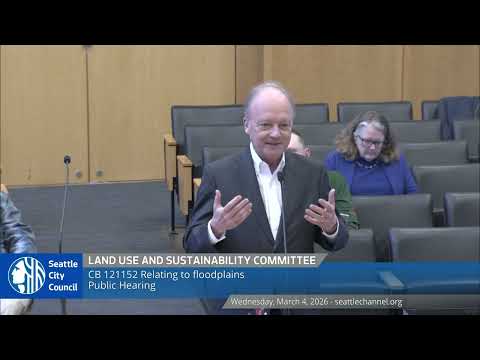
Seattle committee holds public hearing on permanent FEMA floodplain rules, delays vote
Loading...
Summary
The Land Use & Sustainability Committee heard public testimony and staff briefings on Council Bill 121152 to adopt permanent floodplain development rules aligned with FEMA maps; staff said more modeling is needed for some waterfront piers and the committee declined to suspend the rules for a same-day vote, scheduling further work and return to committee.
The Seattle City Council Land Use & Sustainability Committee on March 4, 2026 opened a public hearing on Council Bill 121152, a proposal to adopt permanent floodplain development regulations to align Seattle code with Federal Emergency Management Agency (FEMA) flood insurance rate maps. The committee heard two in-person public speakers and extensive staff explanation of mapping, modeling and next steps, but did not vote.
The matter matters because the city must remain in the National Flood Insurance Program (NFIP) for property owners to access federally backed flood insurance; staff warned that falling out of compliance could end that access. Jack McCullough, speaking for owners of historic waterfront piers, said the existing FEMA/King County mapping places those piers in VE (velocity) zones and that more detailed modeling could exclude the structures from VE designations.
"It's odd that I'm here on behalf of the piers because they really shouldn't even be in the flood plain," McCullough said, adding that the piers are landmark structures that face large maintenance costs — including replacement of creosote pilings that could run into "tens and tens of millions" of dollars — and asked the committee to hold the ordinance to allow a near-term meeting between pier owners and regulators to resolve last-minute drafting issues.
SDCI environmental planner Maggie Glowocki told the committee FEMA produces flood insurance rate maps and that coastal and intertidal areas (the Duwamish River and Elliott Bay were cited) are commonly designated flood zones. She said the city can commission more detailed modeling that incorporates pier geometry (pile count, height, structural footprint) and that such modeling could change VE-zone designations, but it is not immediate: it would require public solicitation of bids, time to gather structural data from owners, and FEMA review.
"FEMA is the agency that needs to map those areas," Glowocki said. "We've met with the pier owners and explained how permits will be reviewed as well as the historic piers. They are exempt from substantial improvement as long as they keep their historic designation. There are paths forward, but it isn't an overnight process."
Keto Freeman of council central staff emphasized the city's limited authority over flood insurance rate maps and pointed to near-term options for property owners, such as seeking a Letter of Map Amendment or Letter of Map Revision from FEMA. Freeman and Glowocki also said staff identified a drafting issue in the bill's definition of "substantial improvement," which Amendment 1 (sponsored by Chair Eddie Lynn) corrects by clarifying that required work to remedy code violations and approved Landmarks Board alterations are not subject to that definition.
Several council members said they were concerned about approving permanent regulations the same day as the public hearing given the long history of interim extensions (staff noted the city has used interim regulations and extensions for about six and a half years). Some members urged delaying final action to allow staff to resolve drafting language and complete outreach; others stressed urgency to avoid risking NFIP participation. Staff said the current interim regulations remain in effect and the committee is within the interim window, giving time to return with clarified language and any additional modeling results.
Chair Eddie Lynn said he would not move to suspend the rules to force a same-day vote; members agreed to continue work with staff and stakeholders and bring the ordinance back to committee on a future date. Staff noted that any changes to the code will ultimately require FEMA review for NFIP compliance.
Next steps: SDCI will continue to work with pier owners, the Landmarks Board and federal FEMA staff on modeling and interpretive guidance; Amendment 1 will correct the drafting error about "substantial improvement;" and the committee will revisit Council Bill 121152 at a future meeting to allow time for additional technical work and stakeholder meetings.