
Mayor’s office and OIRA outline $4 million plan, city readiness and signage to respond to federal immigration activity
Get AI-powered insights, summaries, and transcripts
Subscribe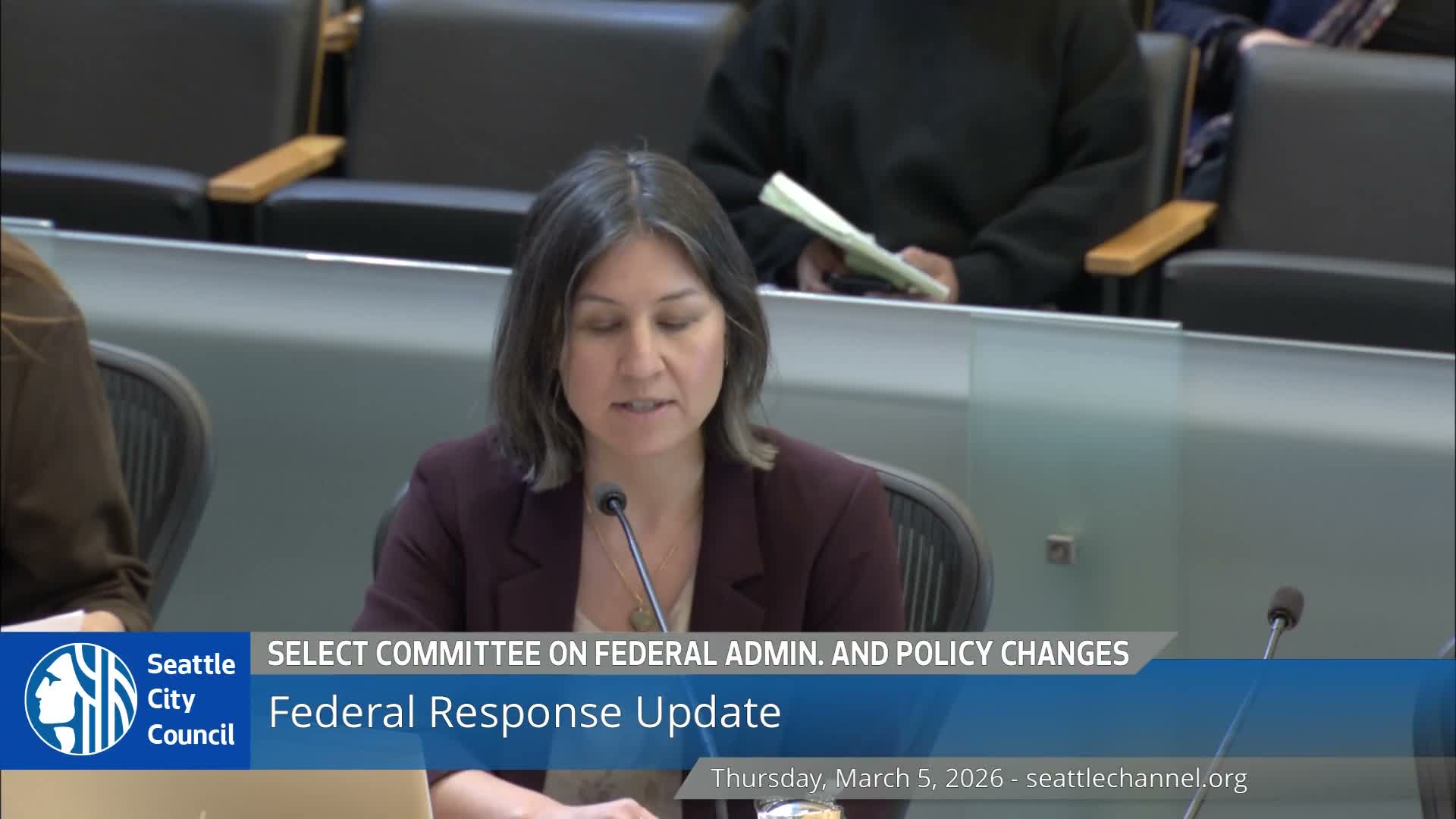
Summary
City officials described a multipronged response to increased federal immigration enforcement: a mayoral directive and executive order, more than 650 'Stand Together' signs on city property, department data/privacy reviews, and a $4,000,000 OIRA spend plan prioritizing removal-defense legal aid, family safety planning and basic-needs support.
City officials briefed the select committee March 5 on Seattle’s planning and early implementation steps to support immigrant and refugee communities in the face of increased federal immigration enforcement.
Deputy Chief of Staff Kelsey Mescher summarized the city’s approach: federal and state policy developments are changing rapidly, but the mayor’s team has issued a January 29 directive reaffirming Seattle as a welcoming city and an executive order that prohibits federal immigration enforcement from staging operations on city-owned or -controlled property. Mescher said departments were asked to complete data and privacy reviews in partnership with the City Attorney’s Office and that the city has installed more than 650 Stand Together Seattle signs on city-owned sites to communicate policy and resources.
Anne Maher of the Office of Intergovernmental Relations reviewed the federal and state landscape, noting that while many appropriations bills passed to avoid a full shutdown, the Department of Homeland Security appropriations remained unresolved and that HR 1 included a large immigration funding package. Maher said the city is monitoring deployments of federal agents and learning from other cities’ responses.
Director Ku (Dr. Vu) with the Office of Immigrant and Refugee Affairs described community input gathered to shape how the $4,000,000 in OIRA funding could be used. Community priorities included legal services for removal defense, family safety planning, emergency basic-needs assistance (food, rental support, towing or impound fees), and support for naturalization, ESL, and workforce programs. Vu emphasized coordination with county and state partners and with nonprofit legal providers to ensure continuity of representation and to stretch limited resources.
Council members asked about the scale and duration of federal funding and how city resources could best complement county, state and philanthropic support. Council member Lynn raised questions about logistics for basic-needs distribution and whether public-private partnerships were being explored. City staff said they are exploring partnerships, following examples from other cities, and will provide more detailed spend-plan information in a future committee meeting.
Mescher said the mayor’s office has also produced a compliance and readiness training video for city staff and asked departments to designate representatives for federal-activity reporting; training is currently voluntary but widely used. OIRA said it is developing neighborhood-level grant approaches, rapid response coordination, and language-access outreach to wrap supports around impacted communities.
The committee thanked the presenters and asked staff to return with further details about the $4,000,000 spend plan and how the city will coordinate with county and state investments.