
Voorhees district meets overall state accountability targets but flags persistent subgroup gaps
Get AI-powered insights, summaries, and transcripts
Subscribe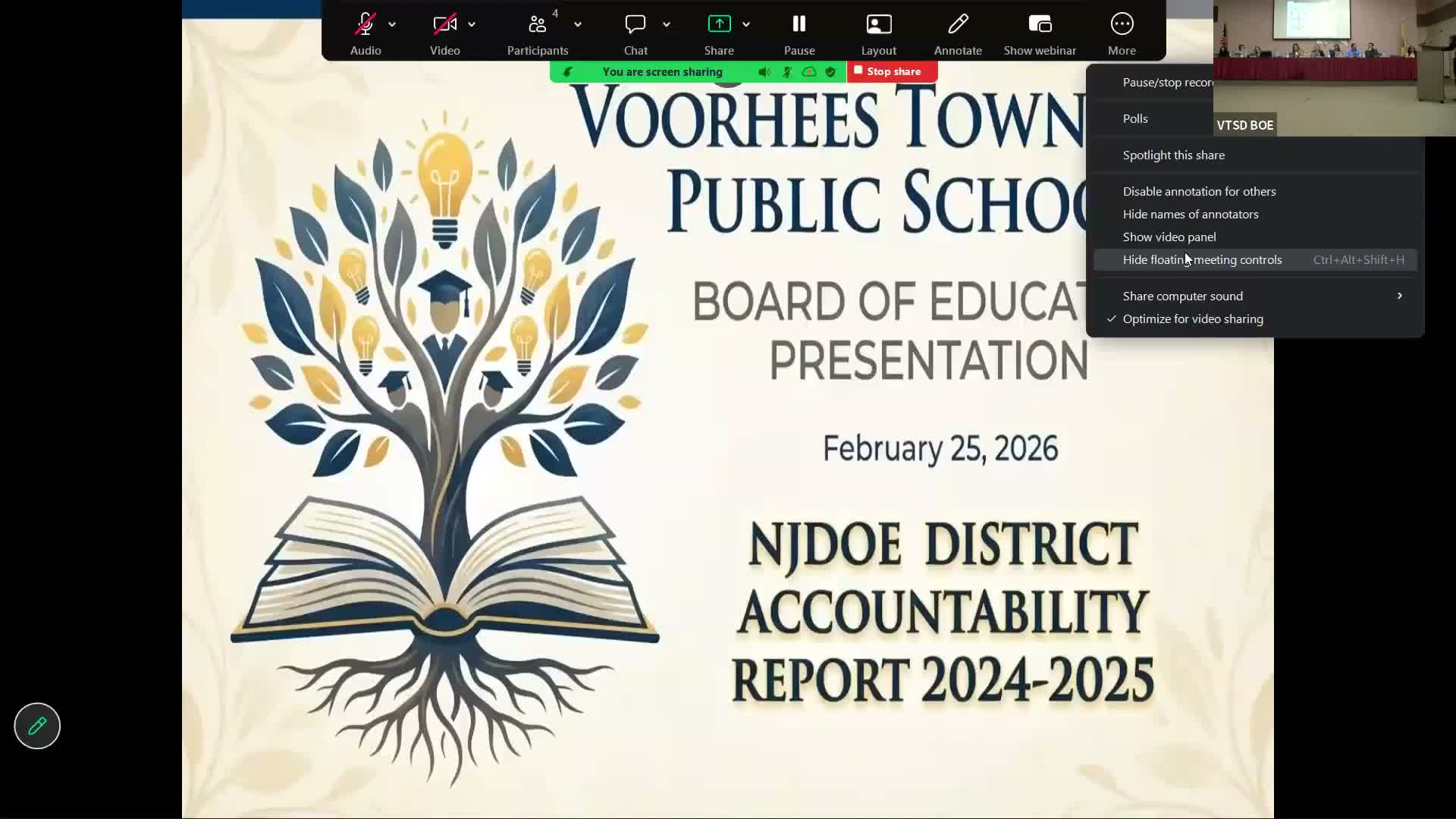
Summary
The Voorhees Township School District reported districtwide gains — including lower chronic absenteeism and meeting overall ELA and math benchmarks — while officials said several subgroups (special education, multilingual learners and some racial subgroups) still lag and will receive targeted interventions.
The Voorhees Township School District reported overall improvement on the state accountability measures but warned that several student subgroups remain below target, Superintendent Doctor Hackett said.
“We met it as overall populations for our district,” Doctor Hackett said, summarizing the New Jersey Department of Education accountability report. He outlined the three prongs the state uses to judge districts: chronic absenteeism, progress measured by median student growth percentile (MSGP), and proficiency as measured by the NJSLA.
The superintendent said chronic absenteeism fell at most schools; Signal Hill posted a notable decline and the middle school showed a 3.6-point reduction. The districtwide chronic-absence rate remains below the state rate of 13.2%, he said, and only Voorhees Middle School currently requires a state improvement plan at 10.5%.
Hackett acknowledged uneven results among historically disadvantaged groups. “Economic disadvantage, multilingual, and special education kind of appeared multiple times across those schools,” he said, and the district will target additional resources — including focused instructional supports, benchmark-assessment standardization and professional development — at schools and subgroups that missed progress or proficiency targets.
The superintendent explained MSGP with a classroom demonstration and said MSGP is used, alongside other indicators, in teacher evaluations: “SGP is individual students. MSGP is what the teacher gets, and that's part of the teacher's evaluation.”
District leaders also described interventions aimed at improving attendance and progress: intermittent home instruction for students with chronic but nonconsecutive health needs, mentor programs at the middle school, reward-based attendance incentives and coordination with outside agencies for family supports.
Next steps: the administration will use subgroup data to reallocate resources where needed, continue professional development on the science of reading and report further updates on targeted interventions at future meetings.