Get Full Government Meeting Transcripts, Videos, & Alerts Forever!
Get email alerts on the Land Use topic
No spam. Unsubscribe anytime.
Council hears first presentation on 'at‑risk' grading permit ordinance tied to state law; staff to return in two weeks
Summary
Staff presented a proposed Title 15.6 at‑risk grading permit ordinance prompted by state bill HB 2447, including new language requiring restoration if projects are not completed, limits on grading over easements without owner permission, bond call and 30‑day restoration timeline; council provided direction and staff will return with final language in two weeks.
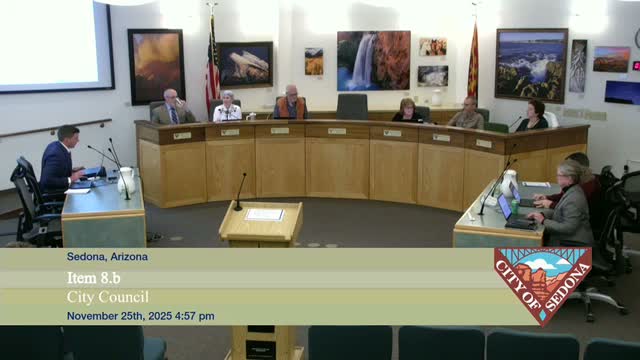
Sedona staff presented an initial draft ordinance to establish an at‑risk grading permit program required by recent state legislation (HB 2447). The council treated the session as the first public meeting on the ordinance and gave staff direction to return with final edits in two weeks.
Staff explained the city historically allowed "at‑risk" grading on an informal basis and the proposed codification clarifies requirements for developers seeking an early start on grading. Key additions discussed include a purpose paragraph explicitly stating that failure to complete the project will require restoration of the property, a clarification that the at‑risk permit would remain in effect until issuance of construction permits or at least 60 days thereafter, and a revocation clause allowing the city to call a bond and require restoration within 30 days.
Councillors asked how environmental and archaeological reviews are handled; staff said those reviews must be completed in advance or be part of the development review process before an applicant may apply for the at‑risk permit. Councilor Kinsella raised whether bonding could cover amenities (private improvements such as shade structures or pools); staff said the at‑risk permit is limited to grading prior to construction and that requiring a bond for amenities would more likely be applied at subdivision or construction phases, but staff would research options.
Councilor Hosseini asked whether the city had used at‑risk permits previously; staff said they had been used informally but not always for every scenario described in the draft. Staff emphasized they had met with public‑works staff and would complete a final review and return to the council in two weeks, likely as a consent item unless an objection is raised.
No vote was taken; council provided direction and asked staff to finalize language addressing easement permissions, restoration requirements and bond procedures before the next meeting.