Get Full Government Meeting Transcripts, Videos, & Alerts Forever!
Get email alerts on the Student Financial Aid topic
No spam. Unsubscribe anytime.
KIA: FAFSA changes have driven a sharp rise in student aid demand, straining lottery-funded programs
Summary
KIA officials told the Budget Review Subcommittee that federal FAFSA methodology changes have increased eligible students and pushed state need‑based programs toward funding shortfalls, and they signaled requests for growth funding for dual credit and other scholarships.
Jo Carol Ellis, executive director of KIA, told the Budget Review Subcommittee on Education that the agency is seeing a substantial and sustained increase in demand for state student aid after the recent federal FAFSA methodology change.
"We entered a new era of student aid eligibility in fiscal year 25 with changes made to the federal methodology...resulting in a major increase in eligible students," Ellis said, and she thanked the General Assembly for additional one‑time appropriations that helped KIA run the award cycle more fully this year.
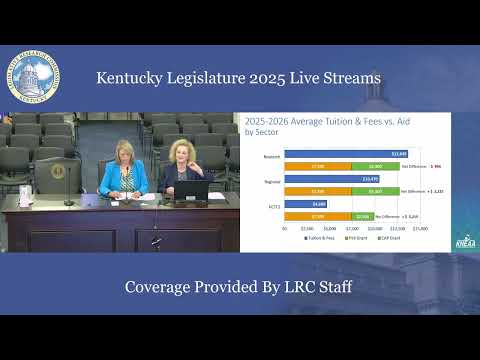
Becky Gilpatrick, KIA's director of student aid, said the FAFSA Simplification Act implementation produced a large rise in Pell‑eligible students and related CAP (College Access Program) applicants. KIA reported that CAP recipients rose from about 55,000 to 72,000 and that the agency disbursed roughly $232 million in the past year for need‑based grants.
"Of that $214,000,000, there is a $148,900,000 of it that was restricted fund pulled from the excess lottery," Gilpatrick said, noting concern that excess lottery revenues are declining. She said KIA continues awarding grants but that future funding choices will be difficult for the next biennial budget cycle.
Committee members asked how KIA distinguishes applicants from actual recipients. "KIA determines initial eligibility based on application data, and then the schools actually determine final eligibility for the program," Gilpatrick said, explaining some applicants do not become recipients after school verification.
Gilpatrick also described trade‑offs KIA faces when setting award maximums: a higher award increases per‑recipient cost and can shorten how far available funds reach into the application cycle, while a lower award can prolong award availability but reduce per‑student support.
Dual credit scholarships were a particular budget pressure. KIA said the dual credit program was consolidated this session and that dual credit spending rose from about $23.6 million (FY24) to $26.4 million (FY25) despite a $13.1 million appropriation; KIA transferred funds from the WorkReady program to fully fund dual credit this year and plans to request growth funding to meet continuing demand.
On projections, KIA cautioned uncertainty. Gilpatrick said cumulative FAFSA filers could approach 200,000 by year end, and that clearer budget impacts will be visible once award funds "go out the door" and institutions report actual enrollment and utilization later in the fall.
KIA also reviewed other scholarship programs funded by lottery proceeds, including the Kentucky Tuition Grant, the KEYS program, the National Guard Tuition Award (about $7.4 million appropriation), teacher scholarship programs, early childhood development scholarships, a teacher recruitment loan program (forgivable with service requirements), and a student‑teacher stipend returning to a statutory $5,000 maximum.
KIA urged the committee to consider that one‑time excess lottery reserves helped in the current biennium but warned those reserves are being depleted, which will complicate decisions on sustaining need‑based aid and accommodating the larger eligible population going forward.