
Support grows for bill to allow owner‑occupied long‑term room rentals in single‑family homes
Get AI-powered insights, summaries, and transcripts
Subscribe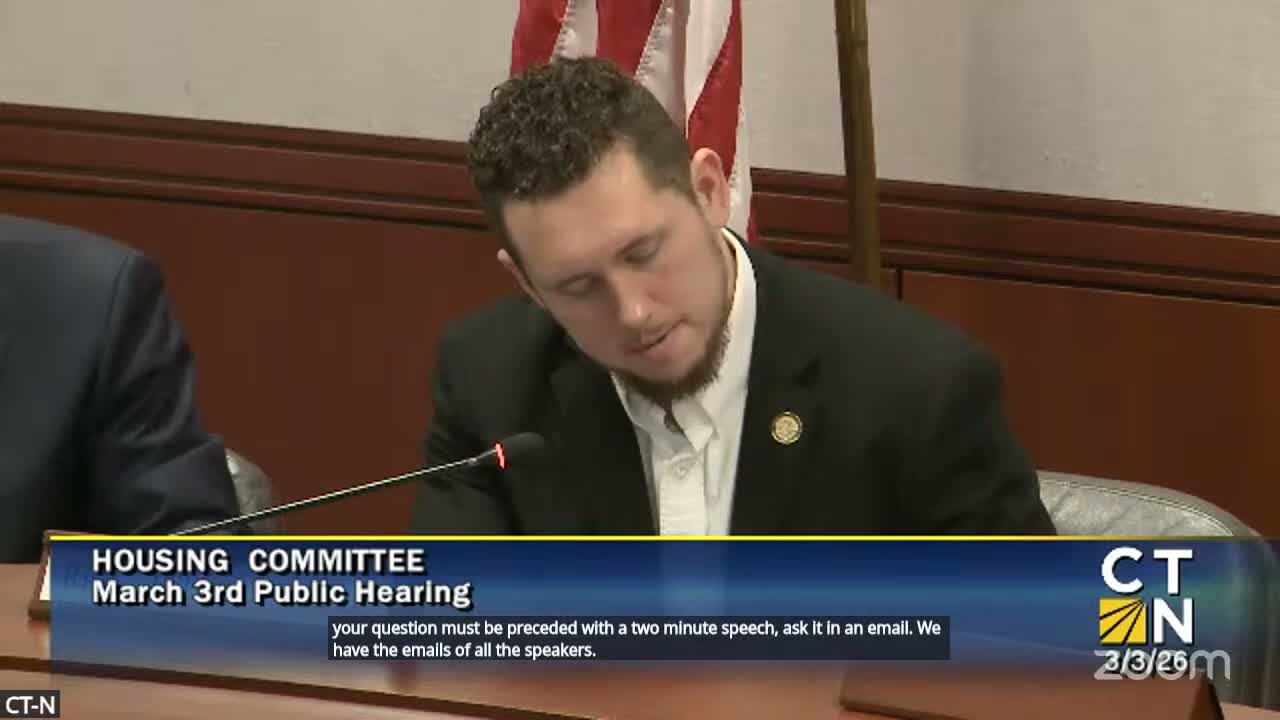
Summary
Witnesses at the Housing Committee hearing backed SB 339, which would let owner-occupants rent up to three bedrooms long term without special local approvals. Supporters said it frees unused capacity and helps seniors and renters; opponents urged maintaining safety and eviction clarity.
Proponents of SB 339 told the General Assembly’s Housing Committee that the bipartisan bill would unlock underused housing capacity by allowing owner‑occupants to rent up to three bedrooms in a single‑family home as of right.
"This bill will unlock unused bedrooms currently sitting empty across our state," said Nick Kanter (S3), program director of Pro Homes Connecticut, who urged the committee to approve the measure. Kanter said the proposal would help seniors on fixed incomes supplement income and provide more affordable choices without public subsidies, while keeping building, fire and health codes in force.
Committee members pressed proponents on details. Representative Corvus (S4) asked how lawmakers chose three bedrooms; Kanter said three made the economics feasible after reviewing other towns and that regulating by bedrooms ties the rule to building codes that define room capacity. Representative Johnson (S6) asked about fire and egress; Kanter replied that existing safety standards remain enforceable.
Several housing advocates, municipal planners and civil‑liberties groups also testified in support. "Shared housing can help seniors age in place and help young workers afford housing in high‑opportunity neighborhoods," Samuel Hooper (S12) of the Institute for Justice said, adding that the bill leaves health and safety rules intact.
Local planners and elected officials urged a measured approach that balances uniform statewide rules with municipal implementation. Pete Harrison (S25) of the Regional Plan Association suggested a Department of Housing model lease rider addressing shared areas (kitchens, driveways) and clearer statutory language to ensure zoning exemptions are explicit. Greenwich Planning & Zoning Chair Margarita Alban (S45) said her town allows boarding and suggested letting towns decide specific limits, though she did not oppose the idea of enabling shared housing broadly.
Opponents and some members pressed the committee about eviction logistics when occupants live in an owner‑occupied home. "It is a different—and potentially tense—situation to remove someone who is living in your house," Representative Scott (S17) commented during the hearing. Supporters responded that formalizing these arrangements and providing a simple model lease would take many occurrences out of an informal, potentially unsafe gray area and improve notice and safety.
The hearing produced bipartisan interest in SB 339 and multiple requests for clarifying language: recordkeepers suggested explicitly preserving building and fire code enforcement, adding a DOH model lease or rider, and clarifying that eviction and tenant‑protections rules applicable to small owner‑occupied arrangements remain in effect. The committee did not take a final vote during this session; the measure remains under consideration.