
DCF commissioner backs kinship, dashboard in child-welfare bill; lawmakers press school-withdrawal concerns
Get AI-powered insights, summaries, and transcripts
Subscribe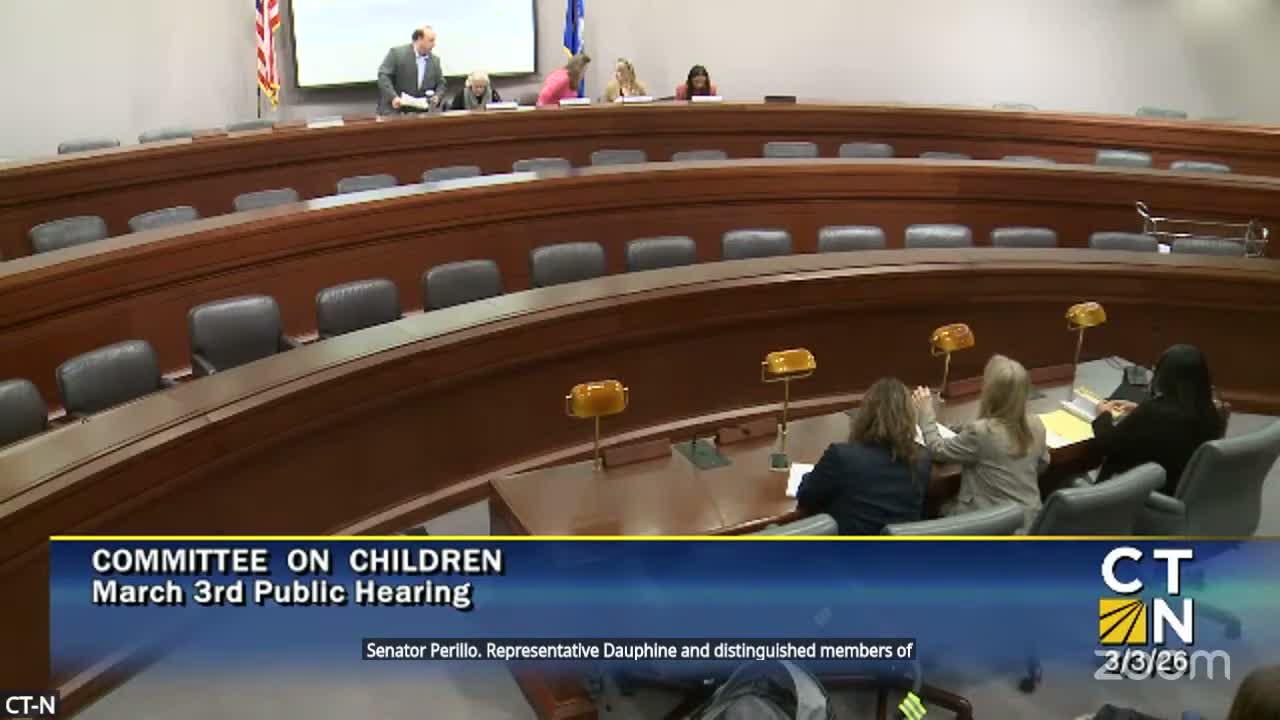
Summary
Susan Hamilton, interim commissioner of the Department of Children and Families, testified in support of House Bill 5004's kinship and transparency provisions while warning of funding gaps and duplicative oversight; legislators questioned a related proposal to notify DCF when students withdraw from school, calling it a potential 'witch hunt.'
Susan Hamilton, interim commissioner of the Department of Children and Families, told the Committee on Children that House Bill 5004 would advance kinship placement and public transparency but that parts of the proposal require clarification and funding.
"Our care line receives nearly 84,000 calls annually, including 64,000 last year neglect and abuse reports," Hamilton said, citing DCF caseload figures and urging a focus on diversion, reunification and permanency. She told lawmakers the department has about 12,000 open cases at any given time, roughly 8,000 families served with in-home supports, and just under 3,000 children in foster care, with more than half placed with relatives or fictive kin.
Hamilton said sections 1, 2 and 21 of the bill align with department priorities by expanding placement with relatives and fictive kin and moving licensing and practice toward national standards. She described sections 10 and 11 as an expansion of post-majority services — the bill would mandate supports to age 23 — but cautioned that the expansion is not included in the governor's current budget.
On transparency, Hamilton said sections 12 and 13 would create a public data dashboard. "We support that," she told the committee, but warned that placing the dashboard on a separate site could confuse the public; DCF prefers a single, public-facing location for data access.
Hamilton also urged the committee to reconsider section 20, which would create another oversight committee. She said DCF already participates in multiple oversight and advisory structures — federal monitoring, the statewide advisory council (including members with lived experience), behavioral health and juvenile-justice bodies — and described the proposed panel as potentially duplicative.
Lawmakers pressed DCF staff on several operational details.
Representative Paris asked whether a single body now exists with end-to-end responsibility for systemwide child-protection oversight; Hamilton answered that statutory responsibility for the mission rests with the DCF commissioner while acknowledging the committee's intent to create centralized, data-driven accountability.
Representative McGee asked about Section 9's cultural-sensitivity training and racial-disproportionality data. Hamilton and Deputy Commissioner Tina Jefferson said much of the training is part of preservice requirements and that DCF tracks decision points across referrals, entries into care and reunification timelines; DCF said it can provide trend data and external reviews of its racial-justice efforts.
A separate but related concern focused on a provision in Senate Bill 6 (section 5) that would require the State Department of Education to notify DCF when a child withdraws from public school. Representative Mastro Francesco described the notification idea as risky and repeatedly warned it could create a "witch hunt" targeting families who homeschool or otherwise withdraw children for innocent reasons.
"It's not a report of alleged neglect or abuse. It's a notification," Hamilton replied, explaining that, as drafted, the notice would prompt DCF to check whether an open case already exists and would not itself create a new case or mandatory follow-up. Hamilton and other DCF staff recommended adding clarifying language to specify how notifications should be handled and whether records should be retained or destroyed when no open case exists.
Representative Lanou pressed operational questions about how DCF would match names, whether districts and DCF could instead exchange lists of children already under protective supervision, and what would happen to notifications that return a "no find." Hamilton acknowledged the need for statutory clarity and raised data-sharing and resource constraints that agencies would face if large volumes of notifications were transmitted.
Committee members also asked about workforce supports. Hamilton said DCF has piloted personal safety devices for field staff and described positive pilot results; Stacy Gerber, a deputy commissioner, said federal HHS approval now allows the state to claim a 50% reimbursement on those devices, reducing net state cost for wider deployment.
The committee recessed the public hearing after more than an hour of testimony; the chair said the hearing will resume online and invited those who signed up to speak to return remotely.
Next steps: DCF committed to provide requested data on training and racial-disproportionality trends, to refine statutory language on kinship licensing (section 21) and to recommend clarifications for school-withdrawal notifications and dashboard hosting before further action by the legislature.