
Erie City SD officials flag chronic absenteeism, rising behavior incidents and racial disproportionality
Get AI-powered insights, summaries, and transcripts
Subscribe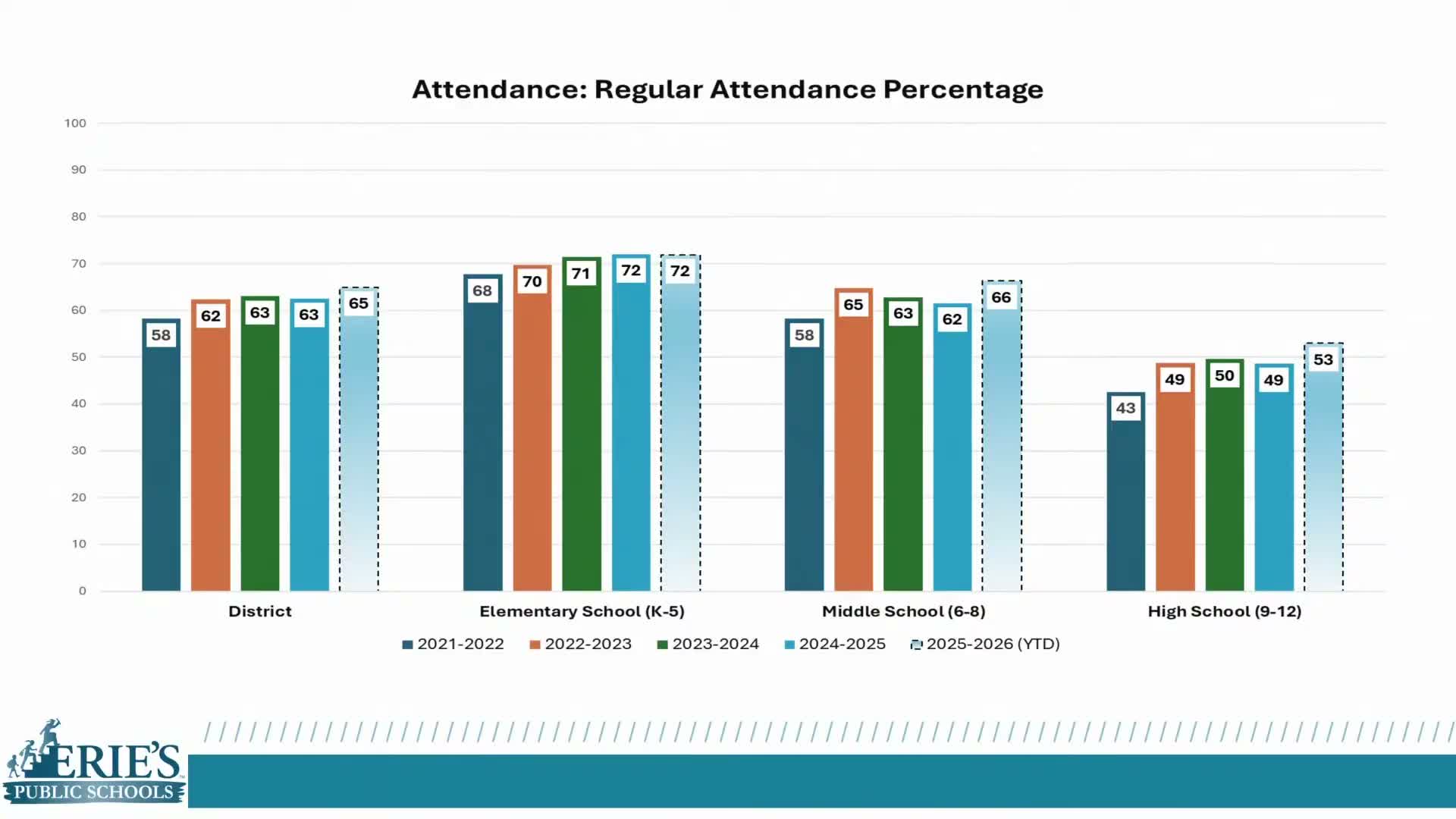
Summary
Administrators told the board that attendance has lagged for five years and behavior incidents — including suspensions and assaults — have risen, especially in secondary grades; the district is asking for system changes, PBIS refreshers and better data to target interventions.
Erie City School District administrators on Tuesday told the board of directors’ committee of the whole that nonacademic indicators — especially chronic absenteeism, out‑of‑school suspensions and behavior incidents — have trended poorly over the past five years and that the district will pursue system changes to address them.
“Our outcomes are not where they need to be. I own that reality,” Superintendent Dr. Gibbs told the board as she introduced a data review that covered attendance, discipline, disproportionality and supports. She urged the board to set clearer expectations and to align the strategic plan and budget with measurable interventions.
Administrators presented five years of district data, year‑to‑date through Feb. 23, and said elementary attendance has generally hovered around 70% (students present 90%+ of days) while high‑school regular attendance averaged about 48% across the period shown. The district also reported an increase in out‑of‑school suspensions, behavior incidents such as assaults and unauthorized‑substance incidents, and growing disparities for Black and Hispanic subgroups.
Board members asked for additional, comparable time‑point reports (for example, February vs. February in prior years), counts of unique students behind suspension totals and root‑cause analysis that separates reporting changes from real increases in incidents. “There’s got to be an alternative to suspending elementary school kids,” one member said, urging expansion of in‑school suspension or other restorative options.
Administrators and board members discussed multiple potential drivers: pandemic‑era shifts in attendance and behavior nationwide, increases in reporting or enforcement at the secondary level, high suspension counts that affect recorded attendance, student mobility (students entering or leaving midyear) and the need for more consistent data entry in Infinite Campus.
The presentation flagged several near‑term actions under consideration: refresh districtwide PBIS (positive behavioral interventions and supports) implementation; improve MTSS (multi‑tiered systems of support) training and fidelity; expand professional development on classroom management and restorative practices; standardize incident reporting across schools; and evaluate alternative‑education programs and IEP compliance.
Administrators said the district has recently rebuilt student‑services capacity after staffing gaps earlier in the decade and that behavior‑intervention staffing has expanded (the district said it moved many contracted positions in‑house in recent years). The board requested that administration return with clearer, normalized visuals and cross‑tabbed reports by race, gender, special‑education status and mobility so the district can target interventions.
The board and administration did not take any formal votes during the session on discipline policy; administrators said they will include requested analyses and options in upcoming reports and in strategic‑plan recommendations.