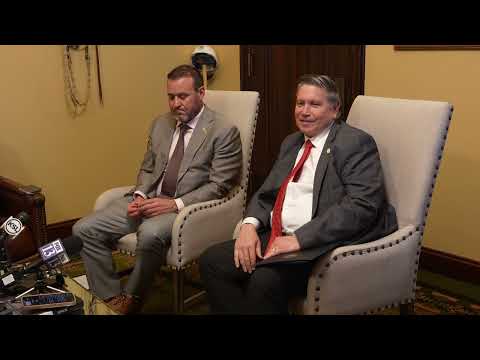
House chair frames homelessness funding as partnership, ties state support to local match and accountability
Loading...
Summary
House leadership said the budget ties homelessness funding to local participation and focused on enforcement for repeat offenders; staff and members said the nicotine-tax revenue could help but its amount and form remain subject to Senate changes.
When asked about homelessness funding, the House chair described a new approach that conditions parts of state funding on local-government participation and emphasized holding repeat offenders accountable.
“It is a new approach that we're taking, with, our partners, our local partners,” the chair said, adding that the state does not want to simply take over local problems and that cities and counties must "step up and do their part." The chair said the budget’s intent language includes a 1-to-1 local-match requirement for some homelessness funds as referenced by a questioner.
The chair also described enforcement concerns. “Our understanding is that there's, roughly 1000, homeless, people that are caught. And the average is being caught for 27 crimes,” the chair said, framing repeat offending as a driver of the "revolving door" that frustrates accountability. The chair characterized the approach as pairing accountability with resources for those who want help, and said targeted sanctions and criminal accountability may be part of the response for repeat offenders.
On funding sources, the chair said a nicotine tax (referred to in the briefing as the "zen tax") would add roughly $40 million to the budget and could fund homelessness efforts and public-safety items but cautioned the Senate might alter its size or provisions.
What was stated vs. what is not yet verified - The figures the chair cited ("roughly 1,000" people and an "average" of 27 crimes) were presented as the chair's understanding and were not accompanied by a cited source in the briefing; the article reports these numbers as stated by the chair and notes they are not independently verified in the session. - The nicotine-tax revenue estimate ($40 million) was mentioned by the chair as a budget-level figure but described as subject to Senate changes.
Next steps Legislative staff are processing fiscal notes and the House expects continued discussion as bills move to the Senate; details of match requirements and enforcement mechanisms will depend on final bill text and appropriations.