
Judge continues Price bond hearing, sentences Damonte Williams to six years’ deferred adjudication
Get AI-powered insights, summaries, and transcripts
Subscribe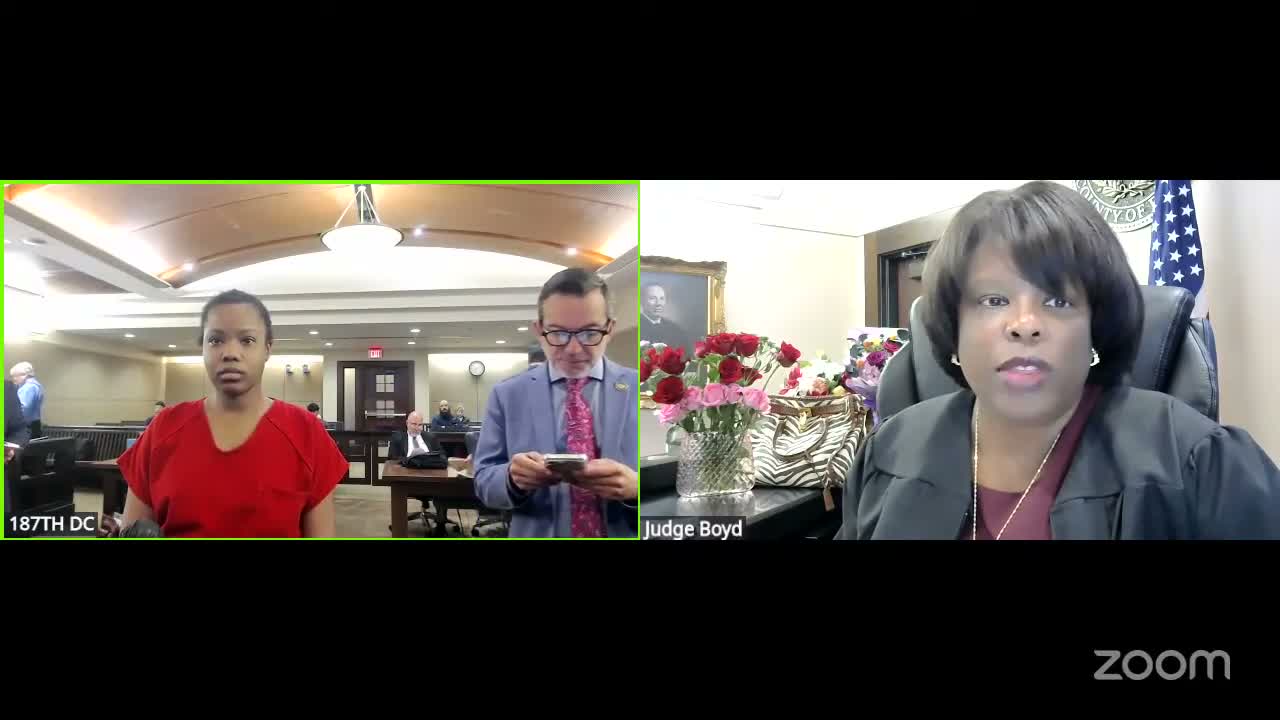
Summary
At a Bexar County criminal docket on March 7, the presiding judge continued a bond-reduction hearing for Courtney Price for lack of evidence about an affordable bond amount and accepted a plea for Damonte Williams, granting six years of deferred adjudication with restitution and multiple probation conditions.
A judge at a Bexar County criminal docket on March 7 continued a bond-reduction hearing for Courtney Price and accepted a plea that resulted in six years of deferred adjudication for Damonte Williams.
The court called State v. Courtney Price and heard argument on whether Price’s bonds should be reduced. The judge told the defendant that the hearing is limited to the question of an affordable bond amount and warned that discussing the facts of the case would allow the state to cross-examine. The judge said she did not have evidence of an amount Price or her family could pay and offered to recall the matter on Monday to allow the defense to submit proof or have a bondsman and witnesses appear by Zoom. The judge described that option as the path to produce a basis for any reduction rather than ruling on the motion that day.
The most significant outcome of the docket involved Damonte Williams, who had entered a plea earlier in the proceeding. The court reviewed the PSI and heard live testimony from character witnesses, including Williams’s former coach and his partner. The judge discussed Williams’s medical records and brain-injury history with counsel.
“I can find you guilty, and I'll sentence you to 2 years in the prison,” the judge told Williams, offering instead the plea-based option: “I'll grant your application for deferred adjudication, and I will have you on deferred adjudication for 6 years.” Williams said he understood and accepted the court’s offer. He later told the court, “I did wrong, your honor,” and expressed remorse.
Under the court’s order, Williams will serve six years of deferred adjudication, with an affirmative finding that a deadly weapon was used. The judge ordered restitution payments of $964 to Joshua Evans and $2,000 to Sebastian Granados, regular reporting by Zoom or in person, regular random drug testing, intensive outpatient treatment, 200 hours of community service with portions creditable for completed parenting and rehabilitation courses, anger‑management or hostility-aggression classes, monthly field visits for an initial period, and a prohibition on possession of firearms. The court also directed that Williams not work in positions where the majority of the business is alcohol sales (effectively barring security‑guard work) and required proof of employment within 45 days of release where applicable.
Other matters on the docket included pleas and dispositions reached in multiple cases. The court accepted a deferred-adjudication plea in State v. Luis Morales for a reduced offense, imposing one year of community supervision, a $1,000 fine and program and reporting conditions, and no-contact orders. In a probation-revocation hearing, the court found Jose Aaron Flores’s violations true, revoked his supervision and sentenced him to one year in a state jail facility with a recommendation for a therapeutic community. The court also accepted a state‑and‑defense agreement in Maria Herrera’s revocation matter and sentenced her to five years in prison as agreed by the parties.
Several other dockets were reset for discovery or pretrial motions after counsel reported missing or corrupted video evidence or outstanding discovery requests. Where appropriate the court set plea-deadline dates or three- to six-week resets so counsel could confer and produce records.
The judge scheduled follow-up hearings and reminded defendants to stay in contact with probation officers and counsel; many cases were set for dates in late March or April for plea deadlines, discovery, or further proceedings.