Committee hears broad testimony on disparate-impact update and AI screening; SF3662 amended and laid over for further review
Loading...
Summary
Senate File 3662 would modernize Minnesota's disparate-impact liability for employment and housing and explicitly address AI-driven screening tools; supporters including the MDHR and ACLU said the bill protects against automated bias, while members sought further examples and data. The committee adopted an A1 amendment and laid the bill over for additional review.
Senator Westlund presented Senate File 3662 to revise disparate-impact language in the Minnesota Human Rights Act, removing an intent requirement and updating the statute to address modern issues such as algorithmic/AI screening in hiring and rental decisions.
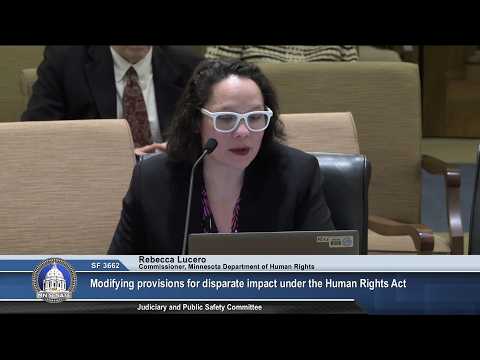
Commissioner Lucero grounded the bill historically and gave practical examples: AI tenant-screening that excludes applicants without full-time employment (which could disproportionately exclude older Minnesotans and people with disabilities), and job postings that require unrelated qualifications such as a bachelor's degree for entry-level positions. "If a policy or procedure harms Minnesotans because of protected characteristics, we should examine that harm," the commissioner said.
John Bealer, policy counsel with the ACLU of Minnesota, testified in support and described disparate-impact liability as a tool to address systemic barriers, noting federal rollback of disparate-impact guidance in recent years and the need for state-level protections. Bealer urged support for SF3662 to maintain accountability for discriminatory outcomes, including those produced by AI systems.
Several members asked for concrete, local examples, statistical methods and how the department evaluates disparate impact; Commissioner Lucero said such cases are rare and fact-specific and that statistical analyses are used by professionals as one tool in a broader inquiry. A disability-advocate testifier, Nathaniel Olsen, raised separate concerns during testimony and the chair reminded attendees of decorum and relevance to the bill.
The committee adopted an A1 author's amendment (voice vote) and laid the bill over for further consideration; members asked for follow-up details and indicated additional committee review would occur.