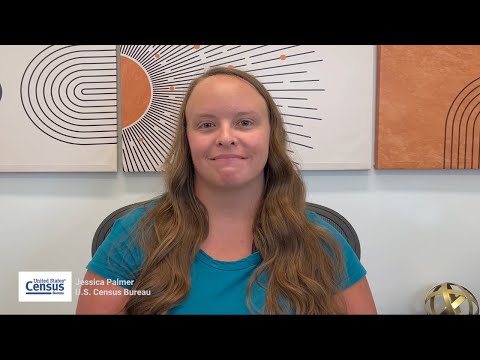
Census program analyst demonstrates population clock, cites net U.S. gain of about one person every 15 seconds
Loading...
Summary
Jessica Palmer of the U.S. Census Bureau demonstrated the Census Bureau's population clock on census.gov, showing how estimates combine the latest census base with births, deaths and international migration and reporting a net U.S. gain of roughly one person every 15 seconds.
Jessica Palmer, a program analyst with the U.S. Census Bureau, demonstrated how to use the agency's population clock on census.gov and explained how the estimates are calculated.
Palmer said the clock starts with the latest census data as a base and then factors in birth rates, death rates and international migration to produce real-time estimates. "The way that we determine the population is using the latest census data as a base," she said.
She walked viewers through navigating to the population clock on the Census Bureau's landing page and opening the detailed population-clock data page. "To look at the population clock, we are starting right on our landing page, which is census.gov," Palmer said, and she showed the controls that let users adjust the year and view annual estimate graphs.
Palmer recited the conversion rates the tool uses in the demonstration: "So, in this case, there's 1 birth every 9 seconds, there's 1 death every 11 seconds, and there is 1 international migrant every 23 seconds, which gives us a net gain of 1 person every 15 seconds." She noted those numbers are updated daily depending on when the video or page is viewed.
On the population-clock data pages Palmer demonstrated, viewers can compare U.S. and world population totals, see the world's top 10 most populous countries, and view charts of annual population estimates. She highlighted a left-side chart showing U.S. population growth by region from 2020 to 2024 and a right-side view with U.S. population by age, as well as tables listing the most populous states, counties and cities and a highest-density chart.
Palmer closed by inviting viewers to subscribe to the Census Academy and follow the Census Bureau on social media for additional videos and explanations. "For more videos like this, please subscribe to the Census Academy and don't forget to follow us on social media," she said.