
Cupertino officials flag rising sheriff contract costs as public-safety partners outline crime and wildfire responses
Get AI-powered insights, summaries, and transcripts
Sign Up Free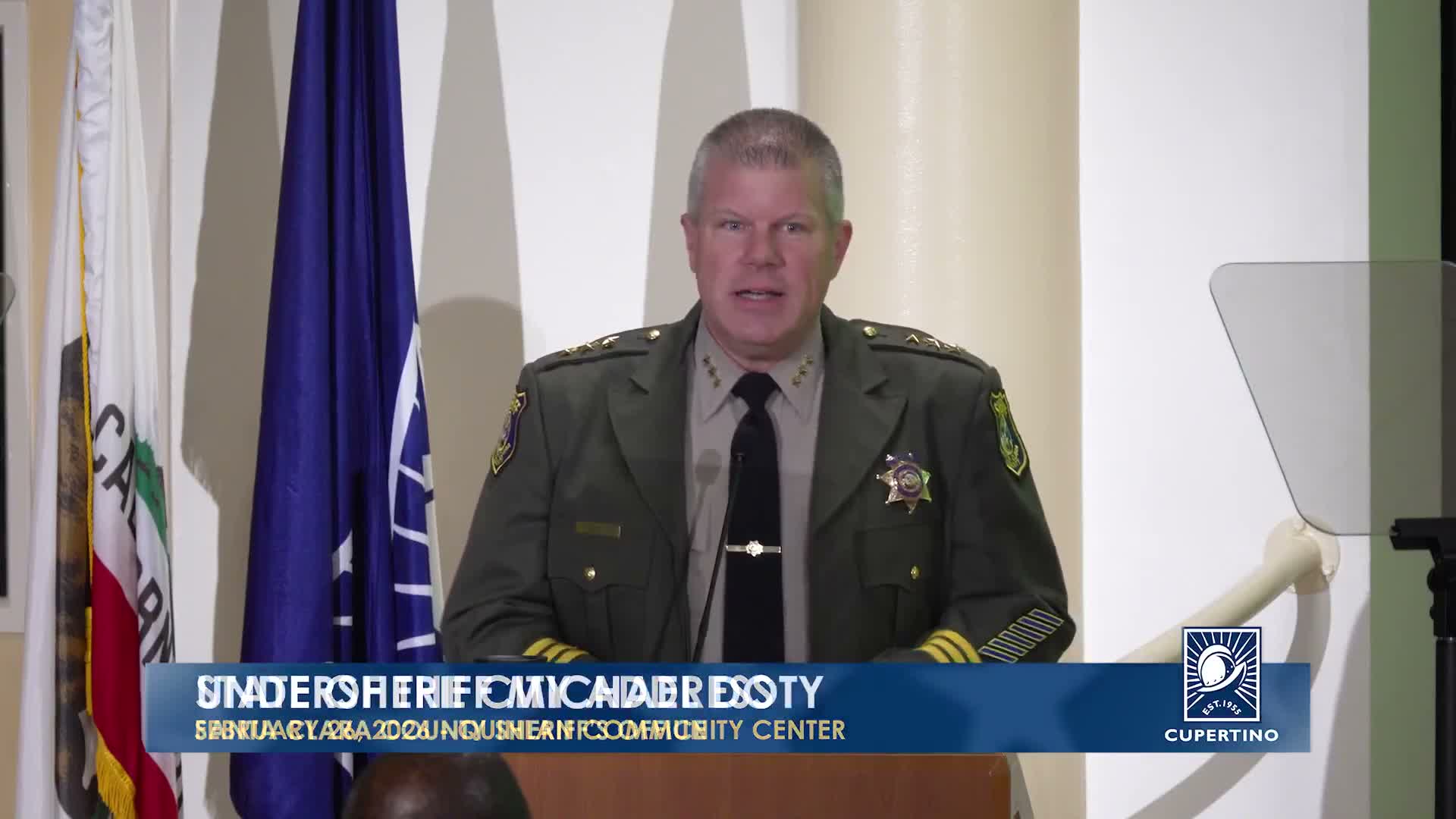
Summary
City and county public-safety leaders told attendees at Cupertino’s State of the City address that residential and vehicle burglaries have risen, the sheriff’s office is reassessing ALPR vendor arrangements, and the city is confronting sharply higher contract costs while exploring alternatives with neighboring cities.
Mayor Kitty Moore told the audience that public safety is essential but increasingly expensive, citing sharply rising costs in Cupertino’s contract with the Santa Clara County Sheriff’s Office and saying the city is working with neighboring contract cities to "understand the cost drivers and seek fair, sustainable terms." Moore said officials are examining service models and phasing options to maintain safety without destabilizing the city budget.
Undersheriff Mike Doty, representing the Santa Clara County Sheriff’s Office, said the office values its long-standing partnership with Cupertino and emphasized deputy commitment to community safety. "The relationship between the sheriff's office and the city of Cupertino is long standing," Doty said, adding that the office takes pride in serving the community and aims to strengthen collaboration.
Captain Neil Valenzuela presented 2025 crime statistics for Cupertino and highlighted trends city officials plan to address. Valenzuela said residential and vehicle burglaries increased in 2025 while identity-theft reports fell slightly. He described patterns — including many residential burglaries occurring during extended absences from homes — and said the department plans to ramp up neighborhood-watch meetings, community presentations and targeted patrols.
Valenzuela also addressed the city’s use of automated license-plate readers (ALPRs). He said the sheriff's office is evaluating alternatives after the Board of Supervisors directed the office to stop using a particular vendor, and he stated, "It’s important to note that the sheriff's office never shared with any federal agency, including ICE," framing ALPRs as a crime-solving tool the office believes is valuable.
Fire Chief Suana Gertkow outlined the fire district's readiness and wildfire mitigation work. Gertkow said the district operates 19 stations and serves roughly a quarter-million people in its jurisdiction, and that EMS calls make up about 65% of call volume. She highlighted recent apparatus purchases and plans to procure seven new Type 1 engines, and described a newly acquired 10-acre site intended for fleet maintenance and a centralized training facility.
Gertkow reported increased incident counts in 2025 driven largely by EMS and traffic incidents, and she emphasized fire-prevention outreach: the department has sent roughly 1,200 informational defensible-space letters and about 707 enforceable defensible-space notices to parcels in moderate-to-very-high severity zones. She encouraged residents to use county alert systems and the Genesis Protect platform for protective-action notifications.
The city and its public-safety partners emphasized community engagement as part of their strategy: neighborhood-watch programming, school outreach by SROs, National Night Out and other educational efforts aimed at reducing victimization and strengthening preparedness.
Moore said the city must weigh trade-offs: public-safety demands and contract costs compete with other services and capital needs, and Cupertino is pursuing collaborative regional approaches while remaining transparent with residents about the choices involved.
The State of the City program included a short station video narrated by Captain Lane Cooley of Santa Clara County Fire Department describing Station 71’s staffing, equipment and training drills. The presentations concluded with recognition of the partnership between the city and county providers and a pledge to continue coordination on operations and regional emergency planning.