Get Full Government Meeting Transcripts, Videos, & Alerts Forever!
Get email alerts on the Budget topic
No spam. Unsubscribe anytime.
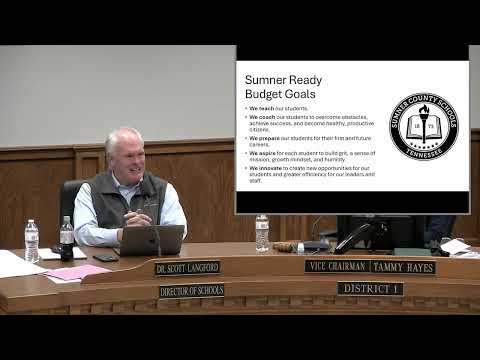
Sumner County Schools outline FY26 budget strategy as TISA funding shifts
Summary
At a March 4 study session, district leaders outlined a strategic approach to the FY26 budget, citing a projected $7.3 million TISA increase, a required $3.9 million teacher-pay increase, potential losses tied to an economic-disadvantage reclassification, and a $26.1 million unrestricted fund balance.
The Presenter, speaking as the session's lead presenter, laid out Sumner County Schools' strategy for building the fiscal 2026 budget and warned the district must balance $400 million in requests against roughly $300 million it expects to spend. "We'll get somewhere around $400,000,000 worth of budget request, all of which are valid. And we'll have about 300,000,000 to spend," the Presenter said.
The district framed the discussion around the new TISA funding formula proposed in the governor's budget, which the Presenter said would increase district revenue by roughly $7.3 million under current proposals and establishes a base of $7,295 per student. The Presenter noted the state has earmarked part of the TISA increase to teacher pay: "What we are required to increase teacher pay raises this year is $3,900,000," the Presenter said.
Nut graf: The session was a strategic briefing, not a final budget vote. District leaders emphasized that while the governor's proposal shows a net funding increase, changes to how students are counted as economically disadvantaged could reduce that benefit and that pending state legislation will materially affect the district's bottom line.
Details and trade-offs The Presenter highlighted a near-30% drop in the district's count of economically disadvantaged students under the state's direct-certification method and estimated a possible revenue loss of about $3.1 million. Staff are tracking a bill that would reimburse roughly 75% of that gap; if passed without amendment the district would reduce the loss to approximately $800,000'$900,000. "So we need that bill to pass," the Presenter said.
Board members pressed on other revenue drivers. The Presenter cited a maintenance-of-effort requirement of $134,000,000 from county partners and said county revenue projections currently sit near $140,062,553. The Presenter thanked county commissioners for earlier coordination and more timely revenue estimates, which the district said makes June submission to the commission more feasible.
Reserves, restricted funds and cash flow The Presenter described how the comptroller's report aggregates restricted and encumbered accounts into a large reserve figure and walked members through categories that cannot be freely spent, including federal projects, school nutrition, and encumbered purchase orders. The Presenter said unrestricted fund balance is about $26,100,000 and described that as roughly a 15% fund-balance position. The Presenter also noted the district aims to hold at least two months of operational expenses in reserve and described a per-day operating cost as presented at the meeting.
Capital plans and near-term actions On capital priorities, the Presenter said bids for North Sumner Elementary will open the following Tuesday and noted the project budget had been raised from $800,000 to $1,000,000 after an initial estimate. The Presenter cautioned that higher-than-expected construction bids could require cuts to other projects or a shift in timing.
Teacher bonus and legislative items The Presenter summarized a scholarship/voucher bill that includes a $2,000 teacher bonus. The Presenter said the bonus is state-funded but requires a local resolution to accept distribution and that payroll tax and benefits will reduce the net amount employees receive. "The $2,000 is not $2,000. You're not going to get a check for $2,000 because it's going to have to pull out all the benefits and taxes," the Presenter said.
What happens next The Presenter asked board members for feedback on a strategic-planning document that staff will circulate for comment and said the full budget will be presented to the board for feedback in May and then sent to the county commission in June for action. No formal votes or motions were taken at the study session.
Ending: The session closed after members asked clarifying questions about capital timing and messaging; staff were asked to continue preparing budget detail and to return with capital estimates and a five-year plan.