Get Full Government Meeting Transcripts, Videos, & Alerts Forever!
Get email alerts on the Charter Leases topic
No spam. Unsubscribe anytime.
Committee examines charter-school lease payments after new Mills charter opened while district buildings remained offline
Summary
Lawmakers pressed staff about the state's obligation to pay charter school leases and whether the state had sufficient front‑end review after a charter opened in Mills while several district schools remained offline; staff said the state pays lease costs based on allowable square footage tied to ADM and that the department was not involved in the Mills project.
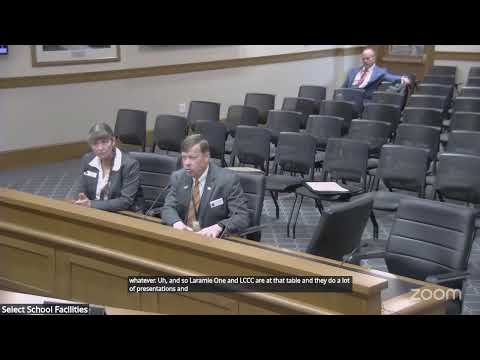
Legislators at the Select Committee on School Facilities on March 5 raised questions about how the state funds charter school facilities, using the recent Mills charter project as an example of where the state now pays lease costs while districts maintain offline buildings.
Shelby Carlson, School Facilities Division Administrator, explained the state's payment method: the state bases its lease payment on allowable square footage determined by ADM and then applies the average cost per square foot in the community. "We pay for the lease, and we base that on the average cost of similar type of square footage in that community," Carlson said, adding that the state will never pay more than the actual lease cost but uses the lesser of allowable or actual square footage in calculations.
Senator Rothfuss described the Mills case as a cautionary example: a new charter opened while multiple district buildings were offline, and the state became obligated to pay lease costs. "We never should have built that school in Mills, and we'll be paying for that school," Rothfuss said. Committee members questioned whether the state could require more front‑end engagement or limit long‑term obligations.
Carlson and finance staff said some charter operators do consult with the department and use the state's design standards, while others do not. The department has prepared a guide for charter facilities and plans to provide it to the committee and LSO staff. Committee members asked staff to clarify statutory language and bring forward options for earlier engagement with charter applicants.
Why it matters: Long lease obligations for charter facilities can create multi‑year state commitments and affect district facility planning; the committee said it wants clearer front‑end controls and better data on how charter ADM interact with district funding formulas.
Next steps: Department and LSO staff will provide a guide and background materials and model the financial interaction between charter ADM, leases and district major maintenance funding for interim consideration.