Get Full Government Meeting Transcripts, Videos, & Alerts Forever!
Get email alerts on the Elections Testing Notice topic
No spam. Unsubscribe anytime.
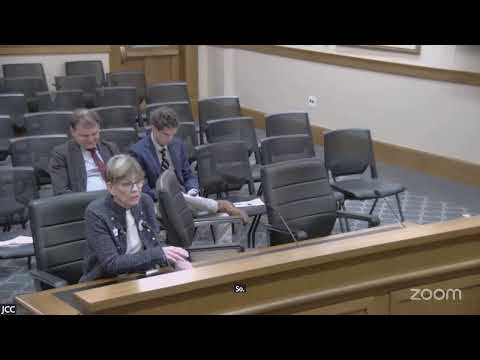
County clerks press for short notice and warn of security risks as committee adopts senate position on voting-equipment testing
Summary
In a conference committee on Senate File 2028, county clerks urged keeping a 2-day notice for voting-equipment testing and warned that larger public observer limits could threaten security; the committee adopted the senate position after a roll-call vote.
A conference committee on Senate File 2028 heard competing views on how much public notice and how many observers should be permitted for voting-equipment testing, and approved the conference committee report aligning with the senate position.
Mary Langford, representing the county clerks of the state of Wyoming, told the committee that a two-day notice requirement is necessary because last-minute logistical issues — missing ballots, delayed test decks or weather — can force clerks to test equipment very close to an election. "Security for our equipment and for our testing and our election are paramount," Langford said, while also emphasizing clerks' commitment to transparency.
Julie Friess, Fremont County Clerk and elections chair for the clerks association, said the bill's two-day "not later than" phrasing still allows testing to occur earlier and that clerks use party emails and social media to notify observers. Friess described practical constraints in some facilities — noting a recently built election warehouse with an occupancy limit of six — and urged innovations such as livestreaming to allow public observation without exposing equipment or other county records.
Gail Simmons, who identified herself as "Civics 307," argued that the house amendments tended to pit security against visibility, and said removing clerks' discretion to limit observers could leave clerks "holding the bag" when they must explain security decisions to the public.
An official addressed in the hearing as the secretary summarized current practice under Chapter 29, voting systems, Section 6(e), and noted notification obligations specified in 22-10-108. The secretary said counties routinely notify party chairs and permit other witnesses, and suggested a middle ground on minimum presence (around three to five people) and three days for notice as a possible compromise between the house and senate positions.
After discussion, the committee proceeded on a motion to adopt the senate position for the conference committee report. A roll call recorded aye votes from Representatives Locke, Lucas and Yen and Senator Landau; Senator Case said no. The committee approved the conference committee report, adopting the senate position on the notification and related language.
Clerks stressed that, even if the bill were to be delayed for further work, they would continue to make testing available to the public and to pursue uniform practices for notification, chain-of-custody and resealing procedures. The committee adjourned after brief closing remarks.