Get Full Government Meeting Transcripts, Videos, & Alerts Forever!
Get email alerts on the Municipal Finance topic
No spam. Unsubscribe anytime.
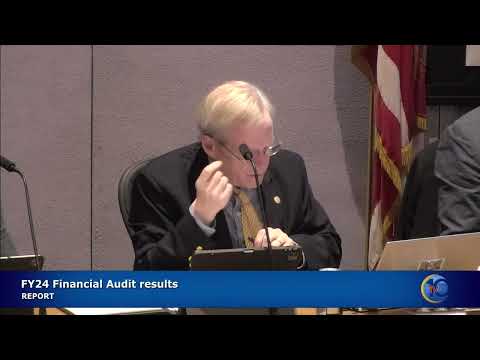
City finance director reports $22.4 million FY24 surplus, recommends transfer to CIP contingency
Summary
Charlottesville's director of finance reported a FY24 audit with a clean opinion and about $22.4 million in surplus; city staff recommended following the financial management policy and placing the surplus in the capital improvement program contingency, with a formal appropriation to be considered at the next meeting.
Chris Cohen, the city's director of finance, told the Charlottesville City Council the auditors issued a clean opinion on the city's FY24 financial statements and the general fund finished the year with roughly $22,400,000 in excess of the city's 17% fund balance policy.
"The general fund ended with approximately $22,400,000 in excess of the 17% fund balance policy," Cohen said, and he noted the amount represents about 9.8% of the adopted FY24 budget. Cohen said the auditors' written confirmation and the annual comprehensive financial report are published and that the city submitted the report to the Government Finance Officers Association for its certificate of achievement program.
The finance director outlined the largest drivers of the surplus: general fund revenues that ran about $12,500,000 over budget and expenditures that came in under budget, particularly salaries and benefits. Cohen highlighted real estate tax collections and higher interest income from the city's invested idle cash as key contributors.
"When interest rates are higher than expected and it generates additional revenue, we see that come here," Cohen said, adding that interest income is volatile and should be treated as a one-time source when planning.
Cohen also described a budgeting practice he called a "recycling" of past one-time surpluses: monies set aside from prior-year surpluses were later placed into department budgets for specific uses, and those departments in some cases still came in under budget, which increased the observed surplus.
A council member asked whether the large surpluses in recent years were an artifact of conservative revenue assumptions, particularly after the COVID-era rebound. "In '22, it definitely was," Cohen said, describing that the FY22 rebound followed conservative budgeting during the pandemic. He said the city is now seeing strong revenue performance for FY23 and FY24 but that it remains difficult to distinguish one-time gains from a new baseline given continued changes in the economy and within the organization.
The council pressed on timing issues that complicate forecasting. One council member noted that a $3.0 million to $3.5 million real estate tax overage could be explained by reassessment and payment timing; Cohen replied the city collects approximately $90,000,000 in property taxes annually and pointed to reporting lags for meals and sales taxes and delayed BPOL (business and professional license) data as complicating factors for budget projections.
On next steps, Cohen said the recommendation from staff is to follow the city's financial management policy and place the FY24 surplus into the CIP contingency. "The recommendation is going to be that we follow the city's financial management policy and that the surplus go to the CIP contingency," he said. He also said a year-end appropriation ordinance and a public hearing will be scheduled at the council's next meeting to formalize any transfers.
Council members voiced concern that treating recurring revenue as one-time could distort decisions about tax rates, investments in the capital improvement program and school funding; they urged prudence in assumptions used for FY26 projections. Cohen said the city's revenue team updates projections frequently and tries to incorporate current performance while respecting timing constraints of various revenue sources.
Cohen confirmed the memo and financial report would be posted on the city's transparency portal. The presentation was a report with no formal action taken; councilors will consider a year-end appropriation and the recommended transfer at the next meeting.