
Committee approves amendment and lays over bill to preserve Minnesota’s reinsurance authority
Get AI-powered insights, summaries, and transcripts
Subscribe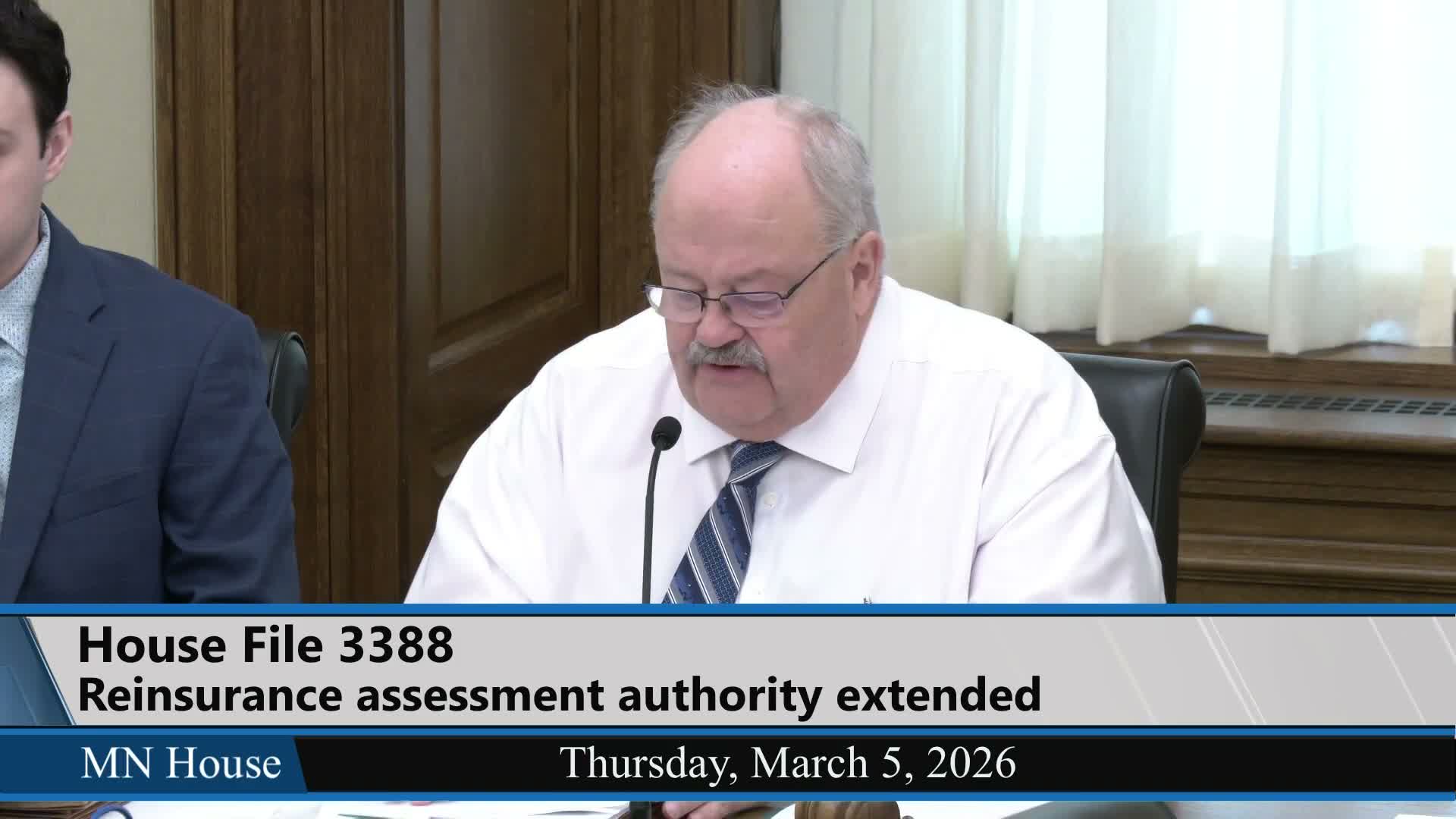
Summary
The committee approved an A1 amendment to House File 33‑88, which seeks to continue and preserve the state reinsurance program and its funding authority (assessment/credit model). Witnesses said reinsurance substantially lowered individual‑market premiums; the committee laid HF 33‑88, as amended, over for possible omnibus inclusion.
Co‑chairs and witnesses described House File 33‑88 as a vehicle to preserve the state’s reinsurance authority and funding model after recent federal premium subsidy changes. Representative O'Driscoll moved an A1 amendment to place the bill in the shape the sponsor wanted; the committee approved the amendment by voice vote.
Why it matters: Minnesota’s reinsurance program subsidies reduce premiums in the individual market by covering a share of very high‑cost claims. Witnesses and committee members said the program helped stabilize a market that serves early retirees, entrepreneurs and others who buy coverage on their own. Without reinsurance or similar tools, witnesses warned, premiums could spike and carriers could exit the market.
What witnesses said: Dan Andreesen (Minnesota Council of Health Plans) told members reinsurance subsidizes roughly 80% of individual‑market enrollee claims between $50,000 and $250,000 and that quarterly audits and public reports document program activity. He said previous analyses showed premiums 22–36% lower with reinsurance and that this year’s extension produced up to 47% lower premiums compared with a counterfactual without the program. Anne New Brindley (Minnesota Business Partnership) and Steven Rubis (Health Plan Partnership in Minnesota) emphasized continuity and predictability for employers and the health‑care system. Jonathan Cotter (Minnesota Chamber) recounted the program’s origins and its role in lowering benchmark premiums.
Funding and mechanics: Witnesses and members discussed the assessment/credit funding model adopted in 2025, which charges assessments to some group health carriers and returns value via state tax credits; members asked for more detailed scenarios to understand how self‑assessment and tax credits operate in practice. One witness cited an assessment figure of about $266,000,000 for the next biennium; committee members asked Commerce staff for additional detail on scenarios and fiscal tradeoffs.
Committee action and next steps: After discussion the committee renewed a motion to lay HF 33‑88, as amended, over for possible inclusion in an omnibus bill. The A1 amendment passed by voice vote; the bill was laid over for further work and staff follow‑up on waiver timing, assessment mechanics and projected fiscal impacts.
What to watch: Members asked the Department of Commerce for a clearer explanation of the assessment/tax‑credit model and requested follow‑up briefings on fiscal scenarios and program audits before the committee considers final action.