
Minnesota counties warn HR 1 changes and aging benefit systems could force property-tax hikes
Get AI-powered insights, summaries, and transcripts
Subscribe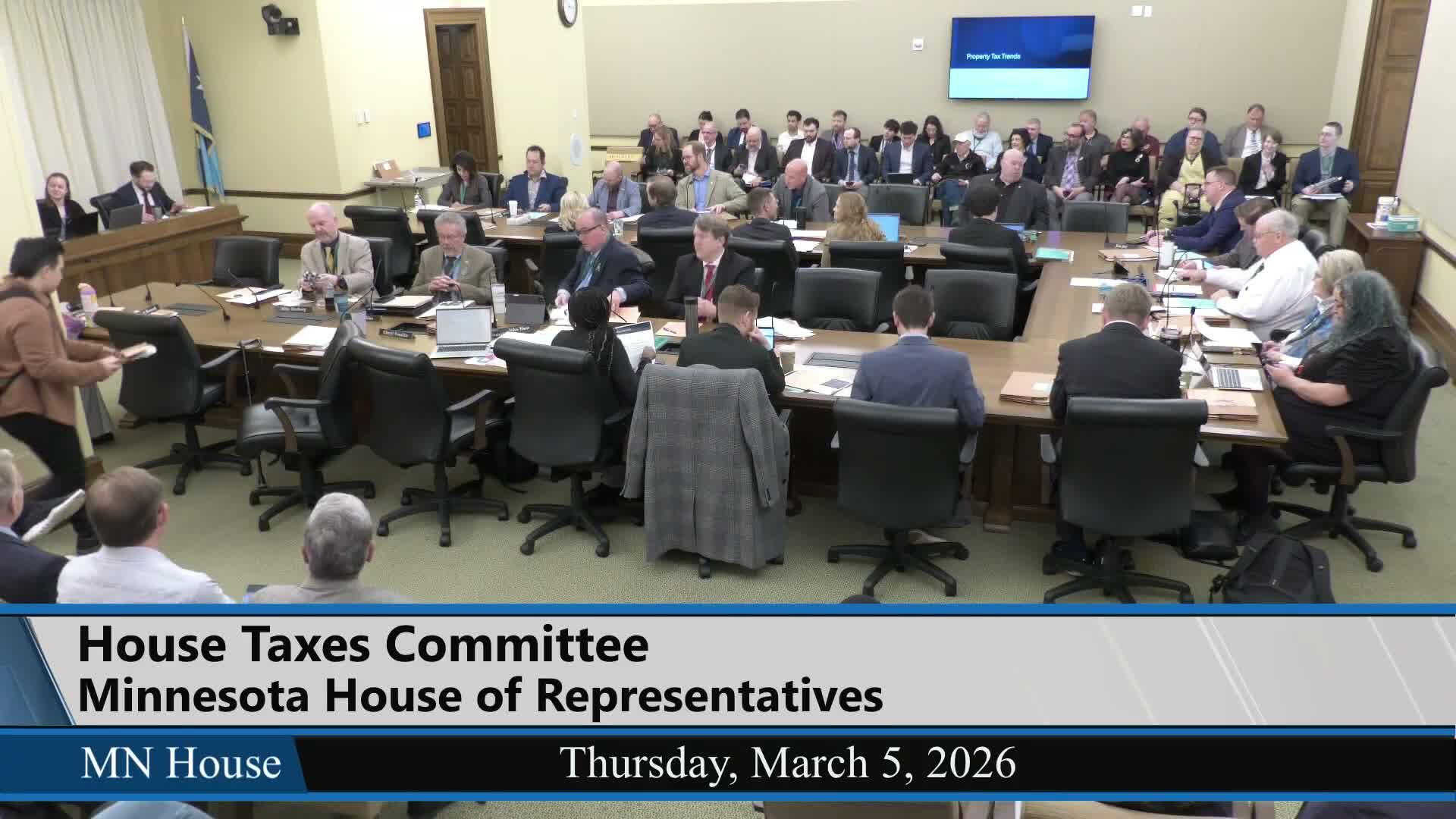
Summary
County officials told the House Tax Committee that federal policy changes in HR 1 and legacy eligibility software are creating administrative liabilities that could be shifted to counties, driving higher property levies; lawmakers laid over a bill to form a property-tax task force.
County officials warned lawmakers on March 4 that federal changes to benefit programs and decades-old eligibility software could translate into steep local costs and force higher property taxes across Minnesota.
Nathan Jessen of the Minnesota Intercounty Association told the House Tax Committee that counties already shoulder most of the local implementation costs for state and federal mandates and depend heavily on property taxes to fund them. “85% of the county’s own-source revenue … is from the property tax,” Jessen said, and he noted a 7.6% average county levy increase for 2026 — the largest countywide increase in 25 years.
Matt Hilgert, presenting for county interests, outlined three federal-driven pressure points tied to HR 1: cuts to federal administrative reimbursements, new or expanded redetermination and work‑verification requirements, and a contested SNAP “error-rate” penalty that, if shifted to the state and then to counties, could create hundreds of millions in liability. Hilgert said the administrative cost shift alone could amount to about $39 million for Minnesota, and the SNAP error-rate exposure could range from about $86 million to $120 million annually; taken together, he said, those changes could represent roughly $125 million a year in potential liability.
“Those costs are going to be felt at the county level,” Hilgert said, warning some counties estimate an immediate 8–11% levy increase if error-rate liabilities are assigned locally.
A Dakota County trainer, Kathleen Walls, demonstrated the state’s legacy eligibility software, Maxis, saying the system dates to 1989 and requires extensive manual entry. “Maxis was new in 1989, and we are still using it to determine eligibility and issue benefits,” Walls said, walking the committee through repeated data entry across screens, manual overrides and the paper notes workers keep to avoid errors.
Walls and county commissioners described the operational consequences: high training time and turnover for eligibility workers (she estimated becoming competent can take roughly two years), front-line staff spending large portions of their day re-entering the same data, and a heightened risk that small data errors or client-reporting lapses will be recorded as program “errors.” Walls and other witnesses said many client-driven errors are not the county’s fault but would still be counted under the federal error‑rate metric.
Fillmore County Commissioner Mitch Lentz and Stearns County Commissioner Terrell Clark described how the combination of program requirements and antiquated IT creates local budget pressure. “In a county with limited tax base, even small spending shifts have a significant impact on us,” Lentz said. Clark warned the SNAP-related exposure could raise levies locally and urged lawmakers to factor workforce and technology impacts into policy design; he estimated one illustrative county outcome as a roughly 3.63% levy increase and a $3.7 million total increase for that jurisdiction tied to the potential SNAP changes.
Lawmakers questioned witnesses about documentation requirements, fraud enforcement and whether modernized systems used in other states could reduce both error rates and staff load. Several members urged an enterprise-wide approach to IT modernization and flagged federal match dollars that could be part of a solution.
Committee chair moved House File 33-96, a proposal to establish a property-tax task force; members passed an A‑1 amendment by voice vote and laid the bill over for possible inclusion in an omnibus tax package. No final votes were taken on program or funding changes during the hearing.
The committee scheduled follow-up work and encouraged House Fiscal staff to pursue further conversations about IT modernization and the fiscal implications of HR 1 changes. The committee adjourned at noon.