
Committee declines to advance bill creating civil remedy for constitutional violations by government actors
Get AI-powered insights, summaries, and transcripts
Subscribe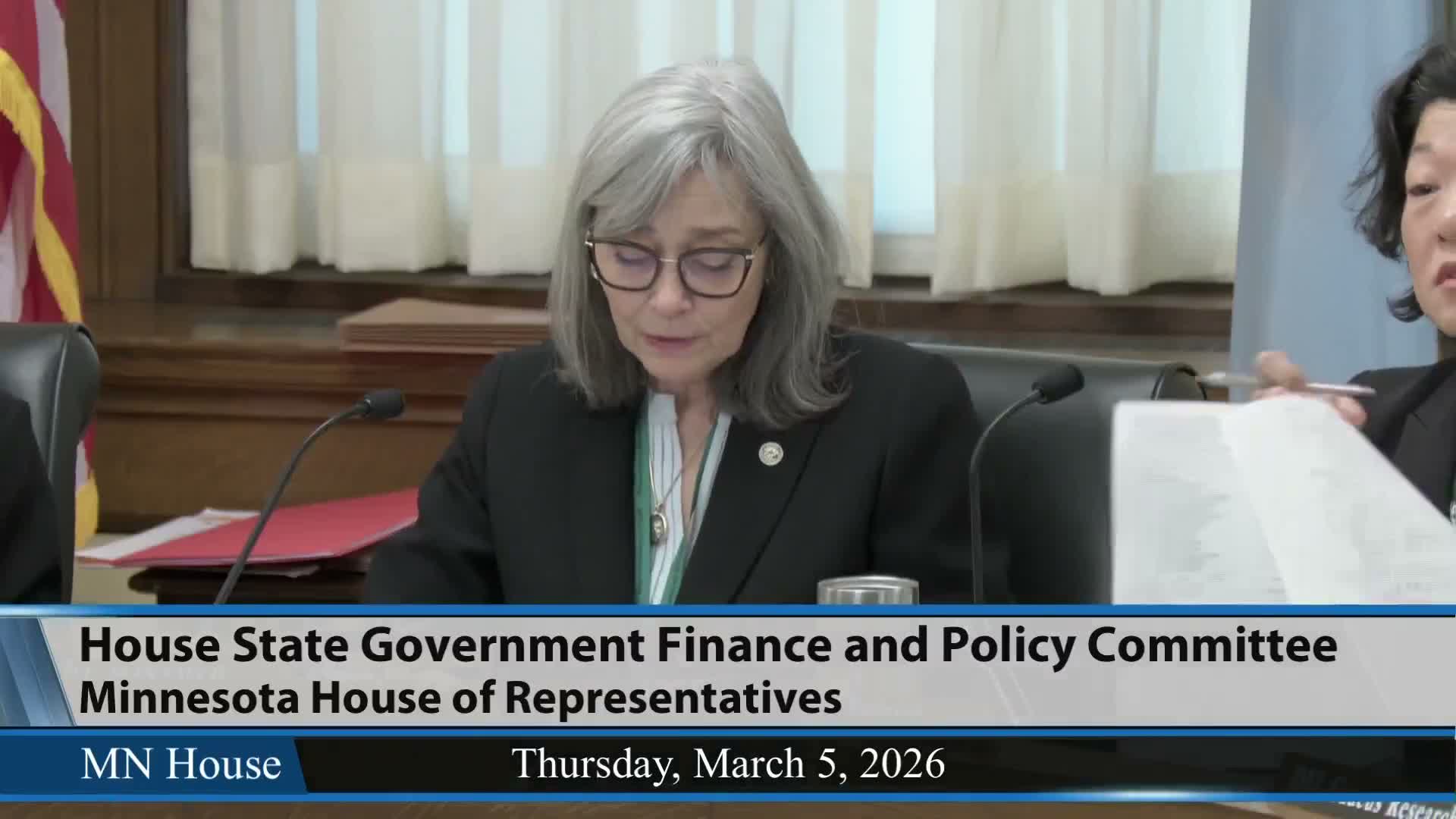
Summary
The committee debated HF3477, which would create a civil remedy modeled on 42 U.S.C. § 1983 to allow suits for constitutional violations by state and federal actors; after discussion on scope and preemption, a requested roll call failed 6–7 and the motion to refer did not carry.
Representative Peter Long introduced House File 34‑77, the "Universal Constitutional Remedies Act," and moved the author's A4 amendment to delete a subdivision and clarify retroactivity to match Senate language. Long framed the bill as expanding remedies available under 42 U.S.C. § 1983 to apply to all government actors, saying the measure "would patch these constitutional holes by establishing a civil remedy when a constitutional right has been violated by a government actor."
Members probed whether the measure would run afoul of the Supremacy Clause. Representative Davis asked, "how does this bill avoid preemption under the supremacy clause given that federal immigration enforcement is exclusively, federal domain?" Long responded the bill is not limited to immigration and "applies evenly to all actors, be they state or federal," and that it enforces constitutional rights rather than federal law.
Vice Chair Davis and several other members expressed concern that the bill’s stated context focused on recent federal enforcement operations and asked whether the proposal would in practice target immigration enforcement. Long said the bill mirrors the longstanding Section 1983 framework and is written to apply "even handedly to state, local, and federal actors." Representative Law urged support on the grounds that the measure would provide remedies for harmed families and hold governments — rather than individual officers — financially accountable.
Representative Davis requested a roll call and recommended a no vote. The committee proceeded to a roll‑call vote; with 6 ayes, 7 nays and 1 excused, the motion to refer HF34‑77 to the next stage failed and the bill was not adopted by the committee.
The committee record shows the bill drew questions about preemption, fiscal impact (a fiscal note had been requested), and the practical effect of civil remedies across a range of constitutional claims. No final action on the substance of the statute was taken; the referral motion failed on the roll call.