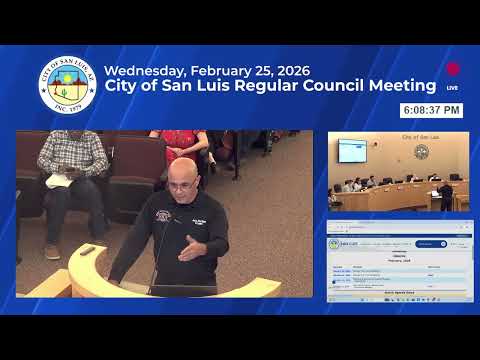
San Luis council deadlocks on ordinance to remove downtown taxi stands after federal port request
Loading...
Summary
The council failed to adopt Ordinance No. 481, which would have repealed code provisions authorizing taxi stands downtown, after tied and split roll-call votes. Staff said GSA/CBP port-of-entry construction requires clearing the right-of-way and gave taxi companies time to find private locations; council members divided over enforcement and alternatives.
The San Luis City Council debated and ultimately failed to pass Ordinance No. 481, a measure staff said is needed to remove references to taxi stands from city code after federal port authorities asked that the right-of-way near the port of entry be cleared before construction.
City staff and police told the council that ongoing GSA and U.S. Customs and Border Protection construction at the port of entry will render current taxi-stand locations unsafe and unavailable. "The public right-of-way portion of the street are currently being used as a taxi stand and will no longer be available for that purpose," said Chief Nigel Reynoso, explaining that staff met with taxi companies and that the city’s posture was to encourage them to find private locations.
Staff said taxi companies were given about a year to locate private lease sites; two companies reportedly found leased locations, but most did not. A staff member noted the federal agencies asked that the stands be removed by March 20.
The measure prompted questions about how pick-up and drop-off time limits would be enforced and whether private businesses could host a taxi hub. City legal counsel outlined options for the council, including a motion for reconsideration if members who voted the prevailing side wished to revisit the item.
Council votes on the ordinance produced multiple tied or split roll calls and the ordinance did not receive the majority needed to pass. After a failed vote and a failed motion for reconsideration (a 3–3 result on the reconsideration roll call), the council left the matter in the hands of the federal agencies and staff.
Council members who opposed the ordinance cited lack of adequate private alternatives and concern for the local taxi businesses; supporters emphasized public-safety risks posed by stand locations near federal construction. Council discussion also noted that the previous council had designated the taxi-stand locations as temporary.
Next steps cited in council discussion included staff research to clarify prior actions that created the temporary stands and, if desired by the council, a formal motion to reconsider the ordinance or an administrative process to identify acceptable alternative locations. The city manager and legal counsel said they would review the prior code language and reports to provide council members with the specific authorities and options available.