Get Full Government Meeting Transcripts, Videos, & Alerts Forever!
Get email alerts on the Budget Investments topic
No spam. Unsubscribe anytime.
Assembly finance committee reviews Land Trust Investment Fund strategy; APCM recommends no allocation changes
Summary
Alaska Permanent Capital Management presented the annual strategic review of the borough's Land Trust Investment Fund, reporting long‑term returns roughly in line with the policy benchmark, a single $1.2M withdrawal since inception, and a modeled sustainable distribution near 4.1%. No allocation changes were recommended for the remainder of 2025 or calendar year 2026.
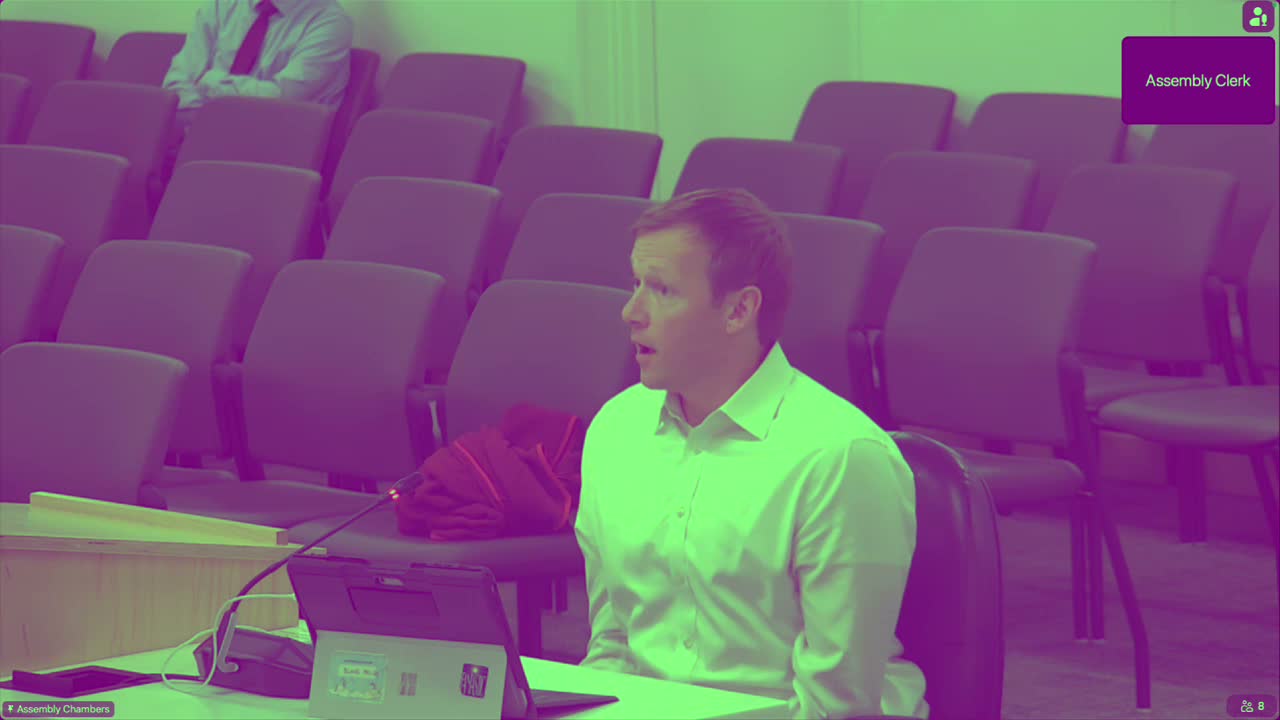
Blake Phillips, director at Alaska Permanent Capital Management, told the Kenai Peninsula Borough Assembly Finance Committee on Dec. 1 that the borough’s Land Trust Investment Fund (LTIF) has performed close to expectations since APCM assumed management in June 2019, and he recommended no changes to the fund’s strategic allocation for the remainder of 2025 or for calendar year 2026.
"Since inception the LTIF has returned 7.37% gross of fees annually," Phillips said, adding net returns are roughly in the low 7 percent range. He told the committee the account has recorded total contributions just under $13.5 million, withdrawals of $1.2 million and about $5.4 million in net earnings since APCM began managing the fund.
The presentation emphasized fee and manager oversight. Phillips described the LTIF advisory fee schedule (0.35% on the first $5 million, 0.25% on the next $5 million and 0.15% thereafter) and noted additional internal fund fees the firm monitors. He said APCM conducts an annual manager review even in years when it is not recommending allocation changes.
Phillips walked committee members through the fund’s distribution rules and the borough’s use of a POMV (percent of market value)‑style averaging policy to reduce volatility in available distributions. He said transfers from the LTIF are constrained by the fund‑balance policy (amounts above 125% of the policy maximum may be transferred to the general fund or used as the Assembly directs) and that the modeled sustainable distribution rate is about 4.1% when a long‑term inflation assumption of 2.5% is included.
A committee member asked about the single $1.2 million withdrawal; staff confirmed the withdrawal funded the Blueberry Hill transaction and was the only withdrawal taken. Phillips said the 5% figure cited in policy refers to a percent of market value and provided a slide showing how distributions at, below or above the 4.1% sustainable rate would affect purchasing power over a 10‑year horizon.
On risk and benchmark monitoring, Phillips said the portfolio is designed to track a strategic benchmark that targets long‑term returns in the mid‑6 to 7 percent range and that APCM watches rolling 12‑month returns, modeled confidence bands and stress scenarios (he cited an average extreme loss metric used in modeling). He described limited tactical discretion for implementation (for example, a small commodities allocation and modest exposures to technology/AI) while stressing that tactical moves should not derail the strategic benchmark.
The Finance Committee heard the presentation and had no further questions; the transcript records the presentation and Committee discussion but does not record a formal vote on adoption of the LTIF allocation resolution during this session.