Get Full Government Meeting Transcripts, Videos, & Alerts Forever!
Get email alerts on the Healthcare Finance topic
No spam. Unsubscribe anytime.
Central and South Peninsula hospitals report rising revenue, growing uncompensated care and mobile crisis services
Summary
Central Peninsula and South Peninsula hospitals reported year-over-year revenue gains but rising uncompensated care and cash-collection challenges. Central described a Mobile Crisis Team launched Dec. 5; South Peninsula outlined new specialty services, infrastructure projects and plans to apply for rural-health transformation funding.
Central Peninsula General Hospital (CPGH) and South Peninsula Hospital presented quarterly reports to the Kenai Peninsula Borough Assembly on Feb. 3, outlining gains in gross revenue alongside increasing uncompensated-care trends and operational pressures.
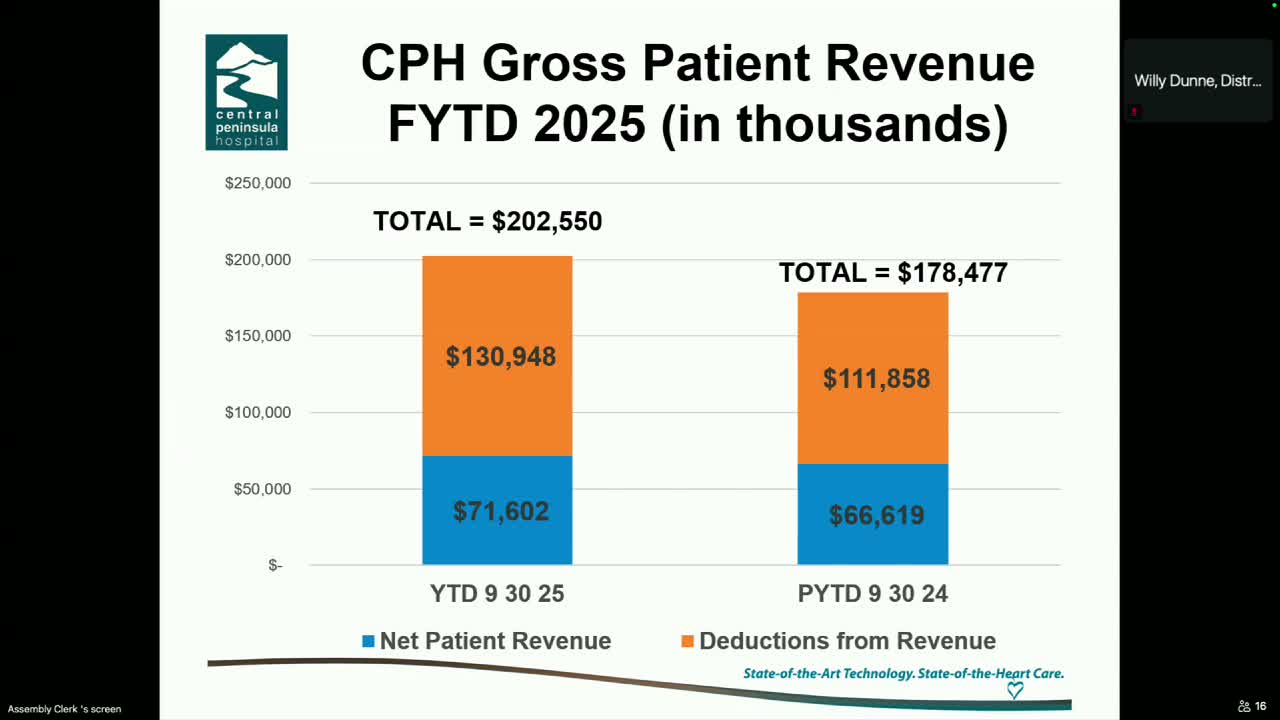
Angela Hennigan, CPGH chief executive officer, said the hospital recorded a 13% increase in gross revenues for the period ending Sept. 30, while net collections grew about 7%. She attributed part of the gap to the sunset of a CMS demonstration project that had boosted Medicare reimbursements, and warned of a rising bad-debt trend: “As of 12/31, we’ve actually had about a 15% increase in our bad debt expense,” Hennigan said. Hennigan said uncompensated-care totals were reported as roughly $6.2 million for the September period, and that as of Dec. 31 the figure was closer to $12 million; she said without renewed ACA marketplace subsidies she expects roughly 1,200 local residents could be affected.
Karl Hertz, CPGH chief operating officer, highlighted staffing additions and the hospital’s Mobile Crisis Team (MCT), which launched Dec. 5 and currently operates Monday–Friday, 9 a.m.–5 p.m. Hertz said each dispatched MCT includes a master’s-level clinician and a trauma technician, and that of six calls the team handled the previous day all were de-escalated and cared for in place without jail or hospital transport.
South Peninsula Hospital CEO Ryan Smith reported a 14% increase in gross patient revenue and an approximately 35% increase in operating income over the comparable prior period, noting growth in orthopedic and specialty services that allowed more procedures to be kept in Homer. Smith described an approved $5 million congressional award to fund generator and critical-infrastructure work and said the hospital is preparing projects for the state’s Rural Health Transformation funding. Smith also described the hospital’s new employee childcare program (about 18 children enrolled, expected to reach roughly 50% capacity by March) and said the hospital converted to the Epic electronic health record in August, which has slowed cash collections temporarily.
Both hospital presentations noted days-of-cash-on-hand metrics in the 80–86 day range and warned that reimbursement shifts and increased self-pay/no-insurance accounts are stressing revenue cycles. Both CEOs told the assembly they are open to hybrid reporting arrangements (committee meetings or assembly presentations) to balance public access and presenters’ travel burdens.
What happens next: Hospitals will continue quarterly reporting; the assembly indicated it may adopt a hybrid schedule for some hospital briefings (two in-person at assembly meetings and two at committee meetings). Officials said they will track uncompensated-care and revenue-cycle metrics in coming quarters.