
Missouri committee hears testimony on multiple bills proposing property‑tax relief for disabled veterans
Get AI-powered insights, summaries, and transcripts
Subscribe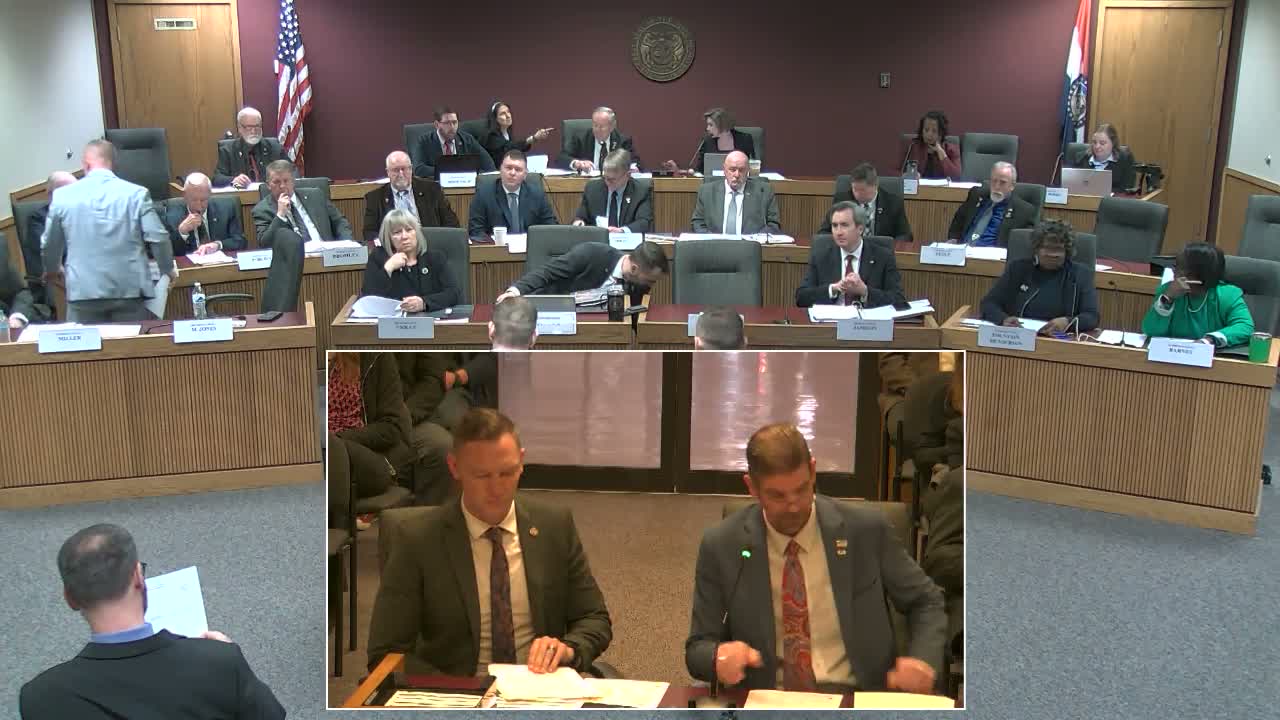
Summary
Sponsors presented several bills that would create tiered property‑tax exemptions or credits for disabled veterans; veterans and advocates urged inclusion and minimal bureaucracy while a state public advocate warned of large fiscal impacts to local governments and state funds.
The Committee on Veterans and Enforcement held an extended public hearing on a package of bills proposing property‑tax relief for disabled veterans, hearing testimony from sponsors, veterans and advocates as well as a fiscal opponent.
Sponsors represented several approaches. Representative Will Jobe (presenting HB 22 76) described a tiered credit tied to homestead status and capped at 5 acres, with a 100% exemption for veterans with a 100% permanent and total disability, up to $5,000 for ratings over 70%, and $2,500 for ratings between 50% and 70%; his version included a six‑year sunset. Representative Crosley (presented in this hearing) and Representative Philip Oler King (HB 23 06) proposed related measures: Crosley’s bill would create a structured homestead exemption tied to VA‑certified disability and cap equalized assessed value at $250,000 in that sponsor’s version; Oler King described exemptions tied to assessed‑value tiers (examples included the first $10,000 to $500,000 of assessed value depending on disability percentage) and rules to continue exemptions for surviving spouses in certain circumstances.
Representative Melissa Schmidt presented HB 23 62 and HB 30 78, describing one bill that matches the discount to the VA disability percentage (an annual application and a six‑year sunset) and another that would let counties opt in to provide a homestead tax credit for primary residences (up to five acres and market value caps, and provisions for surviving spouses that the sponsor said are amendable). Representative Mike Jones presented HB 25 88 and HB 26 72, offering an opt‑in framework for counties (including potential 100% credits for counties that adopt the measure) and a vehicle/personal‑property approach that would rely on constitutional constraints.
Supporters included veterans and veteran‑service officers who urged the committee to include individual unemployability (IU) in 100% coverage, avoid annual recertification burdens that strain county offices, and reject county opt‑outs which they said would create an uneven patchwork of benefits. Major General Will Blalock (ret.) and several veterans including Blake Leach, Tony Lezacs and Clay Williams testified that modest tax relief could preserve housing stability and encourage veterans to remain in Missouri.
Arnie C. (Arnie Dynoff), identifying himself as a state public advocate, testified in opposition on fiscal grounds. He told the committee that several of the bills would have substantial costs to local governments and certain state funds, citing estimates and warning that counties, school districts and local service districts could face revenue shortfalls without a legislative plan to make them whole. He called for fiscal accountability and urged lawmakers to consider offsets or broader approaches rather than awarding targeted tax relief without compensating measures.
Committee members pressed sponsors on technical issues — how to define the homestead acreage eligible for relief (sponsors and questions referenced a 5‑acre cap in statutes and recommended clarifying language), how surviving‑spouse transfers should be limited to avoid unintended perpetual transfers, and whether recertification should be required annually. Sponsors indicated willingness to coordinate language and to consider combining bills into a committee substitute.
The hearing included several emotional, personal accounts from veterans (including Jay and Kayla Fane), concluding with the chair thanking witnesses and adjourning the committee.
No final votes on the veterans tax bills were taken at this hearing; the committee asked sponsors to confer on common language and signaled the bills may be combined into a substitute for future consideration.