
House panel advances bill requiring age verification on adult websites after hours of debate
Get AI-powered insights, summaries, and transcripts
Subscribe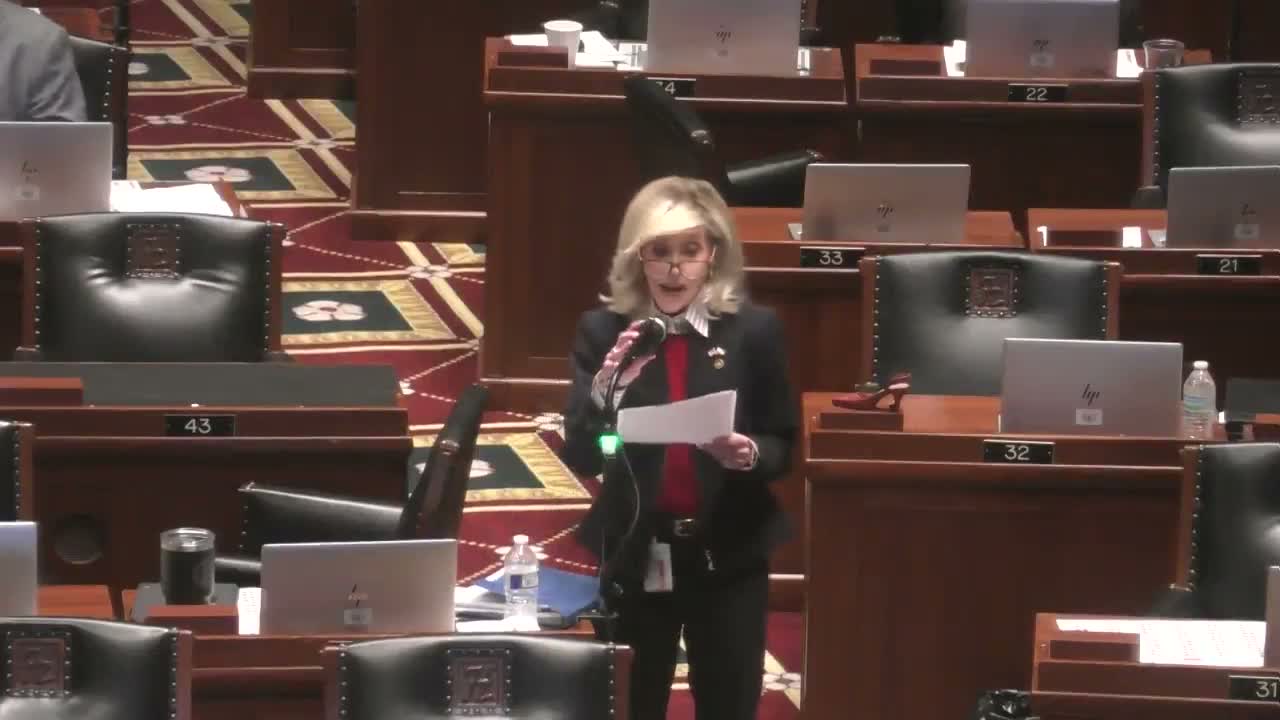
Summary
The Missouri House approved a committee substitute for HB 18-39 requiring commercial adult websites to use third-party age-verification providers; supporters said it protects children, while critics raised privacy and enforcement concerns. The House perfected and printed the substitute and recorded a roll-call result for perfection.
The Missouri House on March 3 advanced a committee substitute for House Bill 18-39 that would require commercial adult websites accessible in Missouri to use a third‑party age‑verification provider before granting access.
The bill’s sponsor, the representative from Cass (speaker 31), told the chamber that HB 18-39 “simply requires that pornographic websites operating in Missouri use a reputable, audited, age verification provider to confirm users are 18 or older without retaining personal data.” She said the measure mirrors protections the U.S. Supreme Court recently upheld in a Texas case and follows a Missouri Attorney General rule that the office said should be codified in statute.
Supporters — including representatives who serve on the children and families committee — described the bill as a child‑protection measure that is already implemented in practice in Missouri and in place in multiple other states. The representative from Laclede (speaker 32) noted the committee produced unanimous, bipartisan support and cited research and expert testimony linking early exposure to adult content with harm to children.
Opponents and some questioners raised practical and privacy concerns. A member with technology and privacy experience (speaker 13) asked whether the bill requires audited providers or merely third‑party providers; the sponsor said the industry has an association and that she expected reputable providers to adhere to strong standards, but acknowledged the bill’s language does not itself enumerate an auditing standard. Other members pressed the sponsor on what forms of verification would be allowed (driver’s licenses, biometrics, two‑factor authentication) and whether children could obtain access by using another person’s ID or technologies such as VPNs.
Critics warned the law could create a “vacuum” in which smaller, noncompliant sites proliferate and be more dangerous for minors until enforcement occurs. The sponsor responded that placing the requirement into statute enables the Attorney General to prosecute noncompliant operators.
The House adopted the committee substitute and, after a requested roll‑call on perfection and printing, the clerk recorded the vote for perfection and printing. (The clerk’s tally was announced on the floor.) The bill was ordered perfected and printed; a roll call was recorded for perfection per the sponsor’s request.
What’s next: With the committee substitute perfected and printed, HB 18‑39 is available for further consideration under House procedures, including potential third‑read consideration later in the session.