
Lawyers and investigators press crypto firms to cooperate with state law enforcement
Get AI-powered insights, summaries, and transcripts
Subscribe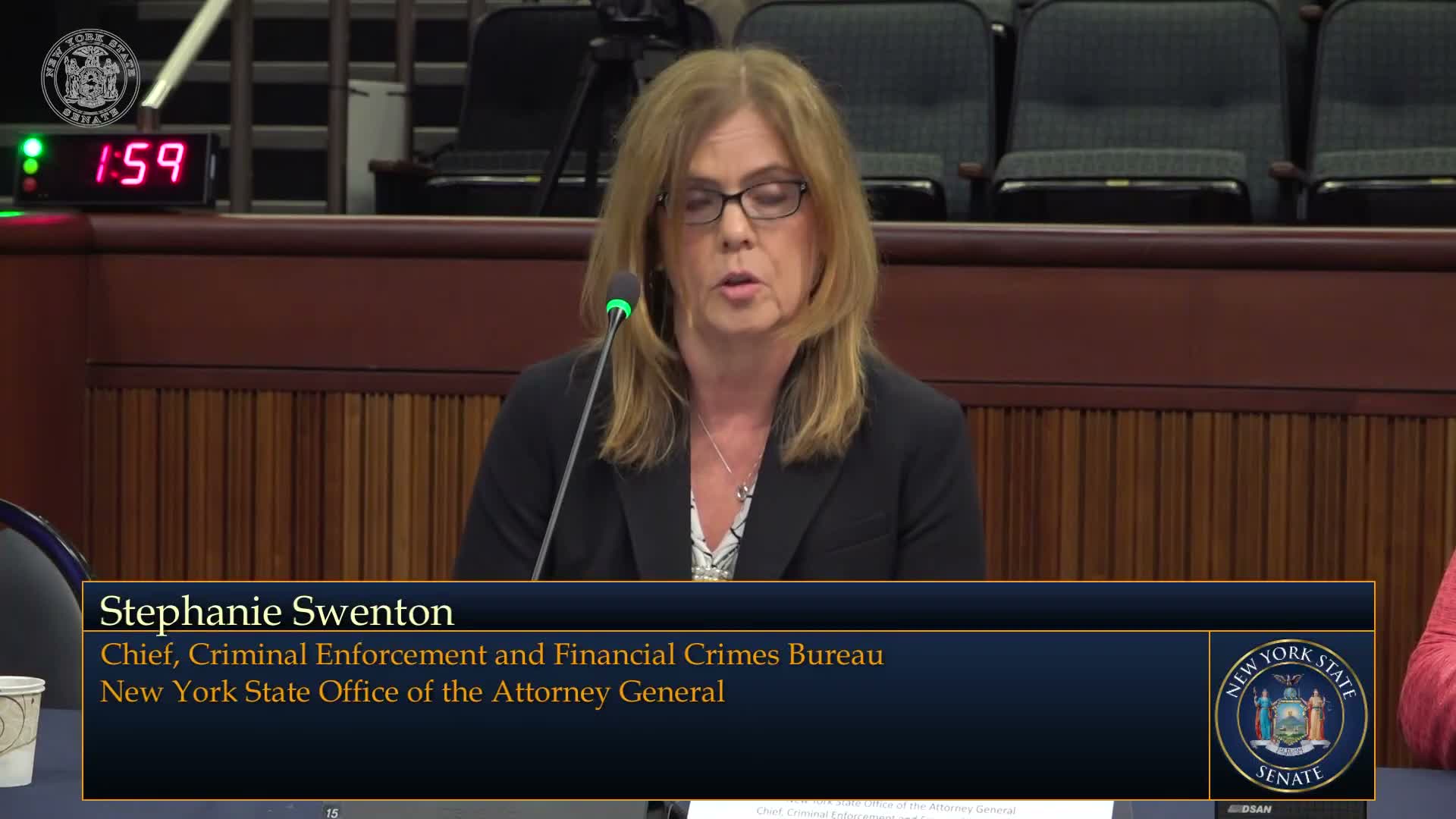
Summary
Attorney general staff and DAs told senators stablecoin issuers and some exchanges have delayed or refused to freeze or return assets, hampering victim recovery; blockchain-analytics firms and DAs urged legislation to compel cooperation and tools to return stolen cryptocurrency.
At a joint Senate hearing in Albany, the attorney general's office and local district attorneys described repeated instances where cryptocurrency firms delayed or declined to cooperate with law enforcement's requests to freeze or return assets tied to fraud.
Shamiso Maswaswe of the attorney general's Investor Protection Bureau said some stablecoin issuers and exchanges have been slow or nonresponsive to law-enforcement requests. "At least one stablecoin issuer, Circle, routinely refuses administrative requests to temporarily freeze assets," she said, describing a case where it took three days to execute a court-ordered freeze and transfers out of the system followed.
Brooklyn DA Alona Katz urged lawmakers to modernize evidence rules so cryptocurrency-exchange records can be admitted in the grand jury via business-record affidavits and to create a legal process for returning stolen crypto to victims, including notice and evidentiary steps. "If enacted, these modernizations will help ensure that victims of cryptocurrency and online crimes are treated no differently than victims of more traditional crimes," Katz said.
Private-sector blockchain intelligence firms described technical and operational solutions. Richard Boris of Chainalysis said blockchain analytics make many movements traceable and urged proactive detection tools, while Ari Redbord of TRM Labs said preserving transaction identifiers at the point a victim reports (wallet address, transaction hash) is crucial because "if those identifiers are not captured and escalated immediately... recovery prospects decline rapidly." TRM estimated $35 billion flowed into crypto-related fraud in 2025 and recommended statewide scaling of blockchain-intelligence tools and training for local law enforcement.
Witnesses proposed statutory changes to require cooperation with lawful freeze requests, criminal penalties for unlicensed virtual-currency business operators, and procedures to enable quicker victim restitution.