Lifetime Citizen Portal Access — AI Briefings, Alerts & Unlimited Follows
Senate subcommittee hears overview of DEEDfs FY27 amended budget, scholarship shortfall flagged
Loading...
Summary
The Senate Finance Subcommittee reviewed the governorfs FY27 amended budget for the Department of Education and Early Development on March 4, 2026; department officials outlined a roughly $1.79 billion budget largely passed through as grants, noted an 18.7% departmental vacancy rate, and ACPE said it projects a $3.7 million shortfall to fully fund scholarships in FY27.
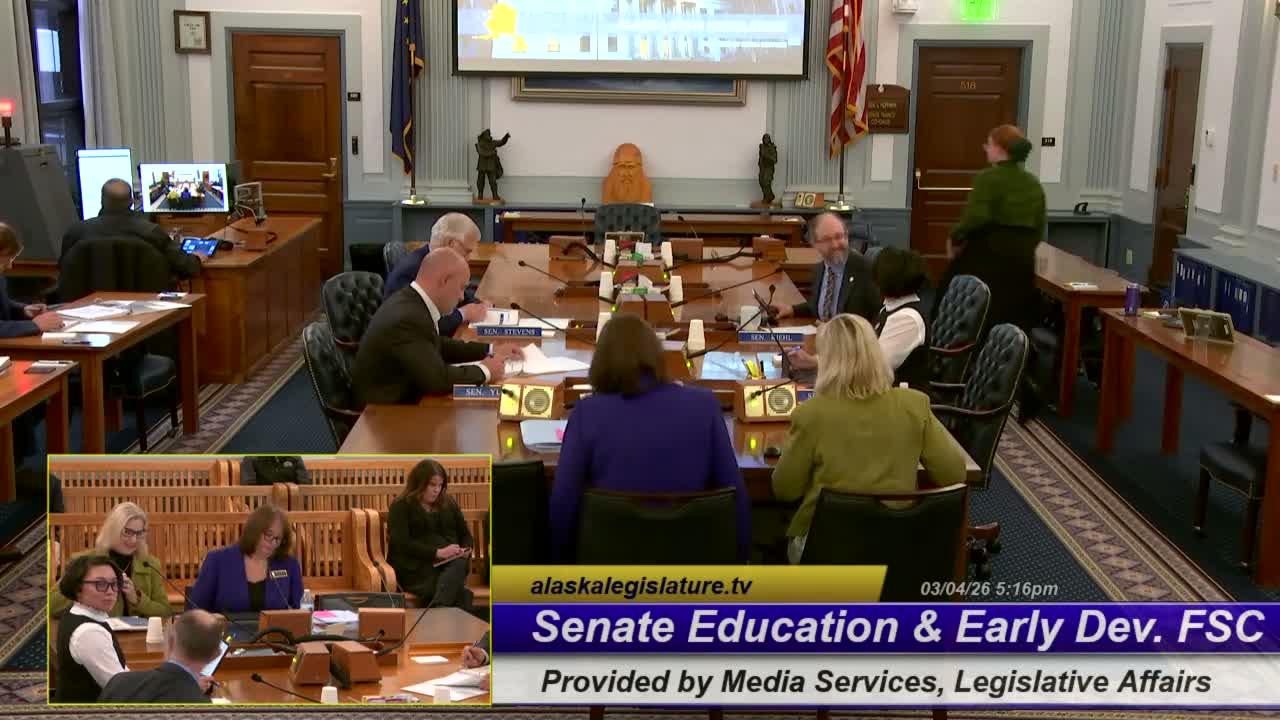
The Alaska Senate Finance Subcommittee on the Department of Education and Early Development reviewed the governorfs FY27 amended budget at a March 4, 2026 meeting, receiving an overview from Commissioner Dina Bishop and department finance staff that emphasized Ku201312 foundation funding, scholarship funding math and enrollment trends.
Commissioner Dina Bishop opened the presentation and said the hearing would cover an organizational overview, division and department financial summaries, average daily membership (ADM) trends and high-level budget changes for FY27. Don Hannish, identified in the transcript as the departmentfs administrative services lead, presented slides showing a governorfs amended departmental total of approximately $1,790,000,000 and 306 authorized positions, with 55 vacancies (an 18.7% vacancy rate).
The department said roughly $1,676,000,000 (about 93.6% of the departments funding) is distributed through grants to support public education, and that the ADM-driven Ku201312 portion represents about 77% (approximately $1,380,000,000) of the total. Hannish told the committee the governorfs amended budget fully funds the Ku201312 foundation program at about $1,292,000,000 with the base student allocation (BSA) set at $6,660 per student, and that pupil transportation is statutorily fully funded at $72,800,000.
Carrie Thomas, executive director of the Alaska Commission on Postsecondary Education, told the subcommittee ACPE has a FY26 supplemental request intended to cover current students if enacted, and that the governorfs FY27 request includes $20,300,000 from the Higher Education Investment Fund (HEIF). "Our projections at ACPE are that we believe we need $24,000,000 to provide full scholarships to all eligible students in FY27," Thomas said, describing roughly a $3.7 million gap between the governorfs requested HEIF increment and ACPEfs projected need.
Thomas also explained the HEIF —7% cap is calculated against the fund balance as of June 30, 2025; she cited a $435,000,000 balance for that calculation and said the FY27 computation was "before the $129,000,000 was transferred out of the fund," a transfer she said took place in September.
Committee members pressed the department on ADM accounting and program details. Director Heather Heineken explained how part-time students who split enrollment between correspondence programs and brick-and-mortar schools are counted: fractional ADM is recorded (for example, 0.5 in each category for a half-time split) and the department rounds when calculating the foundation formula. Commissioner Bishop emphasized statutory allowances for fractional counts but acknowledged districts often find detailed tracking cumbersome.
Senator Stevens raised governance concerns about Mount Edgecumbe, a residential state school, asking whether oversight by the State Board of Education remained the best structure. Bishop said she had discussed streamlining options with Superintendent Langford and noted state-level processes sometimes slow routine school operations, adding that she would continue to examine possible improvements.
Budget details shown to the committee included program increments and changes: a proposed new residential school program through the Bristol Bay Regional Career and Technical Education Consortium would receive $771,000 if approved; the Mental Health Trust would provide $150,000 for PBIS coaching; and the Alaska Commission on Postsecondary Education would receive an increment for Alaska Performance Scholarship and APS Step Up Awards. The department also noted historical one-time appropriationsincluding $173,000,000 in FY25that have affected recent state aid levels.
On school bond debt reimbursement, committee members asked about timing and whether the statutory reimbursement amount in the governorfs request restores prior vetoed amounts. Heineken said the statutory reimbursement level appears in the governorfs request and that no bond debt applications had yet been received for the upcoming year; she said she would confirm application deadlines and follow up on historical details about prior vetoes and when changes to reimbursement splits occurred.
The department concluded its presentation and agreed to provide requested follow-ups, including the early elementary funding report and research on residential school reimbursement history. Senator Kiel said the subcommittee would reconvene March 11 at 5:15 p.m. There were no motions or recorded votes during the session.
The transcript records committee questions, department clarifications and program figures but does not record final committee decisions or enacted changes; committee members asked the department to provide supplemental materials and data ahead of future budget deliberations.