
Alaska courts tell Senate subcommittee they need new operating funds after partial FY26 funding
Get AI-powered insights, summaries, and transcripts
Sign Up Free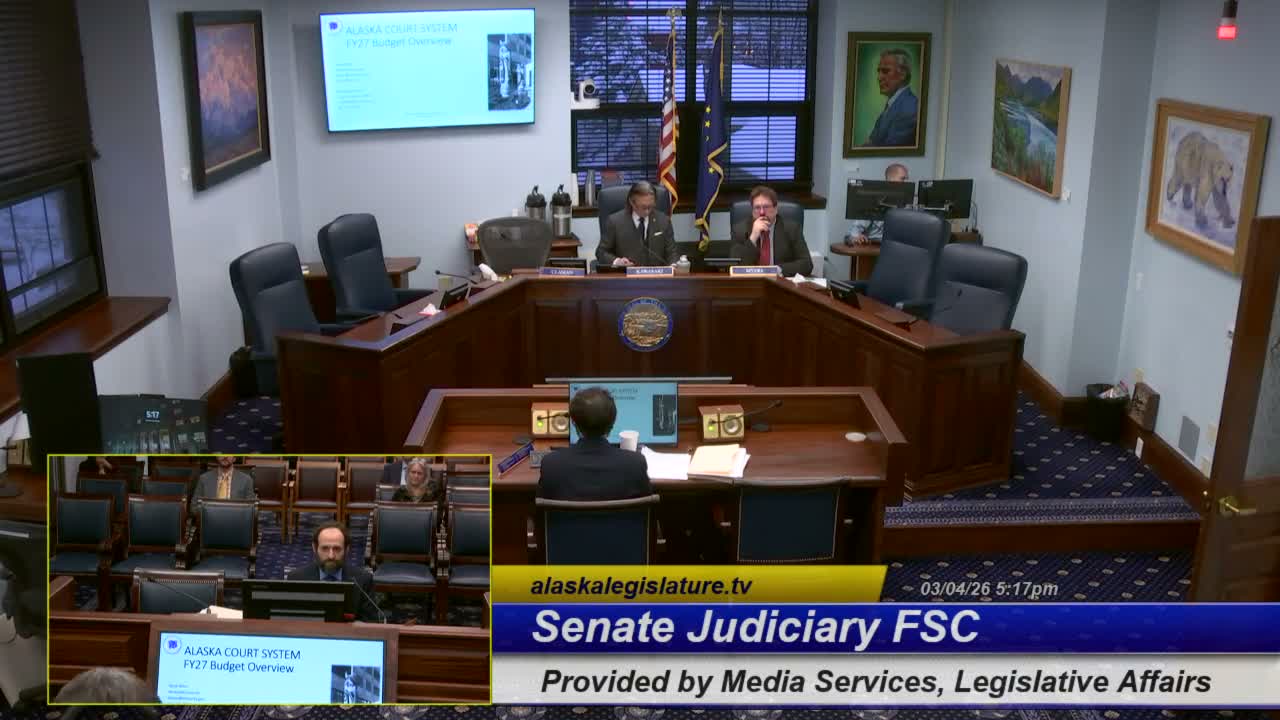
Summary
Alaska Court System officials told the Senate Finance Budget Subcommittee the branch received only part of its FY26 operating requests and has proposed modest FY27 increments — chiefly facilities maintenance and balance funding for competency-calendar positions — while preserving statutorily required court-visitor services.
Noah Klein, associate counsel for the Alaska Court System, told the Senate Finance Budget Subcommittee on Courts that the judiciary received only a portion of its FY26 operating requests and is asking the Legislature for targeted funding in FY27 to avoid service disruptions.
"We received $500,000 last year of a $1,150,000 budget request," Klein said, summarizing FY26 outcomes and the shortfall. He said the court had asked for $534,000 for facilities maintenance and operations in FY26 but received $250,000; the court also received $92,000 for balance funding on two competency-calendaring positions and the reimbursable-service-agreement (RSA) funds for therapeutic courts.
Klein said the court's FY27 request includes two UGF increments the court calculated would be needed to cover the ongoing costs of doing business: an adjusted operating/maintenance increment (about $600,000 after a $100,000 self-reduction tied to Department of Transportation service-level estimates) and balance funding for competency-calendaring positions (now $115,000, up from $92,000 because of salary and benefit increases). Neither increment is currently included in the governor's budget before the Legislature, Klein said.
The court is also seeking non-UGF items. Klein said some MTAR-funded positions for therapeutic courts are now part of the base budget and repeated that the court requested a $102,000 Mental Health Trust–funded behavioral-health administrator position; he acknowledged the court failed to include benefits when transferring the position request and said the court would either hold the position open or use vacancy savings to cover benefits if the full amount is not received.
Committee members pressed how the court plans to manage shortfalls. Klein described one-time savings that helped absorb FY26 reductions — a temporary facility closure and lower-than-expected occupancy agreement costs — and said the court will rely on vacancy savings in some cases. He stressed court visitors are statutorily mandated and said the court will continue those services while smoothing the backlog: "We are getting out of the 3 year backlog," Klein said, adding that smoothing the workload means the court does not expect a long-term decrease in costs for visitor services.
Senator Clayman asked whether the presentation numbers reflected governor vetoes; Klein said the figures reflect both the governor's vetoes and the legislature's final funding choices. No formal motions or votes were taken by the subcommittee.
The committee closed with questions about retention and the effect of recent pay-table changes on court staffing; Klein said vacancy rates have improved from about 10% and noted an uncodified pay-table change that applies the legislative and executive raises to court employees, with a 2.5% increase scheduled for July 1. The subcommittee adjourned without taking action on the court's FY27 request.