
Alaska committee presses elections officials over memorandum that sent statewide voter file to DOJ
Get AI-powered insights, summaries, and transcripts
Subscribe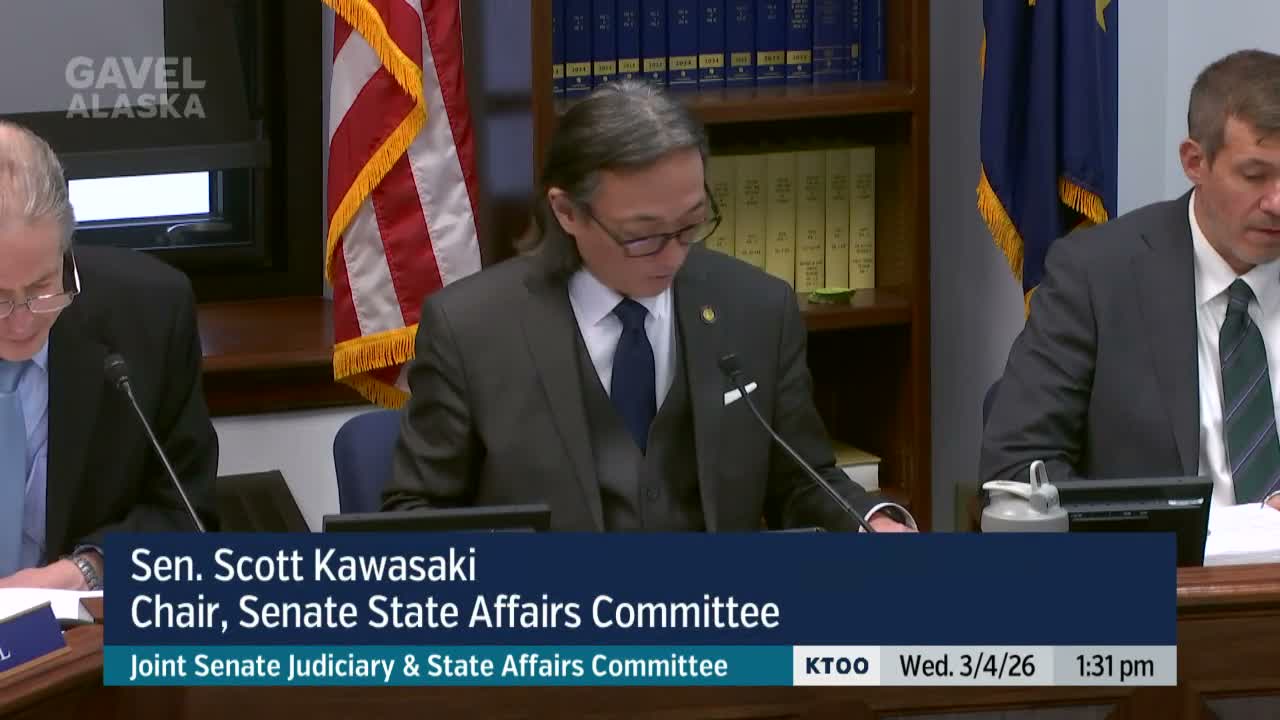
Summary
Lawmakers at a March 4 joint Senate hearing criticized the Division of Elections' transfer of Alaska's statewide voter-registration file to the U.S. Department of Justice under a December 2025 memorandum of understanding, questioned the legal basis and called for documents, possible legislation and litigation.
ANCHORAGE, Alaska ' On March 4, the joint Senate State Affairs and Judiciary committees questioned Division of Elections and Department of Law officials about a memorandum of understanding that transferred Alaska's statewide voter-registration list to the U.S. Department of Justice.
The committee heard from Legislative Legal Services attorney Andrew Dunmire, Division of Elections Director Carol Beecher, Department of Law Civil Division Director Rachel Witty, David Becker of the nonpartisan Center for Election Innovation and Research, and former Alaska Attorney General Bruce Botello.
Dunmire told the committee his February 24 memorandum identified legal risks in disclosing confidential voter-file fields and noted three federal courts (in California, Oregon and Michigan) have rejected the Department of Justice's asserted authority to obtain unredacted statewide voter files. He said 29 states have so far declined to provide the most sensitive fields the DOJ requested.
"The NVRA allows the state to withhold confidential information when it gives the voter rolls," Dunmire said, summarizing court findings and distinguishing the different statutory claims the DOJ has advanced.
Director Beecher told senators the Division provided a public statewide list initially and later provided a confidential dataset after receiving and negotiating an MOU with DOJ. She said the dataset the state provided included the public fields available for purchase and, additionally, the condition date and code (most recent registration change), residential address marked confidential, date of birth, the last four digits of Social Security numbers, and Alaska driver's license number when a SSN was not available.
"They do not have access to our system," Beecher said of the DOJ, adding the department would only "contact us and say these voters, we think should be removed" and that any removal would require the Division to follow state statute and federal requirements.
Senators repeatedly asked whether Section 8 of the MOU, which says the state will remove voters "deemed ineligible" within 45 days of DOJ notice, could be enforced if it conflicted with Alaska law. Dunmire and Beecher both told the committee the Division must follow Alaska law, citing the procedures in AS 15.07.130 governing how voters may be placed on an inactive list.
"It would still be illegal to violate Title 15 even if the memorandum of understanding required someone to violate Title 15," Dunmire told the committee.
Committee members pressed Department of Law officials about whether written advice had been provided to the Division and asked to see that counsel. Director Witty said the offices had worked together, acknowledged ambiguities in the MOU language about whether the state would resend an entire updated voter list or only records DOJ flagged, and said the agencies would provide follow-up clarification. Director Beecher said she would confer with the Department of Law and declined at the hearing to waive attorney-client privilege for internal legal communications.
David Becker, who previously served in the Justice Department's Voting Section and now leads a nonprofit that researches election administration, told the committee he believes DOJ lacks statutory authority to collect sensitive voter data in bulk and urged Alaska to demand that DOJ return and destroy the records and to disclose who accessed them.
"If this data were leaked, the financial well-being of millions of Americans would be put at risk," Becker said, calling the collection "an unprecedented attempt to seize sensitive voter data."
Former Attorney General Bruce Botello told the committee the MOU appears "ultra vires" and inconsistent with Alaska's constitutional right to privacy, and he urged the Legislature to obtain and publish Department of Law advice, adopt a resolution opposing unredacted transfers absent explicit statutory authorization, and consider litigation to void the MOU and require the return or destruction of the data.
Lawmakers asked several practical questions that drew no definitive answer at the hearing: whether the state can retrieve records already transferred to DOJ, whether the state would ever resubmit a full updated voter file in response to DOJ feedback or send only the subset DOJ flagged, and exactly who inside and outside government may have had access to the transferred data. Director Beecher said the Division had not yet received any specific directive from DOJ to remove or alter records.
The hearing produced at least three concrete next steps on the record: (1) the Division agreed to confer with the Department of Law and follow up in writing about whether it would resubmit entire VRL data or only records DOJ identified; (2) senators requested copies of legal advice provided to the Division and signaled oversight hearings or legislation could follow; and (3) witnesses urged the Legislature to consider a resolution and the possibility of litigation to challenge the MOU.
The committee adjourned with senators saying they would continue oversight and requested to be notified if DOJ asks the state for further action. No formal votes or motions were taken at the hearing.